
HBOT for Training Recovery for Busy Professionals [Guide]
You’ve squeezed in a training session before the first meeting, fuelled yourself with a coffee that’s doing most of the emotional heavy lifting, and then spent the rest of the day sitting under fluorescent lights wondering why your legs still feel like concrete. If that sounds familiar, you’re not alone. Busy professionals often train hard but recover like it’s an optional extra.
Recovery, though, is where your body actually adapts. It’s when muscle repairs, energy systems reset, and your nervous system finds its way back to “steady”. When time is tight, the goal isn’t to recover like a full-time athlete—it’s to recover efficiently, consistently, and in a way that fits real life.
One tool gaining attention in performance and wellness settings is HBOT (Hyperbaric Oxygen Therapy). Used for decades in clinical medicine, it’s now being explored for how it may support training recovery, especially when life stress, travel, and long workdays make quality rest harder to protect. In this guide, we’ll cover what HBOT is, what the science actually suggests, who it may suit, and how to build a realistic recovery plan around a busy calendar.
Why recovery is harder when you’re a busy professional
Recovery isn’t just about your last workout—it’s about your total workload. And for most professionals, the “load” includes much more than training.
The hidden recovery blockers: meetings, stress and screens
Even with a solid training programme, recovery can lag when you’re dealing with:
- High cognitive stress: deadlines and decision-making raise sympathetic (“fight or flight”) tone, which can affect sleep quality and tissue repair.
- Long sitting hours: reduced circulation and mobility can leave you feeling stiff and sluggish.
- Inconsistent fuelling: skipped meals and late lunches can compromise protein intake and carbohydrate replenishment.
- Sleep disruption: late-night emails, travel, alcohol at events, or simply a racing mind.
- Compressed training: intense sessions packed into fewer days because your diary won’t cooperate.
The result is a common pattern: you can still train, but you don’t bounce back as quickly. You may notice lingering muscle soreness (DOMS), heavy legs, irritability, poorer focus, or a plateau in performance.
Recovery is where performance is built
Training creates stress; recovery is the adaptive response. In simple terms, you don’t get fitter during the workout—you get fitter afterwards, if you give the body what it needs. That includes sleep, nutrition, hydration, movement, and sometimes supportive therapies that may help you recover more efficiently.
What is HBOT (Hyperbaric Oxygen Therapy)?
HBOT involves breathing oxygen in a pressurised chamber. The increased pressure allows more oxygen to dissolve into the plasma (the liquid part of your blood), which may enhance oxygen delivery to tissues.
A plain-English explanation of what happens in the chamber
Under pressure, oxygen doesn’t just hitch a ride on haemoglobin—it becomes more available in the bloodstream overall. This higher oxygen availability is why HBOT has long-standing medical uses in certain clinical contexts. In performance and recovery settings, interest centres on how improved tissue oxygenation may support the body’s natural repair processes.
Clinical roots vs performance use
It’s important to separate two ideas:
- Established medical indications: HBOT is used in specific medical conditions under clinical guidelines.
- Wellness and performance optimisation: people use HBOT as a supportive recovery tool. Evidence here is emerging and can be promising, but it’s not the same as a guaranteed “fix”.
At LIVBETTER, we keep this distinction clear: HBOT can be part of a comprehensive recovery plan, not a replacement for the fundamentals.
HBOT for training recovery: what the evidence suggests
When people ask whether HBOT “works” for training recovery, the most honest answer is: it depends on what you mean by “works”, and what your baseline recovery looks like. Research into HBOT and exercise recovery is growing, and while findings vary by protocol and population, there are several plausible mechanisms and early indicators that it may support recovery.
1) Muscle soreness and perceived recovery
After hard sessions—especially eccentric-heavy training (think downhill running, heavy negatives, or new strength blocks)—muscles experience micro-damage and inflammation as part of adaptation. Some studies suggest HBOT may help reduce delayed onset muscle soreness and improve perceived readiness, likely through effects on oxygen availability and inflammatory signalling. However, results can vary, and protocols matter (pressure, oxygen concentration, timing and number of sessions).
2) Tissue oxygenation and repair processes
Oxygen is essential for tissue repair. Increased oxygen availability may support processes involved in healing, including collagen formation and cellular energy production. For busy professionals managing both training and work stress, the appeal is straightforward: you’re supporting the physiology of recovery in a time-efficient format.
3) Inflammation and oxidative stress: a nuanced picture
Inflammation isn’t “bad”—it’s part of adaptation. The goal isn’t to eliminate it, but to keep it proportionate and well-resolved. HBOT has been studied for its potential to modulate inflammatory pathways and oxidative stress. This is complex science: oxygen can contribute to oxidative processes, but controlled hyperoxia under pressure may also trigger adaptive antioxidant responses. In practical terms, HBOT may support recovery for some people, but it should be used thoughtfully, and not as a way to “outsource” recovery from poor sleep or chronic overtraining.
4) Recovery isn’t only physical: cognitive performance matters too
Many high performers train to feel sharper at work, not just to hit a PB. There’s interest in HBOT for how it may support mental clarity and fatigue resilience in certain contexts, although research is still developing and outcomes are individual. If your training recovery issues show up as brain fog, low motivation, or feeling “flat” in afternoon meetings, a recovery plan that supports both body and mind is often the most effective.
Who HBOT may suit (and who should be cautious)
HBOT is not a one-size-fits-all intervention. It may be particularly relevant if you’re training consistently, short on recovery time, and you want a structured, clinician-informed approach.
HBOT may be a good fit if you…
- Train 3–6 times per week and struggle to feel recovered between sessions
- Have a demanding schedule and want time-efficient recovery support
- Are returning to training after a layoff and find DOMS unusually disruptive
- Travel frequently and notice your body feels “behind” for days after flights
- Want recovery support without relying heavily on supplements or stimulants
Extra caution is needed if you…
HBOT isn’t appropriate for everyone. You should discuss suitability with a qualified professional, particularly if you have:
- Untreated pneumothorax (this is a strict contraindication)
- Certain ear or sinus issues that make pressure changes difficult
- Severe claustrophobia
- Specific respiratory conditions where individual assessment is needed
- Pregnancy (HBOT may be used medically in some cases, but wellness use should be carefully discussed)
If you’re unsure, that’s normal. The safest approach is a proper screening and a plan tailored to your health history and training goals.
What a typical HBOT session looks like (time-efficient recovery)
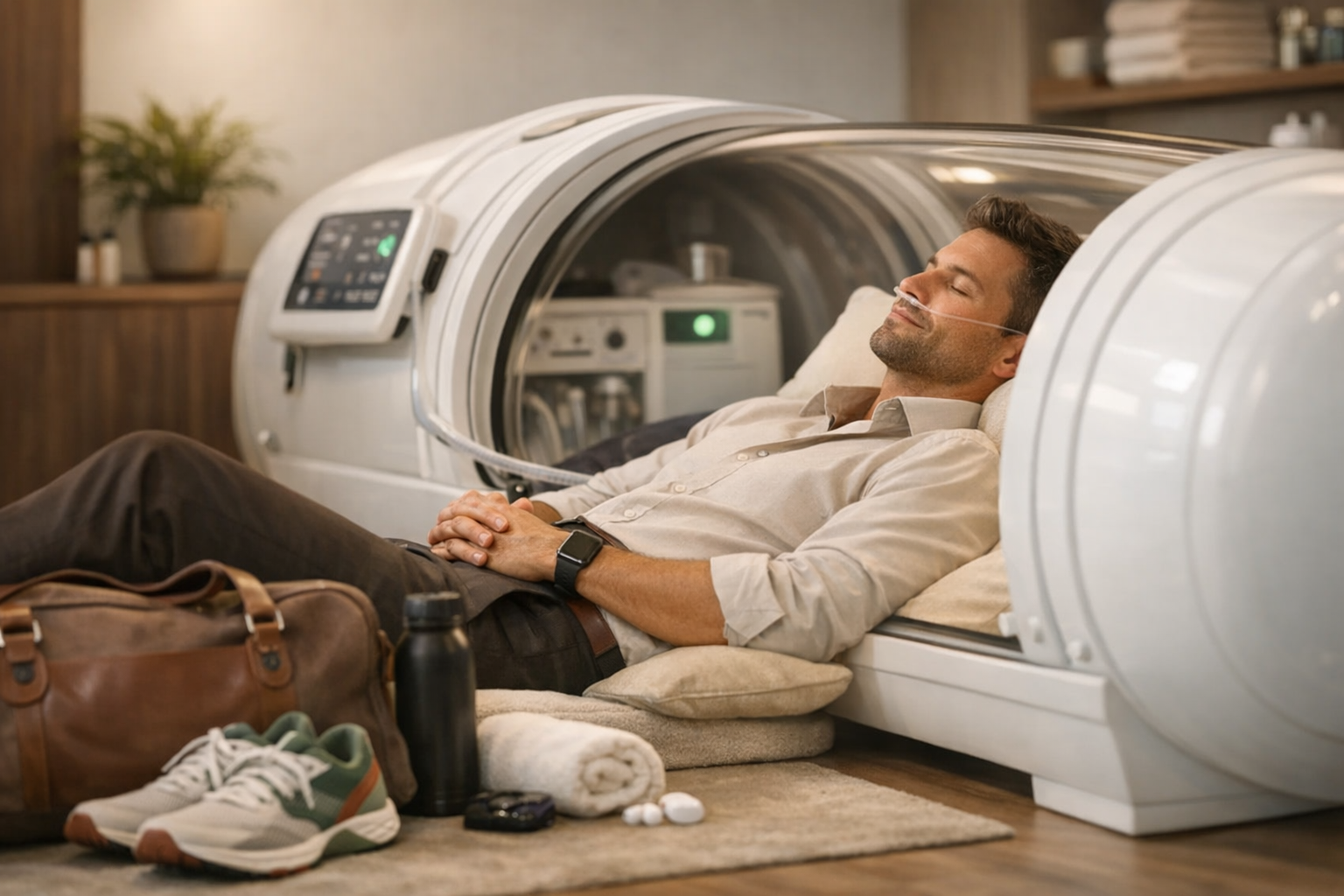
For time-poor professionals, one of the biggest advantages of HBOT is its simplicity: you can lie back and let the therapy do the work.
Before the session
- You’ll typically be screened for contraindications and briefed on what to expect.
- You may be advised to avoid flying immediately before/after, depending on your protocol.
- Wear comfortable clothing; remove products that are not permitted in oxygen-rich environments (you’ll be guided).
During the session
- You’ll enter a pressurised chamber and breathe oxygen at the prescribed settings.
- You may feel ear pressure similar to take-off in a plane; staff will guide you through equalising safely.
- Many people use the time to relax—some listen to audio or practise calm breathing.
After the session
- Most people return to normal activities immediately.
- You may feel relaxed, clear-headed, or pleasantly tired—responses vary.
HBOT is often used as a series rather than a one-off, depending on your objective. A single session may be supportive, but consistent use is typically where people notice more meaningful changes in recovery rhythm.
How to integrate HBOT into a weekly training schedule
The best recovery plan is the one you’ll actually follow. HBOT can be slotted into your week without needing to overhaul your training.
Option A: The “heavy session buffer”
Use HBOT after your two toughest sessions of the week (for example, lower-body strength day and interval day). This may help you feel more ready for the next training day.
- Choose your two most demanding workouts
- Schedule HBOT within 24 hours afterwards if possible
- Track soreness and readiness (simple 1–10 scale) for two weeks
Option B: The “travel recovery reset”
If flights and hotel beds derail you, consider HBOT shortly after travel to support recovery when your sleep and hydration are not ideal.
- Plan HBOT within 24–48 hours of landing
- Pair it with a light mobility session and a protein-forward meal
- Keep the next day’s training moderate rather than maximal
Option C: The “block approach” for busy periods
During a high-stress work sprint (product launch, quarterly close), you may train less but feel more fatigued. A short HBOT block can support recovery and help maintain consistency.
- Pick a 2–4 week period where stress is predictably high
- Use HBOT 1–2 times per week alongside lower training volume
- Focus on sleep regularity and hydration to amplify the effect
HBOT works best when the basics are in place
If your recovery foundations are shaky, HBOT won’t replace them—but it can complement them beautifully. Here are practical, evidence-informed steps you can start today.
The LIVBETTER “busy professional” recovery checklist
- Sleep: aim for consistent wake time; protect the first 60 minutes after waking from email when possible.
- Protein: include a high-quality protein source at 2–4 meals per day to support muscle repair.
- Carbohydrates around training: especially after intense sessions, to replenish glycogen and support recovery.
- Hydration: start the day with water; add electrolytes if you sweat heavily or train in heat.
- Low-intensity movement: 20–30 minutes of Zone 2 cardio or a brisk walk can improve circulation and reduce stiffness.
- Mobility “snacks”: 3–5 minutes between meetings (hips, thoracic spine, ankles) beats a perfect routine you never do.
- Stress downshifts: 5 minutes of slow nasal breathing can help shift your nervous system toward recovery.
A simple readiness tracker (takes 30 seconds)
Each morning, rate the following from 1–10:
- Sleep quality
- Muscle soreness
- Mental energy
- Motivation to train
If two or more scores drop noticeably for more than three days, that’s your cue to adjust: reduce intensity, prioritise sleep, and consider adding a recovery session (HBOT, massage, or a mobility-focused day).
Common questions busy professionals ask about HBOT
Is HBOT the same as oxygen bars or “breathing more oxygen”?
No. The key difference is pressure. Breathing oxygen at normal atmospheric pressure is not the same as breathing oxygen in a pressurised environment, which changes how much oxygen can dissolve into plasma.
Will HBOT make me fitter without training?
HBOT is not a fitness shortcut. It may support recovery and readiness, which can help you train more consistently over time—often the real driver of results.
Can I do HBOT on the same day as training?
Many people do, depending on scheduling. Some prefer it after training; others use it on rest days. The best timing depends on your sessions, stress load, and how you personally respond.
How soon might I notice a difference?
Some people report feeling more relaxed or less sore after a few sessions; others notice changes more gradually across a series. It’s sensible to treat HBOT as a trial: set a baseline, track markers (soreness, sleep, training output), and review after a few weeks.
How LIVBETTER approaches HBOT for recovery
At LIVBETTER, we’re focused on helping you think better, feel better, and live better—without turning wellness into another full-time job. If you’re considering HBOT for training recovery, our approach is:
- Clinically informed screening: to ensure suitability and comfort with pressure changes
- Goal-led protocols: aligning sessions with your training cycle and work demands
- Whole-plan recovery: guidance on sleep, fuelling, stress, and movement so HBOT supports (not replaces) the fundamentals
If you’re curious, the best next step is a conversation about your training week, your bottlenecks (DOMS, sleep, travel fatigue, persistent “heaviness”), and what a realistic recovery plan would look like alongside your workload.
The bottom line: HBOT may support recovery when time is tight
Busy professionals don’t usually need more motivation—they need recovery strategies that respect the calendar. HBOT is a credible, clinically rooted therapy that may support training recovery by improving tissue oxygen availability and helping the body’s natural repair systems. It won’t replace sleep, good nutrition, or smart programming, but it can be a valuable addition when you’re training hard and life is demanding.
If you want to perform well in the gym and still have energy for the boardroom, parenting, or simply enjoying your evening, recovery deserves the same attention as training. Your body will thank you—and your diary won’t have to suffer for it.
Next Steps
Want to learn more? Check out these articles:
HBOT for Post-Travel Recovery: Reset Jet Lag and Energy
HBOT for Soft Tissue Recovery: A Practical, Evidence-Based Guide
HBOT for Sports Injury Recovery: Evidence, Timing and Tips
Check out our Therapies to see which options fit your goals.