
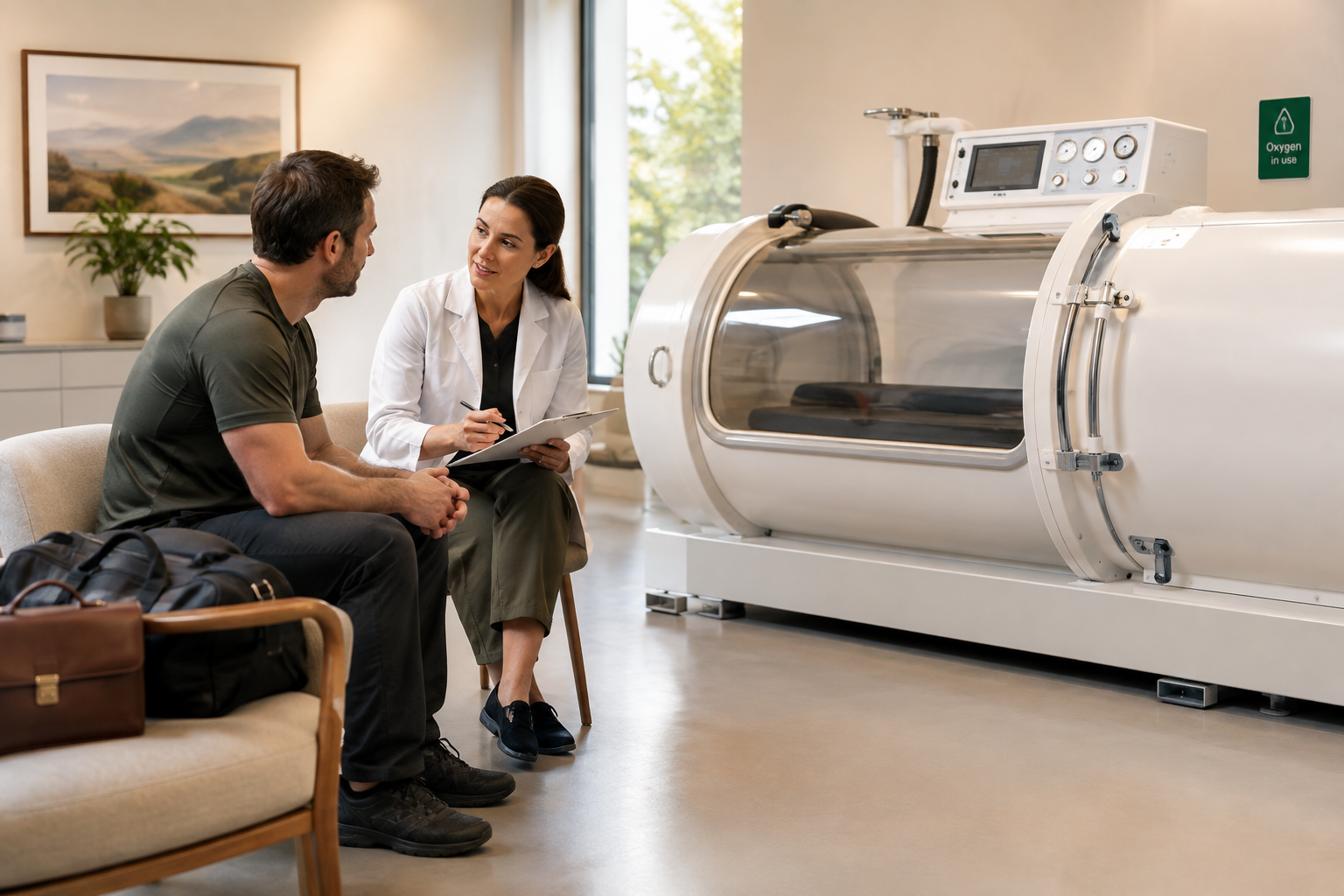
HBOT for Training Recovery: A Guide for Busy Professionals
Your calendar says back-to-back meetings. Your training plan says intervals. Your legs would quite like a word. When work and exercise both demand your best, recovery can become the part of the schedule that gets whatever time is left.
Hyperbaric oxygen therapy, or HBOT, is increasingly discussed as a recovery option. But does spending time in a pressurised chamber actually help you recover from training, and is it a sensible use of a busy professional’s time?
This guide explains how HBOT works, what the evidence can and cannot tell us, and how to weigh up safety, convenience and value. You will also find a four-step framework for making a considered decision, without overlooking the everyday habits that do most of the heavy lifting.
Understanding HBOT and how it works
HBOT involves breathing oxygen in a chamber where the pressure is higher than normal atmospheric pressure. In medical HBOT, people typically breathe close to 100% oxygen under carefully controlled conditions.
Most oxygen in your blood travels attached to haemoglobin, the protein inside red blood cells. Increasing pressure while breathing concentrated oxygen also increases the amount dissolved in plasma, the liquid component of blood. This temporarily makes more oxygen available to tissues.
That physiological effect is well established. Whether it translates into useful improvements in recovery after a gym session, run or cycle is a separate question.
More oxygen does not automatically mean better recovery
Exercise recovery involves restoring energy stores, repairing tissue, regulating inflammation and allowing the nervous system to recover. Oxygen is involved in these processes, but it is not usually the only limiting factor in a healthy person.
A mechanism that sounds promising is not proof of a meaningful benefit. To establish that, researchers need to measure outcomes such as restored strength, reduced soreness and readiness for the next session, ideally against a convincing comparison treatment.
Not all chambers offer the same treatment
Medical HBOT commonly uses pressures around two to three atmospheres absolute, although protocols vary by indication. Some wellness services use lower-pressure chambers, sometimes called mild hyperbaric therapy, with different oxygen delivery arrangements.
These approaches are not interchangeable. Chamber pressure, oxygen concentration, session duration and the number of sessions all affect the exposure. Research using one protocol cannot simply be used to validate another.
Before comparing providers, ask what treatment is actually being offered. A chamber’s appearance, comfort or technology features do not tell you whether its protocol has evidence relevant to your goals.
What the evidence says about training recovery
HBOT has established specialist medical uses, but those should not be confused with routine recovery support for healthy people. Evidence for one clinical indication does not establish a benefit for post-workout soreness or general fatigue.
Research into HBOT and exercise recovery remains limited and mixed. Studies vary in participant characteristics, exercise type, treatment timing and chamber protocols. Many are small, making it difficult to draw confident conclusions or identify who, if anyone, is most likely to benefit.
Muscle soreness and recovery of strength
Delayed-onset muscle soreness, or DOMS, often develops after unfamiliar exercise, especially movements involving muscle lengthening under load. Think downhill running, slow lowering phases in strength training, or your first leg session after a break.
A Cochrane review examining HBOT for delayed-onset muscle soreness and closed soft-tissue injuries found insufficient evidence to support its use. The review is older and does not settle every question about newer protocols, but it remains an important caution against confident recovery claims.
Later research has explored additional approaches, without establishing a reliable, standard protocol for routine training recovery. At present, there is no strong basis for promising that HBOT will consistently reduce soreness or restore strength faster in healthy recreational athletes.
Inflammation, fatigue and performance
Some studies investigate markers linked with inflammation, oxidative stress or muscle damage. These can help researchers explore biological effects, but a change in a blood marker is not necessarily a noticeable improvement in how you feel or perform.
Inflammation also has a normal role in adapting to training. The aim is not to eliminate every inflammatory response, and it remains uncertain how repeated HBOT around exercise affects long-term training adaptation.
Claims about greater energy, sharper thinking or better performance deserve the same scrutiny. Benefits demonstrated in a particular clinical population cannot automatically be applied to healthy professionals managing a demanding week.
A four-step guide to deciding whether HBOT fits
If you are interested in HBOT for training recovery, approach it as an optional intervention to evaluate, not a missing essential. These four steps can help you make a decision that respects your health, time and budget.
1. Define the recovery problem
Start with a specific question. Are you unusually sore after increasing your training load? Struggling to complete planned sessions? Sleeping poorly after evening workouts? Or feeling tired throughout the working day, regardless of exercise?
Those patterns may have different explanations. General exhaustion is not automatically a training-recovery issue, and persistent fatigue deserves assessment rather than an assumption that you need more oxygen.
Write down one meaningful goal, such as returning to your usual training schedule comfortably. Avoid vague targets such as “optimising everything”, which make it difficult to judge whether any intervention is worthwhile.
2. Strengthen the basics first
Give your core recovery habits a consistent place in your week before adding a chamber appointment. This is not less sophisticated. It is where the evidence is generally stronger.
- Protect sleep: most adults need around seven to nine hours, with reasonably consistent sleep and wake times.
- Eat enough overall: under-fuelling can undermine recovery even when food choices look nutritious.
- Include protein across meals: regular portions help provide the building blocks needed for muscle repair.
- Match carbohydrate intake to training demands: harder or longer sessions increase the importance of replenishing fuel stores.
- Replace fluid losses: adjust drinking to exercise duration, heat and how much you sweat.
- Manage training load: avoid repeatedly stacking hard sessions onto poor sleep and demanding workdays.
For many professionals, the highest-value adjustment is practical: preparing lunch, moving a late workout earlier or keeping an easier training day after travel. No recovery technology can reliably compensate for a routine that repeatedly exceeds your capacity.
3. Check safety and provider standards
Arrange a suitability assessment with an appropriately qualified clinician before treatment. Share your medical history, medications, previous problems with pressure changes and any current symptoms.
An untreated pneumothorax, meaning air trapped around a lung, is a major contraindication to HBOT. Other conditions may require additional assessment or precautions. These include certain lung problems, ear or sinus conditions, seizure history, pregnancy and some medication exposures.
A cold or blocked sinuses can also make pressure changes difficult to tolerate. Tell the team rather than trying to push through. If you use insulin or medication that can cause low blood glucose, discuss monitoring and meal timing.
4. Agree a review point before committing
If you and the clinician decide to proceed, agree what you will monitor and when you will review whether continuing makes sense. There is no universally established HBOT schedule for healthy people seeking training recovery.
Do not assume that more sessions must produce better results. Ask for the reasoning behind the proposed protocol, including how closely it matches the available evidence.
Include travel, changing and appointment time in your decision. A recovery strategy that displaces sleep, meals or essential downtime may work against your overall goal, even if the appointment itself feels restorative.
What happens during an HBOT appointment?
Your first visit should include screening, an explanation of the treatment and clear safety instructions. The team should describe how you can communicate during the session and what happens if you feel uncomfortable.
As the chamber pressurises, you may notice fullness in your ears, similar to flying. Staff should explain appropriate ways to equalise pressure. Ear pain should be reported immediately, not treated as something to endure.
You then spend time at the prescribed pressure before the chamber returns gradually to normal atmospheric pressure. Some medical protocols include scheduled air breaks. The exact arrangement depends on the chamber and treatment plan.
Sessions often occupy around 60–120 minutes, sometimes longer once preparation and pressure changes are included. Confirm the total appointment length rather than relying on the advertised oxygen-breathing time.
Treat the session as protected downtime
Do not assume you can bring a laptop, phone or other electronic equipment inside. Oxygen-rich environments require strict fire-safety precautions, and permitted clothing, personal products and devices depend on the facility’s rules.
Ask in advance about what to wear and which products to avoid. A responsible provider will give clear instructions and enforce them consistently. Safety procedures are part of good care, not an optional inconvenience.
What are the risks and limitations?
HBOT is a medical intervention, even when presented in a wellness setting. Most importantly, it is not risk-free and should not be treated as a casual lifestyle accessory.
Possible adverse effects include:
- Ear or sinus barotrauma: pressure-related pain or injury, particularly when pressure cannot equalise properly.
- Temporary visual changes: changes in focusing can occur, especially with repeated exposure.
- Claustrophobia or anxiety: enclosed spaces can be difficult for some people.
- Blood glucose changes: relevant particularly for people using certain diabetes medications.
- Oxygen toxicity: uncommon but potentially serious effects, including seizures.
- Pressure-related lung injury: a rare but serious concern requiring appropriate screening and protocols.
Fire is another serious hazard in oxygen-enriched environments. Proper equipment, trained staff, maintenance and strict operational procedures are essential.
HBOT should not replace assessment of a suspected injury. Severe or worsening muscle pain, marked swelling, unusual weakness or dark urine after exercise needs urgent medical attention rather than a recovery booking.
How to assess a provider without the jargon
You do not need to become a hyperbaric specialist to ask useful questions. A trustworthy service should welcome a conversation about uncertainty as readily as one about potential benefits.
Before booking, ask:
- Who assesses my suitability, and what hyperbaric training do they have?
- What pressure and oxygen concentration will be used, and why?
- What evidence supports this exact protocol for my recovery goal?
- Who supervises treatment, and what emergency procedures are in place?
- What side effects should I report during or after a session?
- What is the full time and financial commitment, including any proposed course?
Be cautious if a provider guarantees faster recovery, claims every protocol offers the same benefits or discourages questions about risks. Testimonials can describe personal experiences, but they cannot establish that HBOT caused an improvement.
How to monitor recovery realistically
Recovery naturally changes with sleep, stress, exercise intensity and expectations. Feeling better after an appointment does not, by itself, show that the treatment was responsible.
Keep a simple baseline for one to two weeks before introducing a new intervention, if practical. Record sleep duration, training load, soreness and how manageable your usual sessions feel. If you proceed, continue tracking without changing several other recovery habits at once.
Keep the measures useful
- Rate soreness at roughly the same time each day rather than checking repeatedly.
- Note whether you complete planned sessions comfortably, not just whether a wearable score improves.
- Record unusually stressful workdays, travel or poor sleep that could affect recovery.
- Review whether any perceived benefit justifies the cost, inconvenience and risks.
This is not a clinical trial and cannot prove effectiveness. It can, however, help you avoid continuing an expensive routine simply because it has become familiar. Do not increase training aggressively because you expect treatment to protect you from overload.
The LIVBETTER approach: technology with perspective
At LIVBETTER, making advanced health options more accessible should also mean making them easier to understand. Technology belongs within a wider picture of nutrition, movement, rest and individual needs, rather than above those foundations.
For a busy professional, a sensible recovery plan should make life more manageable. That might mean adjusting training around a demanding quarter, protecting regular meals or discussing an advanced therapy with a qualified clinician when appropriate.
HBOT may be something you choose to explore, but evidence is currently insufficient to recommend it routinely for training recovery in healthy adults. The most useful next step is to clarify your goal, address the basics and seek an honest suitability discussion before committing.
Recovering well is not about collecting more interventions. It is about choosing the support that earns its place in your week.
Further reading
- Cochrane: Hyperbaric oxygen therapy for delayed-onset muscle soreness and closed soft-tissue injury. An older systematic review highlighting uncertainty in the evidence.
- US Food and Drug Administration: Hyperbaric Oxygen Therapy: Get the Facts. Information on recognised uses, device oversight and safety considerations.
Next Steps
Want to learn more? Check out these articles:
HBOT After Travel: Your Guide to Recovery in 4 Steps
HBOT for Soft Tissue Recovery: What You Need to Know
HBOT for Scar Recovery: What to Know and How to Plan
Check out our Therapies to see which options fit your goals.