
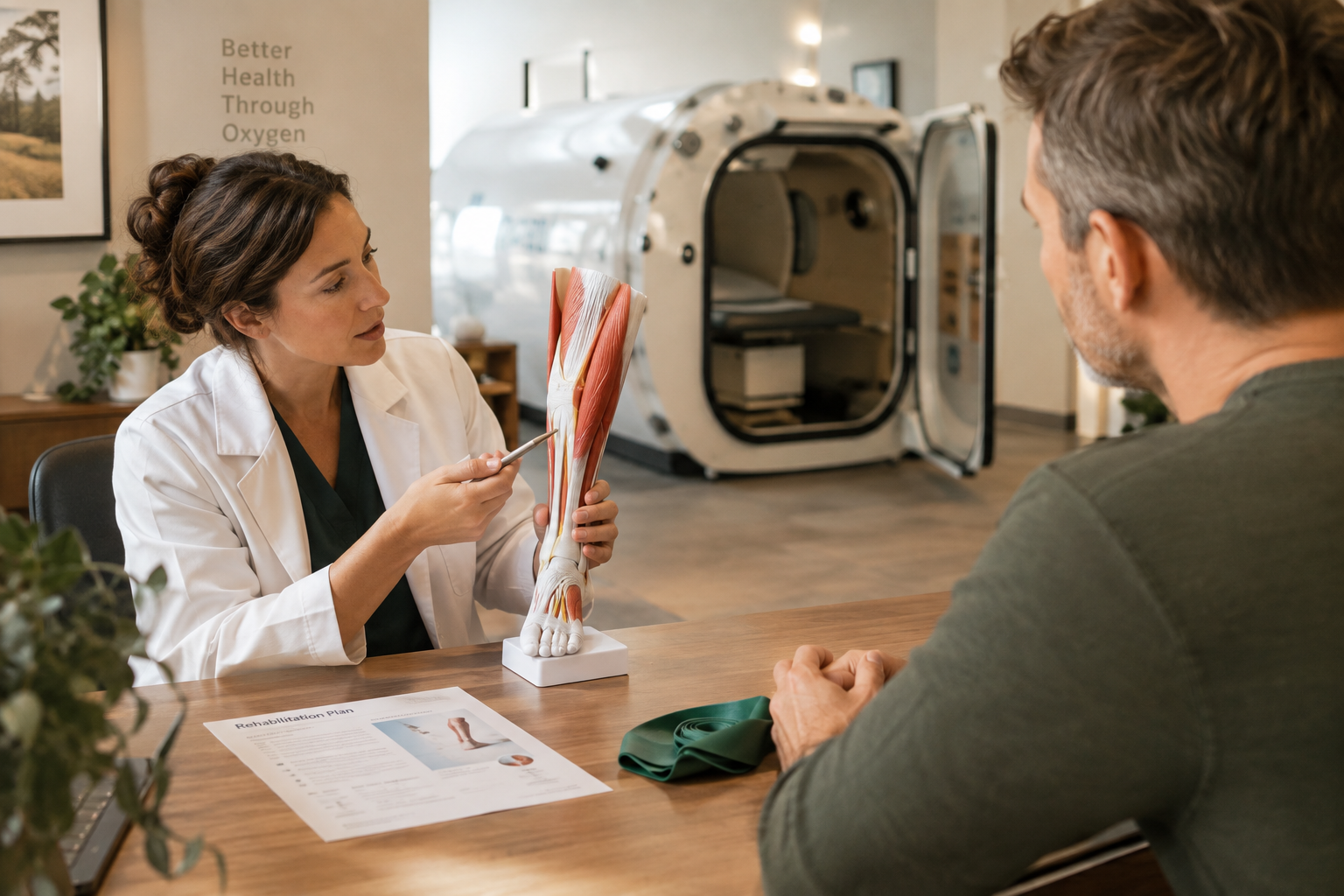
HBOT for Soft Tissue Recovery: What You Need to Know
An injury can make even a short walk feel like a training session. When you are keen to get back to your routine, hyperbaric oxygen therapy (HBOT) can sound appealing: spend time in a pressurised chamber while breathing oxygen, and potentially support recovery. It is worth checking whether the evidence matches the promise.
The answer depends on the tissue involved, the nature of the injury and the treatment setting. HBOT has recognised medical applications, but that does not mean it reliably speeds up everyday sprains, muscle soreness or tendon problems. This guide explains the science, the limitations and four questions worth asking before considering it.
Understanding HBOT and soft tissue
Hyperbaric oxygen therapy involves breathing medical oxygen inside a chamber at a pressure higher than normal atmospheric pressure. This increases the amount of oxygen dissolved in the liquid component of your blood, called plasma.
Medical HBOT typically uses pressures around 2–3 atmospheres absolute (ATA), although the exact prescription depends on the indication. Pressure, oxygen concentration, session duration and clinical supervision all matter: simply entering a pressurised chamber is not equivalent to receiving a studied medical protocol.
Soft tissue includes more than muscle
Soft tissues include muscles, tendons, ligaments, fascia and skin. They have different blood supplies, structures and recovery patterns. A calf strain is not biologically identical to a ligament sprain or a surgical wound.
That distinction matters because evidence from one problem cannot automatically be applied to another. Research involving severely compromised wounds does not establish that HBOT will help an otherwise healthy person return to running sooner after a minor strain.
How oxygen fits into tissue recovery
Oxygen is essential for cellular energy production and several processes involved in tissue repair. However, healing is not simply a case of adding more oxygen. Blood flow, mechanical loading, nutrition, sleep and the extent of tissue damage all influence recovery.
Oxygen delivery and cellular repair
Under increased pressure, more oxygen dissolves in plasma. This can increase oxygen availability in tissues where delivery is limited, provided there is sufficient circulation to carry it there.
Oxygen also supports collagen formation and aspects of immune cell function. These mechanisms help explain why HBOT is used in selected clinical situations involving compromised tissue. They do not, by themselves, prove that additional oxygen improves recovery when tissue oxygen supply is already adequate.
Inflammation is not always the enemy
Early inflammation is part of normal repair. The aim is not to switch it off indiscriminately, but to support an appropriate healing response.
HBOT can influence inflammatory signalling and fluid balance under certain conditions. Much of the discussion about these effects comes from laboratory studies or specific medical settings. A measurable biological effect is not necessarily the same as a meaningful improvement in pain, strength or return to activity.
The useful distinction is therefore between HBOT affecting tissue and improving outcomes for people with an injury like yours.
What the evidence actually shows
The evidence is strongest for specific medical indications, not for general recovery or performance optimisation. Hospital-based hyperbaric services assess selected problems such as certain difficult-to-heal wounds and severely compromised tissue using defined referral criteria.
These applications should not be interpreted as a broad endorsement for all soft tissue injuries. Even where HBOT is appropriate, it is usually an additional intervention alongside other care, rather than a replacement for it.
Everyday sprains, strains and exercise soreness
Evidence for routine sports injuries remains limited and inconsistent. A Cochrane review, “Hyperbaric oxygen therapy for delayed onset muscle soreness and closed soft tissue injury”, did not establish a dependable recovery benefit for the conditions studied.
The review is older, which is an important limitation. However, newer small or condition-specific studies should not be treated as proof that HBOT works across common injuries. Differences in participants, treatment pressures and outcome measures make broad conclusions difficult.
For delayed-onset muscle soreness after exercise, there is no strong basis for routinely recommending HBOT over sensible load management and recovery fundamentals. For tendon and ligament problems, clinical evidence is also insufficient to promise faster healing or an earlier return to sport.
How to recognise a meaningful result
A study reporting changes in blood markers is less directly useful than one showing a meaningful improvement in everyday function. When assessing a claim, look for:
- Participants with the same type and severity of injury as yours.
- A suitable comparison group, rather than before-and-after testimonials alone.
- Outcomes such as function, pain, strength and sustained return to activity.
- Follow-up long enough to assess whether any benefit lasts.
An athlete’s positive experience can be genuine without proving that HBOT caused the improvement. Rehabilitation, time and other treatments may all contribute.
A four-question guide to deciding whether HBOT fits
Before booking a session or purchasing a course, work through these four questions. They can help turn an interesting technology into a more informed decision.
Do I have a clear diagnosis?
“Soft tissue pain” describes a symptom, not a diagnosis. Persistent tendon pain, a muscle tear and a stress fracture can sometimes feel similar, but they need different management.
Start with an appropriate assessment if pain is persistent, recurring or limiting normal activity. Imaging is not always necessary. A clinician can decide whether it would change your care. HBOT should not become a detour around identifying the actual problem.
What outcome am I trying to improve?
Choose a practical target: walking comfortably, regaining ankle movement or rebuilding the strength needed for work or sport. “Better recovery” is too vague to measure reliably.
Agree how progress will be assessed and when the plan will be reviewed. Pain alone can be misleading, particularly if you are resting more. Useful measures might include walking tolerance, a relevant strength test and your response to gradually increased activity.
What evidence supports this exact protocol?
Ask about chamber pressure, oxygen concentration, session length and the proposed number of sessions. Then ask whether that approach has been studied for your specific problem.
Lower-pressure chambers, sometimes marketed as “mild hyperbaric” systems, are not automatically equivalent to medical HBOT. Some use compressed air or different oxygen delivery arrangements. Evidence from a hospital protocol cannot simply be transferred to a different device or exposure.
A responsible provider should explain these differences clearly and acknowledge uncertainty. Be cautious if a fixed package is presented as suitable for nearly every injury.
Is it worth the time, cost and risk?
Consider the complete commitment, including travel, screening, sessions and follow-up. Could that investment displace physiotherapy, rehabilitation equipment, adequate meals or the time needed for sleep?
Where evidence is uncertain, there should be a particularly clear rationale and a review point. If there is no measurable improvement, the answer should not automatically be to buy more sessions. Discuss whether continuing makes sense with an appropriately qualified clinician.
What happens during a medical HBOT session?
A medical assessment should come first. This includes the reason for treatment, relevant medical history, medicines and factors that could make pressure or oxygen exposure unsafe.
Depending on the facility, treatment takes place in a single-person chamber or a larger chamber accommodating several people. In some systems, oxygen is delivered through a mask or hood. Pressure rises gradually, and you may need to equalise your ears, rather like during an aircraft descent.
Treatment exposures often last around 90–120 minutes, depending on the prescription, with additional time potentially needed for preparation and assessment. A trained team should monitor you and explain how to communicate discomfort. Significant ear pain is not something to push through.
Safety considerations that deserve attention
HBOT is not risk-free. Possible adverse effects include ear or sinus barotrauma, temporary changes in vision and claustrophobia. Less common but serious complications include oxygen-induced seizures and lung injury.
An untreated pneumothorax, or collapsed lung, is an absolute contraindication. Other lung conditions, recent ear procedures, difficulty equalising pressure, pregnancy and some medicines require individual medical review. Blood glucose may also need monitoring in people with diabetes.
Oxygen-rich environments increase fire risk. Facilities need strict rules about clothing, electronics and prohibited products, alongside appropriate equipment maintenance and emergency procedures.
Ask the provider:
- Who determines whether I am medically suitable, and who supervises treatment?
- What training does the team have in hyperbaric safety?
- How are complications and emergencies managed?
- What should I do if I develop a cold, blocked ears or a change in medication?
A calm, thorough screening process is a sign of quality, not an unnecessary obstacle.
The recovery foundations HBOT cannot replace
Whatever you decide about additional therapies, your core recovery plan should address the factors that consistently matter. Technology can be part of a comprehensive plan, but it should not distract from the plan itself.
Use progressive, appropriate loading
Prolonged complete rest can reduce strength and capacity. Equally, repeatedly testing an injury at full intensity can keep symptoms unsettled. The right balance depends on the diagnosis and stage of recovery.
A physiotherapist can help you progress from comfortable movement towards strengthening and activity-specific demands. Track how symptoms respond during activity and afterwards, including the following day. Progress should be guided by function and tissue tolerance, not simply by how many days have passed.
Eat enough to support repair
Recovery requires energy and building materials. Include a protein source at regular meals, alongside a varied intake of vegetables, fruit, wholegrains and dietary fats. Practical options include yoghurt, eggs, beans, tofu, fish or poultry, according to your preferences.
If your appetite or activity level has changed, avoid assuming that your body no longer needs adequate nourishment. Supplements are not a substitute for sufficient food, and targeted supplementation is best considered when a need has been identified.
Make sleep and routine easier
Most adults benefit from around seven to nine hours of sleep. A consistent wake-up time, a comfortable sleep environment and less late-evening stimulation can make that target more achievable.
Build recovery into your diary rather than hoping spare time appears. Short rehabilitation sessions completed consistently are generally more useful than an ambitious plan you cannot maintain. If pain repeatedly interrupts sleep, ask your clinician about appropriate management rather than simply accepting it.
Common questions about HBOT for soft tissue recovery
How many sessions would I need?
There is no universal evidence-based number for general soft tissue recovery. Medical protocols depend on the indication and response. Be wary of anyone prescribing a standard course without first explaining the diagnosis, evidence and review criteria.
Can HBOT replace physiotherapy?
No. Increasing oxygen exposure does not rebuild movement skills, strength or load tolerance on its own. Where HBOT is appropriate, rehabilitation and management of the underlying problem still matter.
Will feeling better after a session mean I am healed?
Not necessarily. Symptoms and tissue readiness do not always move together. Feeling more comfortable is welcome, but return-to-activity decisions should also consider strength, movement, task demands and your clinician’s advice.
When should I seek medical help instead?
Seek prompt assessment for severe or worsening pain, marked swelling, inability to bear weight, spreading redness, fever, numbness or a limb that looks pale or feels unusually cold. Chest pain or sudden breathlessness requires emergency help. Do not delay assessment while arranging a recovery treatment.
The LIVBETTER perspective: informed recovery, not shortcuts
At LIVBETTER, advanced technology belongs alongside good nutrition, realistic goals and evidence-informed care. The most useful intervention is not always the most sophisticated one. It is the one that makes sense for your situation.
HBOT may support selected clinical recovery pathways, but evidence does not justify promising faster recovery from routine soft tissue injuries. Start with a clear diagnosis, build a manageable rehabilitation plan and ask specific questions about any additional therapy. Progress should be measured by what you can comfortably and confidently do again.
Further reading
- Cochrane: “Hyperbaric oxygen therapy for delayed onset muscle soreness and closed soft tissue injury”: a review of trial evidence and its limitations.
- US Food and Drug Administration: “Hyperbaric Oxygen Therapy: Get the Facts”: an overview of medical uses, device considerations and safety.
- Undersea and Hyperbaric Medical Society: recognised HBOT indications, useful for distinguishing established clinical applications from broader wellness claims.
Next Steps
Want to learn more? Check out these articles:
HBOT for Scar Recovery: What to Know and How to Plan
HBOT for Sports Injury Recovery: 4 Things You Should Know
HBOT for Dental Implant Recovery: 4 Things You Need to Know
Check out our Therapies to see which options fit your goals.