
HBOT for Scar Recovery: What to Know and How to Plan
A scar can be small and still raise plenty of questions. Is this redness normal? Will the tightness settle? Could something more support recovery?
If you have been exploring hyperbaric oxygen therapy, or HBOT, you may have seen oxygen described as a shortcut to better healing. The reality is more nuanced. Oxygen is essential for tissue repair, but that does not mean extra oxygen improves every scar.
HBOT has established roles in selected specialist wound-care situations; its value for routine scar recovery is much less certain. This guide explains the science, separates wound healing from scar remodelling, and offers four practical steps to help you discuss your options with confidence.
Understanding what your scar actually needs
Wound healing and scar recovery are not the same
A wound is a break in the skin or deeper tissue. A scar is the tissue that remains as the body repairs that damage. The two overlap during recovery, but they are not interchangeable.
This distinction matters because evidence about difficult-to-heal wounds cannot automatically be applied to a closed surgical scar, an old acne scar or a raised scar after an injury.
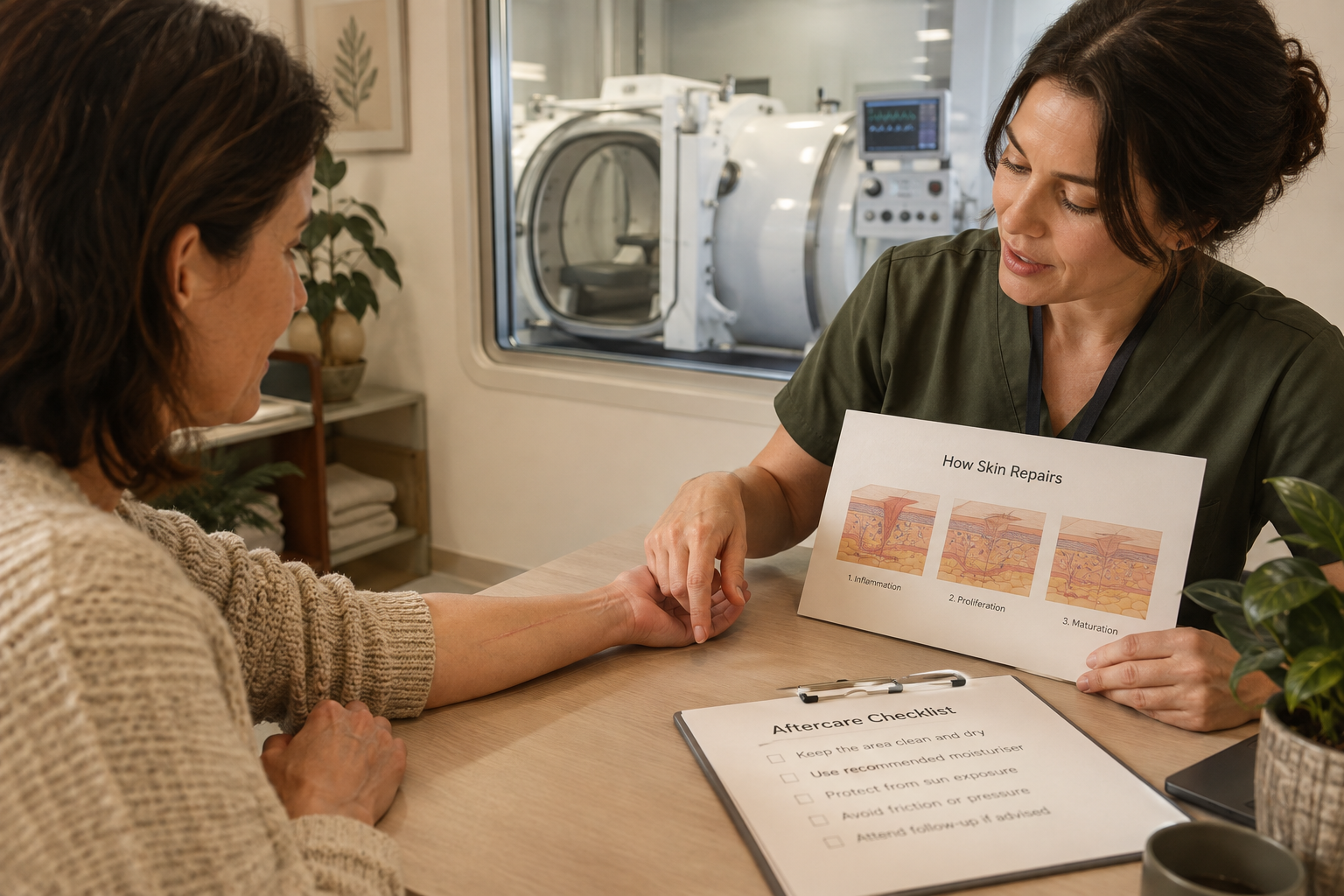
Broadly, healing moves through overlapping stages:
- Haemostasis: clotting helps stop bleeding after an injury.
- Inflammation: immune cells clear damaged material and help protect the wound.
- Proliferation: new tissue, blood vessels and collagen develop.
- Remodelling: collagen reorganises as the scar gradually matures.
Scar maturation commonly takes 12–18 months and sometimes longer. Changes in colour, firmness and sensitivity during that period do not necessarily mean healing has gone wrong.
Different scars need different conversations
A flat, pink surgical scar is different from a hypertrophic scar, which is raised but stays within the original wound boundary. A keloid grows beyond that boundary, while an atrophic scar appears indented. Tight scars may also restrict movement.
HBOT is not an established first-line approach for these scar types. Identifying the scar correctly is usually more useful than choosing a technology first.
What is hyperbaric oxygen therapy?
How pressure changes oxygen delivery
Medical HBOT involves breathing oxygen in a chamber pressurised above normal atmospheric pressure. Depending on the chamber, oxygen may fill the chamber or be delivered through a mask or hood.
At increased pressure, more oxygen dissolves in the liquid component of blood, called plasma. This can increase oxygen availability in tissues, including some areas where delivery is compromised.
Oxygen contributes to several repair processes, including:
- Collagen formation and maturation.
- The activity of certain immune cells.
- Processes involved in new blood vessel development.
- The energy demands of repairing tissue.
These mechanisms explain why HBOT may support selected wound-care pathways. They do not, by themselves, prove that treatment will make an otherwise healthy scar flatter, paler or less noticeable.
Why chamber specifications matter
Not every service marketed as “hyperbaric” provides the same intervention. Chamber pressure, oxygen concentration, delivery method and clinical supervision all affect what someone receives.
Lower-pressure wellness sessions, sometimes called mild hyperbaric therapy, should not be assumed equivalent to medical HBOT protocols used in clinical research. A chamber's appearance or comfort level does not establish its medical suitability.
Ask what is delivered and whether the evidence being discussed actually matches that protocol and your situation.
What does the evidence say about HBOT for scar recovery?
Where the clinical rationale is stronger
Specialist hyperbaric practice includes selected non-healing wounds, compromised skin grafts or flaps, and certain radiation-related tissue injuries. These are specific clinical situations, not general indications for anyone who wants a better-looking scar.
For example, a compromised graft may involve insufficient oxygen reaching tissue that needs urgent assessment. That is a very different problem from a fully closed scar that remains slightly raised several months after surgery.
Even where HBOT is considered appropriate, it is generally an adjunct to standard care. It does not replace surgical review, adequate blood supply, appropriate dressings, infection management or other necessary treatment.
Where expectations need to stay modest
For uncomplicated surgical scars, mature scars, acne scars and keloids, there is insufficient high-quality evidence to recommend HBOT routinely for cosmetic improvement.
Research may explore oxygen-related repair mechanisms or postoperative outcomes, but findings can be difficult to generalise. Studies may be small, use different protocols or assess wound closure rather than the long-term appearance of a scar.
“Helps a wound heal” and “improves the final scar” are different claims requiring different evidence.
The practical takeaway is straightforward: do not assume that more oxygen means a less visible scar, and do not interpret an established wound-care indication as proof of benefit for your own scar.
Your four-step scar recovery support guide
Step 1: Establish where you are in recovery
Before comparing treatments, clarify whether your main concern is an open wound, a newly closed incision or a mature scar. Note when the injury or procedure happened, whether the skin is fully closed, and what has changed recently.
Useful details to record include:
- Redness, swelling, discharge or wound separation.
- Itching, tenderness, numbness or increasing pain.
- Raised areas, indentation or tightness.
- Any effect on sleep, movement or daily activities.
- Current dressings, creams and aftercare instructions.
Seek prompt medical advice for spreading redness, worsening warmth or swelling, pus, fever, increasing pain or a wound that starts opening. A newly pale, dusky or darkening graft or flap needs urgent contact with the surgical team. Do not wait for a wellness appointment to assess these changes.
Step 2: Build the basics around your clinician's plan
For most uncomplicated scars, consistent aftercare matters more than adding another intervention. Follow the instructions provided by your surgeon, nurse or other treating clinician, particularly while the wound is still closing.
Once skin has fully healed, ask whether silicone gel or silicone sheets are appropriate. These are commonly recommended options for raised scars, although results vary and regular use over time is usually needed.
Other practical foundations include:
- Protecting healed scars from sunlight with clothing and broad-spectrum SPF 30 or higher.
- Avoiding picking, friction and unnecessary tension across the area.
- Eating enough overall, with regular protein-containing meals.
- Keeping well hydrated and maintaining a consistent sleep routine.
- Avoiding smoking and discussing vaping or nicotine use with your surgical team.
Scar massage may be suggested after full closure, but timing and technique should be individualised. Do not massage an open, inflamed or painful wound without professional guidance.
Step 3: Decide whether an HBOT assessment is relevant
If healing is delayed or there are concerns about tissue viability, start with the team managing your wound or surgery. They can assess the cause and decide whether specialist hyperbaric advice belongs in the plan.
If your wound has healed normally and the concern is appearance alone, a scar-focused consultation may be a more direct next step. Depending on the scar, options might include observation, silicone, rehabilitation or specialist procedures.
If HBOT is proposed, ask:
- What specific problem are we trying to address?
- Is there clinical evidence for my situation, rather than for wounds generally?
- What alternatives should I consider first?
- How will the benefits, risks and costs be reviewed?
- Will the provider coordinate with my treating clinician?
If you are exploring recovery support with LIVBETTER, bring your aftercare plan and these questions. A useful conversation should clarify suitability, not presume that every scar needs advanced therapy.
Step 4: Set realistic goals and review them
A meaningful goal might be improved comfort, easier movement or appropriate progress towards wound closure. “Erase the scar” is not a realistic medical promise.
Agree how progress will be assessed before starting any additional intervention. Photographs taken in similar lighting, at consistent intervals, can help document changes. Avoid checking multiple times a day: scar remodelling is slow, and daily comparison can create unnecessary worry.
Keep track of symptoms and function as well as appearance. If you begin HBOT under medical supervision, ask when the plan will be reviewed and what would lead to continuation, modification or stopping. Natural healing and other treatments can also explain improvement; change alone does not prove that HBOT caused it.
What might an HBOT appointment involve?
Before entering the chamber
A clinical assessment should cover your medical history, current medicines, previous procedures and the reason treatment is being considered. You should receive instructions about clothing, personal items and products that cannot enter the chamber.
During pressurisation, your ears may feel similar to the sensation experienced during an aircraft descent. Staff should explain how to equalise pressure and how to signal discomfort.
Treatment duration and frequency depend on the clinical indication and protocol. There is no evidence-based universal “scar recovery package” suitable for everyone.
Practical planning beyond the session
If treatment is appropriate, consider the time required for travel, preparation and repeat appointments. Recovery support should fit into a coherent care plan rather than crowd out sleep, nutrition, rehabilitation or essential follow-up.
Ask who supervises sessions, how you communicate with staff and what emergency procedures are in place. Clear answers are a basic expectation, not an optional extra.
Risks and suitability: what to know first
HBOT is a medical intervention, not simply a relaxation session with extra oxygen. Potential adverse effects include ear or sinus pressure injury, temporary changes in vision and claustrophobia. Oxygen toxicity, including seizures, is uncommon but possible; pressure-related lung injury is another important risk.
Oxygen-rich environments also carry a fire risk. Strict equipment, clothing and product rules are therefore essential, even when they seem unusually detailed.
Who needs additional assessment?
An untreated pneumothorax, or collapsed lung, is a contraindication to HBOT. Other conditions require individual assessment rather than a simple online suitability checklist.
Tell the assessing clinician about:
- Lung conditions, previous pneumothorax or chest surgery.
- Ear or sinus problems, or a current cold.
- Seizure history or difficulty tolerating enclosed spaces.
- Pregnancy, diabetes or medicines that can lower blood glucose.
- All medicines, including current or previous chemotherapy, and any implanted medical devices.
Do not stop prescribed medicines to prepare for HBOT unless your treating clinician specifically instructs you to do so.
For elective scar appearance concerns, an uncertain benefit deserves particularly careful consideration against the risks, inconvenience and expense.
Frequently asked questions
Can HBOT remove an old scar?
There is no good evidence that HBOT removes established scars. Mature scar tissue differs from normal skin, and its management depends on the scar type and your goals. A dermatologist or plastic surgeon can explain options without promising complete removal.
How soon after surgery should I start?
There is no standard start date for routine scar recovery. Your surgical team should guide postoperative care. If a graft, flap or wound is compromised, assessment may be urgent, but that does not mean routine HBOT is needed after every operation.
Is HBOT better than silicone or scar massage?
These approaches have different purposes, and HBOT has not been established as a superior routine scar treatment. Silicone may be appropriate for some healed, raised scars. Massage may help selected symptoms when recommended, but should not begin before the wound is ready.
Can nutrition support scar recovery?
Adequate energy, protein and a varied diet help provide the materials needed for repair. Eggs, fish, beans, yoghurt, tofu, vegetables and fruit are practical foundations. Supplements are not automatically necessary; discuss restricted intake, poor appetite or suspected deficiencies with a clinician or dietitian.
The bottom line: match the support to the need
HBOT may support selected, clinically assessed wound-care situations, but it is not a proven shortcut to a less visible scar. For routine recovery, appropriate aftercare, time and targeted scar advice remain the foundations.
The LIVBETTER approach is to make advanced health options easier to understand while keeping the decision grounded in evidence. Start with the simplest useful question: what does this tissue need at this stage?
Further reading
- NHS: Scars — information on scar types, self-care and treatment options.
- US Food and Drug Administration: Hyperbaric Oxygen Therapy: Get the Facts — an overview of uses, safety and unproven claims.
- Undersea and Hyperbaric Medical Society: Hyperbaric Oxygen Therapy Indications — specialist information on recognised clinical applications.
This guide provides general education and does not replace individual medical advice or your surgical team's aftercare instructions.
Next Steps
Want to learn more? Check out these articles:
HBOT for Sports Injury Recovery: 4 Things You Should Know
HBOT for Dental Implant Recovery: 4 Things You Need to Know
HBOT for Active Adults: A Guide to Recovery and Wellness
Check out our Therapies to see which options fit your goals.