
HBOT for Sports Injury Recovery: A Practical Guide 2
Introduction
If you’ve ever tweaked a hamstring, rolled an ankle, or pushed through a stubborn tendon niggle, you’ll know the most frustrating part of sports injuries isn’t just the pain—it’s the waiting. You do the “right things”: rest, rehab, sleep, good food… and still, recovery can feel slow and unpredictable. This is where people start looking at adjunct therapies that may support the body’s natural repair processes—one of the most talked-about being hyperbaric oxygen therapy (HBOT).
This guide explains HBOT for sports injury recovery in clear, practical terms: what it is, what the physiology suggests, what the research is (and isn’t) saying, who it may suit, how a course is typically structured, and how to combine it with sensible rehabilitation. Consider it your clinician-style walkthrough—science-first, hype-free, and designed for real life.
What is HBOT (Hyperbaric Oxygen Therapy)?
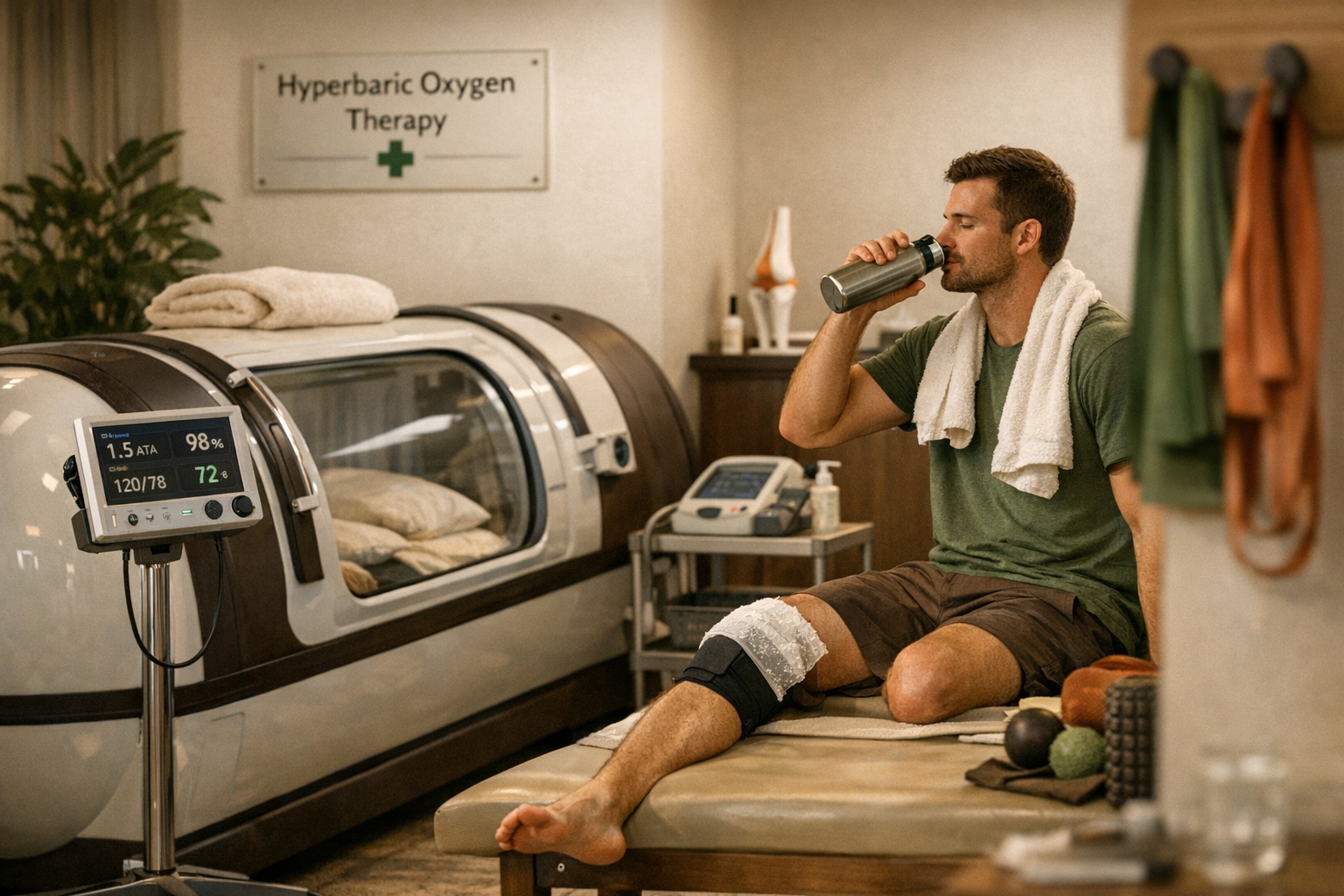
HBOT involves breathing oxygen in a pressurised chamber. The pressure is higher than normal atmospheric pressure, which allows more oxygen to dissolve into the plasma (the liquid part of blood). That matters because oxygen delivery is a key ingredient in tissue repair—particularly when tissues are inflamed, bruised, or have compromised microcirculation.
In sport and performance settings, HBOT is typically used as a supportive therapy alongside a tailored rehab plan. It is not a replacement for proper assessment, progressive loading, or addressing biomechanics, strength deficits, and movement patterns.
How HBOT differs from “just breathing oxygen”
Breathing oxygen through a mask at normal pressure increases oxygen in the lungs, but it doesn’t change how much oxygen is carried in the plasma to the same extent as pressurisation. The combination of increased pressure + increased oxygen concentration is what changes oxygen availability in tissues.
Soft-shell vs hard-shell chambers (and why it matters)
- Hard-shell (medical-grade) chambers can reach higher pressures and are commonly used in hospital settings for specific medical indications.
- Soft-shell chambers used in wellness/performance environments often operate at lower pressures.
For sports recovery, different clinics may use different systems. The best choice depends on the individual, the injury type, safety screening, and the clinical rationale. If you’re considering HBOT, ask what pressure is used, what protocols are followed, and how outcomes are monitored.
Why oxygen matters for injury recovery
Your body’s repair work is an energy-intensive process. Oxygen supports cellular metabolism and is involved in multiple stages of healing. In simple terms: recovery tends to go better when tissues get the right nutrients, the right signals, and the right environment—including adequate oxygenation.
The key physiological ideas (in plain English)
- Inflammation control: Early inflammation is normal, but prolonged or excessive inflammation can slow progress. Oxygen availability may influence inflammatory signalling.
- New blood vessel formation (angiogenesis): Repair often involves improving local blood supply. Oxygen fluctuations and tissue oxygen levels are part of the signalling environment.
- Collagen and connective tissue remodelling: Tendons, ligaments, and fascia adapt over time. The quality of remodelling depends on progressive loading and biological readiness.
- Swelling and microcirculation: Pressure and oxygen dynamics may support tissue oxygenation even when local circulation is suboptimal post-injury.
- Recovery from bruising/contusion: Where microvascular disruption occurs, supporting oxygen delivery may be relevant.
These mechanisms are biologically plausible. The important nuance is that plausible does not automatically mean guaranteed. Response varies by injury type, timing, dose (pressure/time), and the quality of the rehab programme.
What does the evidence say about HBOT for sports injuries?
HBOT has established medical uses for certain conditions (for example, specific wound-healing contexts). For sports injuries specifically, the research is more mixed, and it’s essential to be honest about that. Some studies and clinical reports suggest HBOT may support aspects of recovery—particularly where tissue oxygenation is a limiting factor—while other studies show limited or inconsistent benefit depending on injury and protocol.
In practice, many athletes consider HBOT as part of a broader recovery strategy, especially when:
- progress has plateaued despite good rehabilitation
- there is significant bruising/soft tissue trauma
- they need to support recovery quality during a heavy training or competition period (under appropriate guidance)
A sensible, evidence-based approach is to treat HBOT as a potential amplifier of the basics (rehab, sleep, nutrition, load management), not as a standalone fix.
Injuries where HBOT is commonly discussed
- Muscle strains (e.g., hamstrings, calves, adductors)
- Ligament sprains (e.g., ankle sprains)
- Tendon pain and tendinopathy (e.g., Achilles, patellar tendon, rotator cuff-related pain)
- Bone stress injuries and slower-healing bone issues (always requires medical oversight)
- Post-operative recovery in selected cases (only with surgical team alignment)
Note: Tendon and bone conditions are particularly nuanced. They rely heavily on progressive loading, and “feeling better” too quickly can lead to doing too much too soon. Any supportive therapy must be matched with a plan that respects tissue timelines.
Who may benefit most from HBOT in a recovery plan?
HBOT tends to be most appealing when you want to support recovery quality while staying consistent with rehab. People who may be good candidates (after screening) often include:
- Recreational athletes who want to return to sport with confidence and reduce stop-start cycles
- Competitive athletes in multi-session training weeks where recovery capacity is stretched
- Busy professionals balancing training with long workdays and travel (sleep disruption and stress can slow healing)
- Individuals with repeated flare-ups who need a more comprehensive recovery strategy
It may be less appropriate if the underlying diagnosis is unclear, if you haven’t had a proper assessment, or if the issue is primarily driven by training errors, footwear, technique, or strength deficits that remain unaddressed.
HBOT safety: who should not use it (or should check first)
HBOT is generally well-tolerated when delivered properly, but it isn’t for everyone. Safety begins with screening.
Common reasons to pause and get medical clearance
- Untreated pneumothorax (a key contraindication)
- Significant ear or sinus problems affecting pressure equalisation
- Certain lung conditions (risk depends on specifics)
- Recent ear surgery or active ear infection
- Uncontrolled seizures or specific neurological conditions (requires clinician review)
- Pregnancy (protocol-dependent; needs medical oversight)
- Claustrophobia (often manageable with preparation, but should be discussed)
Potential side effects can include ear discomfort/pressure, sinus discomfort, temporary changes in vision, and fatigue. A reputable provider will explain risks, monitor you throughout, and adjust protocols if needed.
What a typical HBOT session looks like
Most people are surprised by how straightforward a session feels. You’ll be in a chamber for a set time while the pressure increases and decreases gradually.
What you might experience
- Pressurisation: similar to take-off/landing in an aeroplane; you may need to equalise your ears
- During the session: resting, breathing normally; some people listen to audio or simply relax (depending on the chamber set-up)
- Depressurisation: pressure is slowly reduced back to normal
How many sessions are usually needed?
There isn’t a universal number because protocols vary by injury, goals, and response. In sports recovery contexts, people often use HBOT as a short course (for acute issues) or a structured block alongside rehab (for persistent issues). What matters is having a plan, tracking progress, and reassessing rather than doing endless sessions without a clear objective.
Timing HBOT with your injury: acute vs persistent
The “when” can be as important as the “what”.
Acute injuries (first days to weeks)
Early on, the focus is accurate diagnosis, protecting the tissue, managing swelling, and maintaining gentle movement where appropriate. HBOT may be considered as a supportive option during this phase, particularly for significant soft-tissue trauma. However, you still need to respect pain, function, and load tolerance.
Persistent issues (weeks to months)
If you’ve had a recurring tendon problem or a stubborn strain that keeps returning, HBOT may be used to support a more comprehensive reset: optimising sleep and recovery capacity while you rebuild strength, control, and tissue tolerance. This is often where you’ll get the most value from a “whole plan” approach rather than searching for one magic modality.
How to combine HBOT with rehabilitation (the part that actually drives results)
If you want HBOT to make sense, pair it with a rehab framework that is progressive, measurable, and specific to your sport.
A practical recovery framework
- Get a clear diagnosis: “Achilles pain” isn’t a diagnosis. Is it mid-portion tendinopathy, insertional pain, paratenon irritation, or something else?
- Protect what’s injured, keep what’s healthy moving: Modify training load but keep conditioning where possible (bike, swim, upper body work, etc.).
- Build capacity with progressive loading: Tendons and ligaments need graded strength work. Muscles need strength + length tolerance + speed exposure.
- Restore sport-specific demands: Change of direction, acceleration, jumping, throwing—whatever your sport requires—reintroduced stepwise.
- Track objective markers: pain scores alone aren’t enough. Use hop tests, calf raises, strength numbers, range measures, or running metrics as appropriate.
Where HBOT may fit in
- On recovery days: to support overall recovery while you continue progressive rehab
- During high-stress weeks: when work, travel, or poor sleep may reduce recovery capacity
- When swelling/bruising is significant: as part of early supportive care (after screening)
One caution: feeling better is not the same as being fully resilient. If HBOT reduces discomfort, treat that as an opportunity to rehab more intelligently—not as permission to jump straight back to maximal training.
Action steps you can start today (with or without HBOT)
The basics aren’t glamorous, but they’re reliably effective. If you do HBOT, these steps make it more likely you’ll benefit. If you don’t, these steps still move you forward.
1) Run a simple “recovery audit”
- Are you sleeping 7–9 hours most nights?
- Are you eating enough protein and total energy to support repair?
- Is your training load modified appropriately, or are you re-irritating the injury every few days?
- Do you have a rehab plan with measurable progressions?
2) Choose one objective marker to track
Pick something relevant and repeatable, such as:
- single-leg calf raise reps (for Achilles-related issues)
- isometric mid-thigh pull or squat strength markers (for knee/hip issues)
- range of motion measures (for ankle sprains)
- running tolerance: minutes at easy pace with next-day symptom response
3) Respect the “24-hour rule”
After rehab or training, assess symptoms over the following day. A mild increase that settles quickly can be acceptable in many programmes; a big spike that lingers means the load was too high and needs adjusting.
4) Prioritise circulation without aggravation
Gentle movement, walking, easy cycling, or pool work can support circulation and maintain fitness without excessive tissue stress—depending on the injury and stage.
5) Use pain relief strategically
Short-term symptom relief can help you move and rehab, but masking pain to push through high loads is a common route to setbacks. If you’re relying on painkillers to train, consider that a flag to reassess.
HBOT at LIVBETTER: how we typically approach it
At LIVBETTER, we view advanced therapies as part of modern performance healthcare: high-end, time-efficient, and grounded in physiology. If you’re exploring HBOT for sports injury recovery, the goal is to integrate it into a structured plan—ideally alongside clinical assessment, load management, and recovery optimisation.
What this looks like in practice:
- Screening first: to check suitability and reduce risk
- Clear goals: for example, improved training tolerance, improved function markers, and reduced next-day flare-ups
- Plan-based dosing: a defined course with reassessment rather than open-ended sessions
- Whole-recovery support: sleep, stress, nutrition fundamentals, and evidence-based adjuncts when appropriate
If you’re unsure whether HBOT makes sense for your specific injury, a brief consultation can help decide whether it’s a fit—or whether other approaches (physiotherapy-led rehab, strength diagnostics, nutrition support, or recovery scheduling) are likely to move the needle faster.
Frequently asked questions
Is HBOT legal and safe for athletes?
HBOT is widely used in clinical and wellness settings. Suitability depends on health history and screening. If you compete, it’s also sensible to stay aware of your sport’s rules around any treatments (HBOT is generally not a doping issue, but always check your governing body guidance).
Will HBOT get me back to sport faster?
It may support recovery in certain contexts, but it’s not a guaranteed shortcut. The biggest predictors of a solid return are accurate diagnosis, sensible load progressions, and adherence to rehab.
Can I do HBOT and train on the same day?
Often yes, but it depends on your programme, fatigue levels, and the nature of your injury. Some people prefer HBOT on lighter days. If you notice fatigue afterwards, adjust training intensity accordingly.
Does HBOT help tendon injuries?
Tendon recovery is primarily driven by progressive loading and time. HBOT may support the biological environment, but it shouldn’t replace a structured tendon rehab plan. Tendons are especially prone to flare-ups if you progress too quickly.
What should I do before my first session?
- Hydrate normally and eat a light meal if needed
- Avoid training to exhaustion immediately beforehand
- Let the provider know about sinus/ear issues, asthma, or recent illness
- Ask what to expect with ear equalisation and what happens if you feel discomfort
Conclusion: a realistic, performance-minded way to use HBOT
HBOT is best thought of as a supportive tool: by increasing oxygen availability under pressure, it may help create a better internal environment for repair—especially when paired with high-quality rehab and recovery habits. If you’re managing a sports injury and want a modern, evidence-informed approach, HBOT can be part of a comprehensive plan, but it isn’t a replacement for the fundamentals.
When you combine clear diagnosis, progressive loading, smart recovery, and carefully selected advanced therapies, you give yourself the best chance of returning to sport feeling not just “better”, but more resilient.
Next Steps
Want to learn more? Check out these articles:
HBOT for Dental Implant Recovery: Your Complete Guide
HBOT for Wellness Recovery in Active Adults: A Practical Guide
HBOT for Recovery After Demanding Weeks: A Practical Guide
Check out our Therapies to see which options fit your goals.