
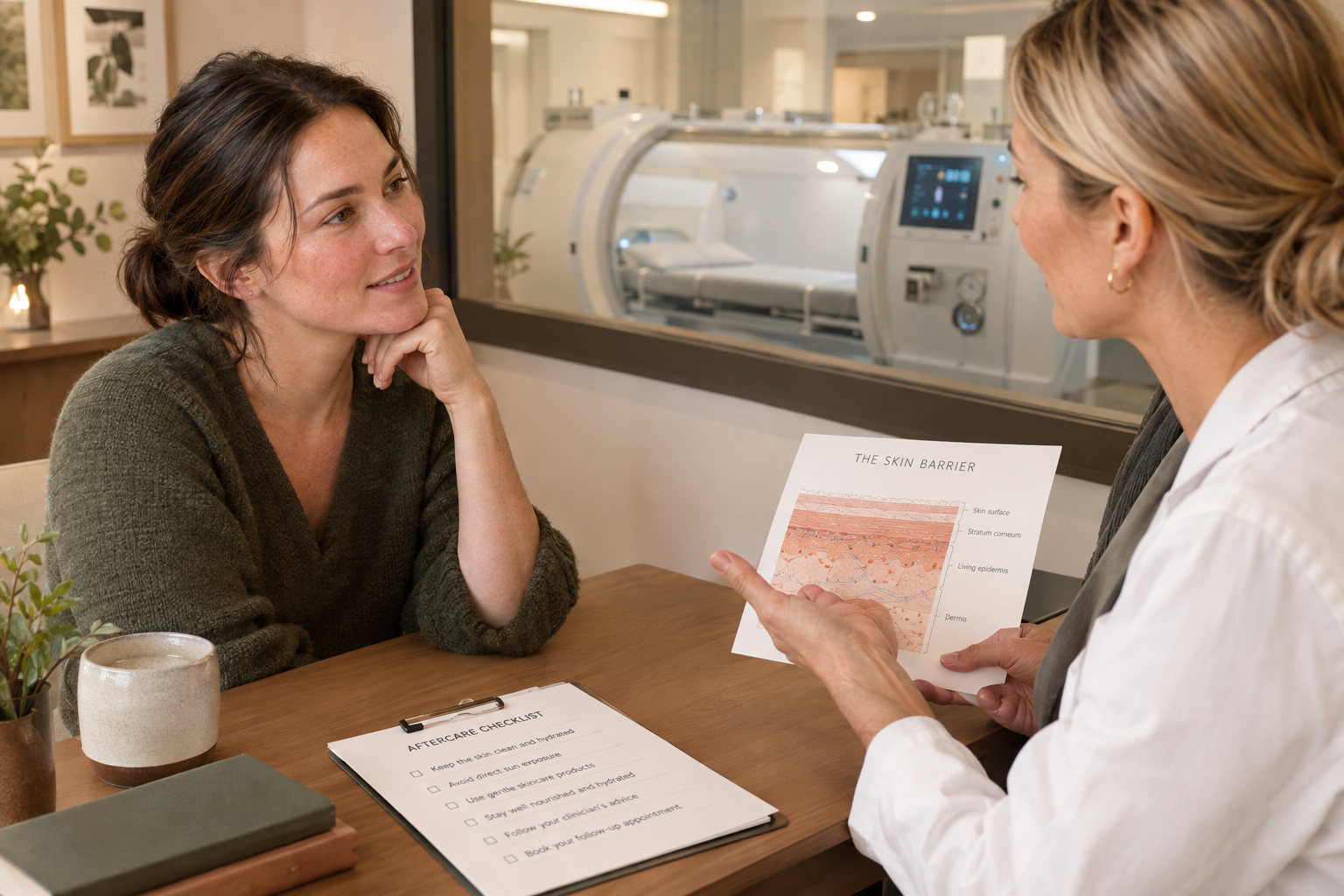
HBOT for Skin Repair: A Guide to Care After Treatments
Your aesthetic appointment may be finished, but your skin is still working. Depending on the procedure, it may be rebuilding its protective barrier, managing inflammation or repairing deeper tissue. That recovery phase matters just as much as the treatment itself.
Hyperbaric oxygen therapy, or HBOT, is sometimes suggested as additional recovery support. The science behind oxygen and wound healing is well established; the evidence for routinely using HBOT after cosmetic procedures is much less certain.
This HBOT for skin repair guide explains that distinction, explores where treatment might fit and gives you four questions to ask before booking. The aim is not to add another appointment automatically, but to help you make a well-informed decision.
What is HBOT, and how does it affect skin?
HBOT involves breathing oxygen inside a chamber pressurised above normal atmospheric pressure. In medical HBOT, patients generally breathe close to 100% oxygen under a prescribed treatment protocol.
The increased pressure allows more oxygen to dissolve in blood plasma, the liquid component of blood. This can increase oxygen delivery to tissues, including areas where delivery is compromised.
That mechanism is relevant to wound care, but it does not mean every patch of redness or peeling skin needs extra oxygen.
Why oxygen matters during repair
Skin repair is an overlapping process involving inflammation, tissue rebuilding and remodelling. Oxygen contributes to several normal functions involved in that process:
- Energy production: repairing cells need energy to carry out their work.
- Collagen formation: oxygen is required for steps that help stabilise newly formed collagen.
- Immune activity: some infection-fighting functions of white blood cells depend on oxygen.
- Tissue adaptation: oxygen availability influences signals involved in blood vessel development and repair.
However, supporting a biological process is not the same as proving a noticeable cosmetic benefit. Well-perfused skin may already receive sufficient oxygen for uncomplicated healing. More oxygen does not automatically mean better skin, shorter downtime or a better final result.
What does the evidence actually show?
HBOT has recognised medical applications, including selected difficult wounds and compromised skin grafts or flaps. These situations involve specific clinical problems and specialist assessment.
Routine recovery after an aesthetic treatment is different. Healthy skin recovering from a planned procedure cannot simply be compared with tissue affected by severe injury or impaired circulation.
Established wound care versus cosmetic recovery
Research in reconstructive surgery and wound care provides a rationale for investigating HBOT around aesthetic procedures. However, studies specifically examining uncomplicated cosmetic recovery are limited and vary in quality, treatment settings and outcomes.
Some reports describe improvements in particular postoperative settings, but small studies and uncontrolled case series cannot reliably establish how much improvement came from HBOT rather than normal healing or other care.
There is not a robust basis for promising that HBOT will routinely shorten redness, prevent scarring or improve the final appearance after laser resurfacing, microneedling or chemical peels.
What realistic expectations look like
If a clinician recommends HBOT, ask what benefit they are targeting and how they will assess it. A useful answer should relate to your procedure, tissue condition and medical history—not simply to “boosting collagen”.
HBOT may support recovery in selected clinical circumstances. It should not be presented as an essential upgrade for everyone having aesthetic treatment, nor as a substitute for competent procedural care and appropriate aftercare.
You should also be able to ask about cost and inconvenience without pressure. Where benefit is uncertain, the time, travel and financial commitment deserve a place in the decision alongside potential clinical advantages.
Does the type of aesthetic treatment matter?
Yes. “Skin repair” can describe anything from a temporarily sensitive surface to a surgical wound with threatened blood supply. The expected recovery and the reasons for considering HBOT are very different.
Laser resurfacing and chemical peels
Ablative lasers and deeper peels deliberately injure selected layers of skin to stimulate repair. Redness, swelling, oozing or peeling may be expected, depending on the procedure and its intensity.
HBOT is sometimes discussed as an adjunct, but evidence does not establish it as standard aftercare. Barrier protection, appropriate cleansing, prescribed medicines and follow-up remain the priorities.
Your practitioner should explain what normal recovery looks like for your particular treatment. Increasing pain or unexpected skin changes need assessment, not an assumption that more recovery support is required.
Microneedling and less intensive treatments
Microneedling creates controlled micro-injuries. Superficial peels and non-ablative energy treatments usually involve a different degree of tissue disruption from ablative resurfacing.
For uncomplicated recovery after these procedures, there is little strong evidence that adding HBOT provides a meaningful benefit. A straightforward aftercare routine may be entirely sufficient.
Avoid treating social media recovery photographs as evidence: lighting, treatment intensity and the time since the procedure can all change how skin appears.
Surgery, grafts and flaps
A compromised graft or flap is a specialist issue, not ordinary downtime. HBOT may be considered as an adjunct in selected cases, alongside urgent assessment and correction of the underlying problem where possible.
It cannot mechanically restore an obstructed vessel or replace necessary surgery. The operating team should lead decisions and coordinate any hyperbaric referral.
Four questions to ask before considering HBOT
Is my recovery normal, or does it need medical assessment?
Start with the clinician who performed your procedure. Ask whether your symptoms fit the expected pattern and whether anything suggests infection, impaired circulation or another complication.
Seek prompt medical advice for worsening pain, spreading redness, fever, pus, wound opening or skin becoming unusually pale, dusky or dark. These signs do not identify the cause by themselves, but they deserve assessment.
After injectable treatments, severe or increasing pain and unusual colour changes require immediate contact with the treating clinician or urgent medical care. Any visual disturbance requires emergency assessment. Do not wait for an HBOT appointment: time-sensitive complications need established emergency management first.
What evidence supports it for my exact procedure?
Ask about evidence for the treatment you actually had—not wound healing in general. Findings from compromised grafts cannot establish a benefit after an uncomplicated facial peel.
Useful questions include:
- What outcome are we hoping to improve?
- Is there comparative research in patients like me?
- What benefit is plausible, and what remains uncertain?
- Would you still recommend this if my recovery were progressing normally?
A trustworthy explanation should acknowledge uncertainty. A fixed promise about fewer recovery days, scar prevention or improved cosmetic results should prompt caution.
What chamber and protocol would be used?
The term “hyperbaric” covers services that are not necessarily equivalent. Chamber pressure, oxygen concentration, session duration and clinical supervision all matter.
Lower-pressure “mild” chambers, particularly those pressurised with air, should not be assumed to reproduce the effects of medical HBOT. An oxygen mask alone does not tell you the effective oxygen exposure.
Ask the provider to explain the planned pressure, oxygen delivery, medical screening and monitoring. They should also describe staff training, emergency procedures and fire-safety precautions in clear language.
There is no universally established HBOT schedule for routine recovery after aesthetic treatments. Avoid packages presented as clinically necessary without an individual assessment and a clear explanation of the rationale.
Do the potential benefits outweigh the risks for me?
HBOT is a medical intervention, not simply a relaxation session. Your suitability depends on your health, medicines, procedure and ability to tolerate pressure changes.
Disclose lung conditions, previous pneumothorax, ear or sinus problems, recent illness, seizure history, pregnancy and all medicines. People who use insulin or certain diabetes medicines may need a plan for blood glucose monitoring.
An untreated pneumothorax is a contraindication. Other conditions require individual evaluation rather than an automatic yes or no.
Your aesthetic practitioner and hyperbaric clinician should agree on the purpose and timing of treatment. You should not have to coordinate conflicting medical instructions yourself.
HBOT risks and practical considerations
The most common difficulties involve pressure changes. Ear discomfort or middle-ear injury can occur, particularly when equalising pressure is difficult. Sinus discomfort and claustrophobia are also possible.
Repeated treatments can cause temporary changes in vision. Less commonly, oxygen toxicity can cause a seizure, and pressure-related lung injury is a serious potential complication.
Oxygen-enriched environments also create a fire risk. Strict rules about clothing, electronic devices, dressings and products brought into the chamber are essential safety measures.
Why cosmetic aftercare needs coordination
Freshly treated skin may require ointments or dressings that need checking for chamber compatibility. Never remove prescribed wound protection or stop a medicine independently to attend a session.
Ask both teams to agree on a safe plan. If the chamber provider cannot accommodate the aftercare your skin needs, that conflict must be resolved before treatment—not worked around on the day.
A provider should also explain what happens if you develop ear pain, anxiety or another symptom during a session. Feeling comfortable asking for help is part of safe care.
The recovery basics that still matter most
Even when HBOT is appropriate, it remains an addition to foundational care. These practical steps are often the most useful place to focus your attention.
Follow a procedure-specific skincare plan
Use the cleansing method, moisturiser or barrier ointment recommended by your practitioner. Freshly resurfaced skin may need a very different routine from skin recovering after a light treatment.
Avoid scrubs, retinoids, exfoliating acids and other potentially irritating actives until your clinician says they can be restarted. Do not pick peeling skin or remove crusts prematurely.
Protect healing skin from ultraviolet exposure with shade and suitable clothing. Introduce or resume sunscreen according to your practitioner’s instructions, particularly if the surface is not yet intact.
Support repair with everyday habits
- Eat regularly: include protein-containing foods such as eggs, fish, yoghurt, beans or tofu alongside varied meals.
- Stay hydrated: drink normally and follow any individual medical guidance; excessive water intake does not accelerate healing.
- Prioritise sleep: allow a consistent sleep opportunity and adjust your schedule if discomfort interrupts rest.
- Avoid smoking: smoking impairs wound healing. Discuss vaping and nicotine use with your surgical team, including any cessation support.
- Follow activity restrictions: heat, strenuous exercise, swimming and sauna use may need to wait, depending on the procedure.
There is no need to build a supplement stack for routine recovery. If nutritional intake is poor or a deficiency is suspected, seek individual advice rather than assuming high doses will help.
Keep follow-up appointments
Recovery is easier to judge against a baseline. If your practitioner recommends progress photographs, take them in consistent lighting and avoid repeatedly touching the area to inspect it.
Attend planned reviews even if things appear to be improving. Report changes according to the contact instructions you were given, rather than relying on online comparisons with other people’s skin.
What would a properly assessed HBOT visit involve?
A responsible service begins with a clinical history and suitability assessment, not simply a booking slot. The team should explain why HBOT is being considered, its limitations, alternatives and likely practical demands.
Before entering the chamber, you should receive instructions about approved clothing and products, pressure equalisation and communication with staff. During compression, you may notice ear pressure similar to that experienced when flying.
Session length and the number of visits depend on the clinical protocol. For routine aesthetic recovery, an evidence-based universal number cannot be supplied.
Agree on a review point and a clear reason for continuing. Changes in symptoms or the absence of a convincing indication should prompt reassessment rather than automatic completion of a package.
Common questions about HBOT after aesthetic treatments
Can I start immediately after my procedure?
There is no universal start time. It depends on the procedure, your condition, required aftercare and the reason for considering HBOT. Your treating clinician should advise; complications require urgent assessment rather than self-directed scheduling.
Will HBOT prevent scars or pigmentation?
It cannot be relied upon to prevent either. Scarring and pigment changes depend on treatment depth, skin characteristics, inflammation, infection, ultraviolet exposure and other factors. Follow-up and procedure-specific prevention advice remain important.
Does it replace antibiotics or wound care?
No. HBOT does not replace prescribed medicines, appropriate dressings, drainage or surgery when these are indicated. It should never delay assessment of a suspected complication.
Where can I check broader medical information?
The Undersea and Hyperbaric Medical Society provides information about recognised HBOT indications. The US Food and Drug Administration also publishes patient guidance on HBOT, including safety considerations and cautions about unsupported claims. Neither should be read as blanket endorsement for cosmetic recovery.
A considered approach to skin recovery
At LIVBETTER, the emphasis is on making advanced health options understandable—not making your recovery routine unnecessarily complicated. Technology deserves a place when its purpose, evidence and safety are clear.
For most uncomplicated aesthetic treatments, practitioner-led aftercare remains the foundation. HBOT may have a role in selected circumstances, but the best next step is a conversation with your treating clinician, not an assumption that more treatment means better healing.
Next Steps
Want to learn more? Check out these articles:
HBOT for Skin Repair After Aesthetic Treatments: A Practical Guide
HBOT for Skin Repair After Aesthetic Treatments [Guide]
HBOT for Skin Repair After Aesthetic Treatments: A Clinician’s Guide
Check out our Therapies to see which options fit your goals.