
HBOT for Skin Repair After Aesthetic Treatments: A Clinician’s Guide
If you’ve ever had an aesthetic treatment and then looked in the mirror thinking, “Is it meant to look like this today?”, you’re not alone. Redness, swelling, dryness, tenderness and that slightly “raw” feeling can be completely normal parts of the recovery process—especially after procedures that intentionally create controlled micro-injury to stimulate renewal.
At the same time, most of us want two things: excellent results and a smooth, predictable recovery. That’s where Hyperbaric Oxygen Therapy (HBOT) comes into the conversation. HBOT has long been used in medical settings to support tissue repair. More recently, it’s being explored as a supportive recovery tool after certain aesthetic treatments because of its ability to increase oxygen delivery to tissues and modulate inflammation.
In this article, we’ll break down what HBOT is, how skin healing actually works after aesthetic procedures, what the science suggests HBOT may help with, who it’s suitable for, and how to use it sensibly as part of a comprehensive aftercare plan.
What is HBOT (Hyperbaric Oxygen Therapy)?
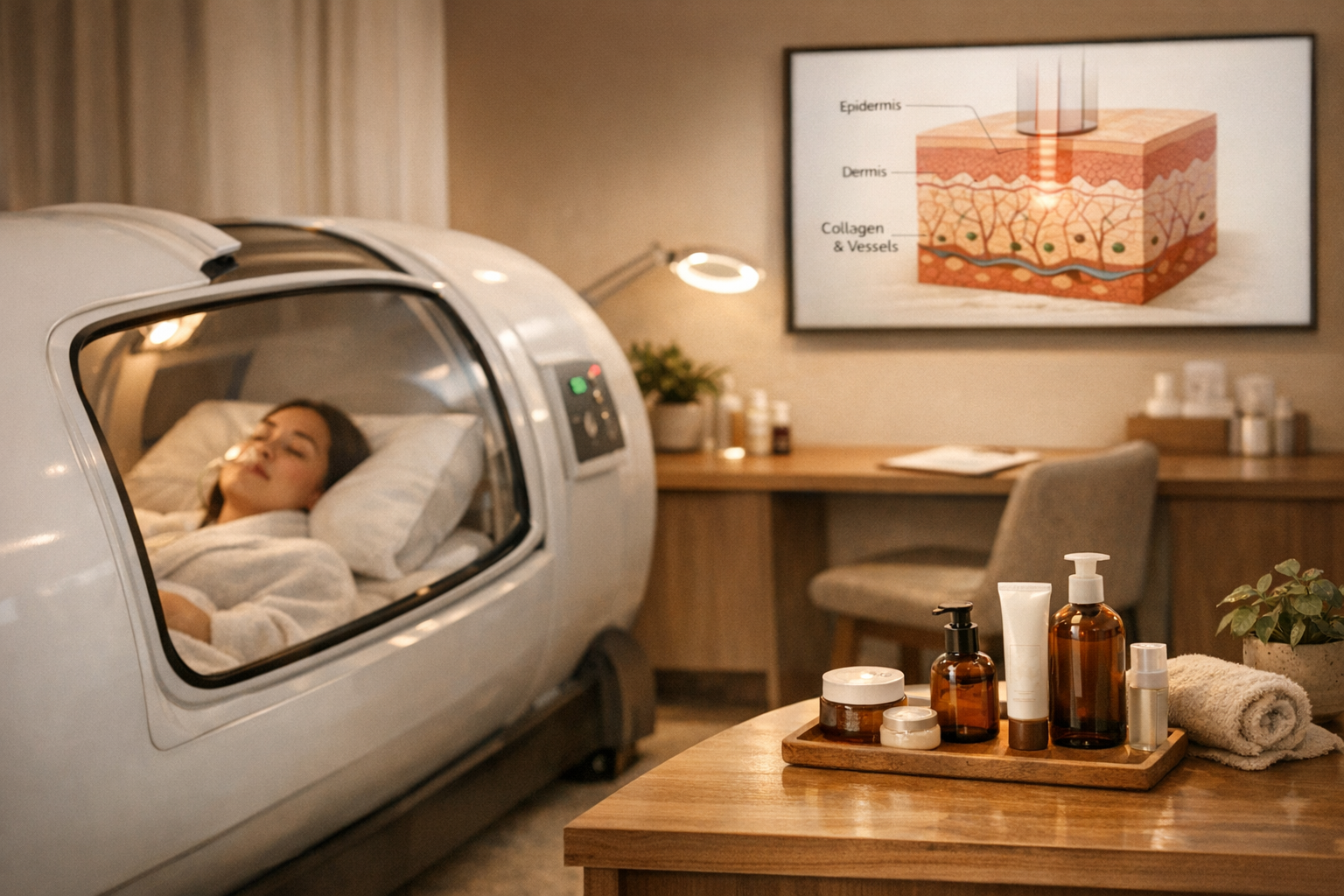
HBOT involves breathing near-100% oxygen inside a pressurised chamber. The pressure is typically higher than normal atmospheric pressure (at sea level), which allows more oxygen to dissolve into the plasma (the liquid part of your blood). That dissolved oxygen can then diffuse more effectively into tissues—especially in areas where circulation is temporarily compromised or where tissues are demanding extra resources for repair.
In clinical medicine, HBOT is used for indications such as certain non-healing wounds, radiation tissue injury and decompression sickness. In the wellness and performance space, it is sometimes used to support recovery, inflammation balance and tissue resilience—although the evidence varies depending on the outcome being measured.
The important point: HBOT is not a “quick fix” or a substitute for quality skin care and proper clinical aftercare. Think of it as a potential recovery enhancer—particularly when your skin barrier has been challenged.
How skin repairs itself after aesthetic treatments
Different treatments create different types of stress in the skin, and the recovery timeline depends on depth, intensity and individual biology.
The common thread: controlled injury + controlled healing
Many popular procedures are designed to create controlled micro-inflammation to trigger a cascade of repair:
- Collagen remodelling
- Increased cell turnover
- Improved texture and tone over time
- Strengthening of the dermal matrix
This is why “downtime” exists. Your body is doing real work.
Key phases of skin healing (simplified)
- Inflammation (hours to days)
Your immune system arrives to clear debris and signal repair. Redness, warmth and swelling can show up here. - Proliferation (days to weeks)
New tissue is laid down, new vessels may develop (angiogenesis), and the barrier begins restoring. - Remodelling (weeks to months)
Collagen reorganises, tensile strength improves, and results often become more noticeable.
Oxygen is involved at every stage—supporting immune function, collagen synthesis, angiogenesis and overall cellular energy production. After certain procedures, oxygen demand can exceed supply locally, particularly when swelling or microvascular disruption temporarily limits delivery.
Which aesthetic treatments might pair well with HBOT?
HBOT is most often discussed for recovery after treatments that meaningfully challenge the barrier or deeper layers of the skin. Examples may include:
- Fractional laser resurfacing (ablative or non-ablative)
- Microneedling (especially deeper sessions)
- RF microneedling
- Medium-depth chemical peels (clinician-led)
- Certain post-procedure recovery periods where swelling and inflammation are prominent
For injectable treatments (e.g., dermal fillers, neuromodulators), recovery is usually straightforward and HBOT is not routinely needed. However, some people may still choose it for general recovery support—particularly if they’re prone to pronounced swelling or bruising. This should be discussed with your clinician, especially soon after an injectable treatment.
How HBOT may support skin repair after treatments (the science, without the hype)
Let’s keep this evidence-led and realistic. The mechanisms by which HBOT may help are biologically plausible and supported by medical literature in wound healing contexts. Direct studies specifically in “aesthetic downtime” are still emerging, so we translate cautiously.
1) Increased oxygen delivery to stressed tissues
Under pressure, oxygen dissolves more readily into blood plasma. This can increase tissue oxygenation even where microcirculation is temporarily reduced. Oxygen supports:
- Fibroblast activity (cells that help make collagen)
- Collagen synthesis (oxygen is required for key steps)
- Cellular energy (ATP production)
Why this matters after aesthetic treatments: when your skin is inflamed and repairing, oxygen demand rises.
2) Supporting angiogenesis (new blood vessel formation)
HBOT has been associated with signalling processes that can promote angiogenesis in wound contexts. Healthy microcirculation is foundational for longer-term tissue quality.
In aesthetic recovery, this may be relevant when treatments transiently disturb microvascular networks and the skin needs to restore efficient nutrient delivery.
3) Modulating inflammation (not “switching it off”)
Inflammation isn’t the enemy—it’s part of the signal for renewal. But excessive or prolonged inflammation can be uncomfortable and may complicate recovery for some skin types. HBOT may help balance inflammatory signalling and oxidative stress responses. The goal is not to eliminate inflammation, but to support a more regulated healing environment.
4) Supporting immune function and reducing infection risk (context-dependent)
In medical wound care, HBOT can enhance certain immune cell functions and support antimicrobial activity in specific settings. For aesthetic procedures, good hygiene and clinician-led aftercare remain the primary infection-prevention tools. HBOT is not a substitute for these, but improved oxygenation may be a helpful adjunct for selected individuals.
What HBOT can’t do
- HBOT cannot replace good procedural technique or appropriate aftercare.
- It won’t “force” results faster than biology allows.
- It doesn’t guarantee prevention of complications.
- It isn’t suitable for everyone (more on that below).
What a sensible HBOT plan can look like after aesthetic treatments
Protocols vary depending on the chamber type, pressure settings, and clinical goals. If you’re considering HBOT for post-aesthetic recovery, the safest approach is to coordinate with both your aesthetic clinician and an HBOT provider who understands post-procedure skin.
Timing: when to start
Many people consider HBOT in one of these windows:
- Within 24–72 hours post-procedure, when swelling and inflammatory discomfort are often highest
- As a short series over the first 1–2 weeks, depending on intensity of the treatment and your response
However, timing should be individualised. Certain procedures have very specific aftercare rules (for example, avoiding heat, friction or pressure). Your provider should guide you.
How many sessions?
There isn’t a one-size-fits-all number. Some people choose a small cluster (e.g., 3–6 sessions) around a major treatment, while others prefer a more structured series. A sensible principle: start with the minimum effective dose and reassess. Your skin’s response is the best guide.
What you might feel after HBOT
Most people find sessions relaxing. You may notice:
- Ear pressure changes (like flying), which can be managed with equalisation techniques
- Mild fatigue or, conversely, a “clear-headed” feeling
- Improved sense of recovery over the next 24–48 hours
If you have significant discomfort, your provider should adjust or stop the session.
Safety and suitability: who should be cautious
HBOT is generally well-tolerated when properly screened and supervised, but it is not appropriate for everyone.
Common reasons to delay or avoid HBOT include:
- Untreated pneumothorax (absolute contraindication)
- Certain lung conditions that increase risk under pressure (requires medical clearance)
- Acute respiratory infections or severe sinus congestion (equalisation issues)
- Some ear conditions or recent ear surgery
- Uncontrolled seizures (requires specialist input)
- Certain chemotherapy agents (requires medical review)
- Claustrophobia (often manageable, but should be discussed)
If you’ve just had an aesthetic procedure
Always disclose:
- The exact treatment, depth and settings used
- Any active skin infection (cold sores, impetigo, etc.)
- Any unusual pain, blanching, increasing redness or discharge
If something feels “not right”, seek clinical review first rather than trying to “treat through” it.
Practical aftercare that pairs well with HBOT (and works even without it)
HBOT is an adjunct. Your fundamentals still do the heavy lifting.
Barrier-first skincare (first 3–7 days, or as advised)
- Use a gentle cleanser (or just lukewarm water initially if advised)
- Apply a bland, barrier-supporting moisturiser (think ceramides, glycerin, petrolatum-based options if appropriate)
- Avoid active ingredients until cleared: retinoids, exfoliating acids, high-dose vitamin C, benzoyl peroxide
- Be cautious with fragranced products
Sun protection (non-negotiable)
After lasers, peels or microneedling, UV exposure can worsen redness and pigmentation changes.
- Use a broad-spectrum SPF 30–50 daily once skin is intact enough, as advised
- Add physical barriers: hats, shade, avoiding midday sun
Reduce friction and heat stress
- Avoid intense exercise, saunas and very hot showers for the period your clinician recommends
- Don’t pick or scrub flaking skin
- Sleep on a clean pillowcase
Hydration and protein for repair
Skin repair is metabolically expensive.
- Aim for consistent hydration
- Include protein at each meal (e.g., eggs, yoghurt, fish, poultry, tofu, legumes)
- Consider vitamin C from food (berries, citrus, peppers) to support collagen processes
Sleep and stress: the underrated “treatment”
Poor sleep can amplify inflammatory signalling and slow subjective recovery.
- Prioritise 7–9 hours
- Keep evening light low and avoid late caffeine
- Use simple wind-down routines (10 minutes of reading or breathwork)
How LIVBETTER approaches HBOT for post-aesthetic recovery
At LIVBETTER, our focus is performance-oriented wellness with clinical standards. If you’re using advanced aesthetic treatments to look refreshed and feel confident, your recovery matters.
Our approach is:
- Screening first: we check for contraindications and make sure HBOT is appropriate for you
- Coordination-minded: we encourage you to align HBOT timing with your aesthetic clinician’s aftercare plan
- Protocol-led: sessions are structured and monitored, with an emphasis on safety and comfort
- Outcome-focused: we track how you feel and how recovery progresses, adjusting sensibly
If you’re planning a more intensive treatment (such as fractional laser or RF microneedling), it can be helpful to think about recovery support in advance rather than only once you’re already uncomfortable.
Frequently asked questions
Is HBOT the same as an oxygen facial?
No. Oxygen facials deliver oxygen topically to the skin surface. HBOT increases oxygen delivery systemically through your bloodstream under pressure.
Will HBOT reduce redness and swelling immediately?
Some people report feeling less “puffy” or irritated after sessions, but responses vary. Your procedure type, skin sensitivity and baseline inflammation all play a role.
Can HBOT prevent bruising after injectables?
There’s no guarantee. Bruising is influenced by technique, vessel fragility and individual clotting dynamics. HBOT may support recovery generally, but it should not be positioned as a bruise-prevention promise.
Is HBOT suitable for melasma or pigmentation concerns after treatments?
Pigmentation management is multifactorial and UV protection is the cornerstone. HBOT is not a primary pigmentation treatment, but it may support healthier healing conditions. If pigmentation is a concern, discuss a preventative plan with your clinician.
How to decide if HBOT is worth it for you
Consider HBOT as a supportive tool if:
- You’re undergoing a higher-intensity procedure with expected downtime
- You tend to experience prolonged redness or swelling
- You want to support recovery while maintaining a busy schedule
- You have a clinician-led plan and can be properly screened
You might skip it if:
- Your treatment is very low downtime and you heal quickly
- You have contraindications or significant equalisation issues
- You’re not able to commit to consistent sessions during the recovery window
A simple action plan (do this before your next treatment)
- Ask your aesthetic clinician: “What is the expected healing timeline, and what are the top two things that delay recovery?”
- Plan your calendar: treat recovery like training—avoid stacking late nights, alcohol and intense workouts immediately after.
- Build a barrier kit: gentle cleanser, barrier moisturiser, SPF, clean pillowcases.
- If considering HBOT: share your treatment details with the HBOT provider and confirm timing, number of sessions and safety screening.
- Track your recovery: photos in consistent lighting every 2–3 days and notes on sensitivity, redness and sleep.
Conclusion
Skin repair after aesthetic treatments is a biological process with real demands: oxygen, nutrients, time and good aftercare. HBOT is compelling because it directly supports tissue oxygenation—one of the limiting factors in repair—and may help regulate inflammation and recovery in the right context.
The key is using HBOT thoughtfully: as a clinically guided add-on to excellent skincare fundamentals, not a replacement for them. If you’re investing in advanced aesthetic treatments and want to support a smoother recovery, HBOT can be a valuable option to discuss with your clinician and a qualified provider like LIVBETTER.
Next Steps
Want to learn more? Check out these articles:
HBOT and Compression Therapy for Recovery: A Practical Guide
HBOT Recovery Routines After Treatments: A Practical Guide
HBOT and Red Light Therapy for Tissue Repair Support
Check out our Therapies to see which options fit your goals.