
HBOT for Skin Repair After Aesthetic Treatments [Guide]
Ever had a skin treatment and then immediately started “mirror-checking” every few hours, wondering how quickly things should calm down? You’re not alone. Whether you’ve had microneedling, laser resurfacing, a chemical peel, or a more intensive procedure, the post-treatment period can feel like a waiting game: you want the best possible outcome, but you also want to heal well and get back to life.
One therapy that’s gained attention in performance and recovery medicine—and is now increasingly discussed in skin health circles—is Hyperbaric Oxygen Therapy (HBOT). You may have heard that HBOT can “boost healing”, but what does that actually mean for skin repair after aesthetic treatments? Who is it for, when should it be used, and what can you realistically expect?
This guide breaks down the science, practicalities, and sensible ways to consider HBOT as part of a comprehensive post-aesthetic recovery plan.
What HBOT is (and what it isn’t)
HBOT stands for Hyperbaric Oxygen Therapy. You breathe oxygen in a pressurised chamber, usually at 1.3–2.5 atmospheres absolute (ATA), depending on the clinical goal and protocol. Under pressure, more oxygen dissolves into the plasma (the liquid part of your blood), which can increase oxygen delivery to tissues.
HBOT is not a facial. It’s not a topical oxygen “spray” or oxygen-infused skincare. And it isn’t a guaranteed shortcut to perfect results. What it can do, in the right context, is support the body’s natural healing processes that rely heavily on adequate oxygenation.
Why oxygen matters for skin repair
After aesthetic treatments, your skin is often intentionally “injured” in a controlled way. The goal is to trigger regeneration and remodelling.
Skin repair generally moves through:
- Inflammation (hours to days): immune cells clear debris and coordinate repair.
- Proliferation (days to weeks): new tissue forms; blood vessels develop; collagen framework begins.
- Remodelling (weeks to months): collagen and elastin reorganise; texture and tone improve.
Oxygen plays a role across all three phases—supporting immune function, new blood vessel formation (angiogenesis), collagen production (including fibroblast activity), and overall energy (ATP) generation in cells.
If oxygen delivery is limited—due to swelling, compromised microcirculation, or individual factors—healing may be slower or more reactive.
How HBOT may support post-treatment recovery
HBOT’s potential benefits are best understood as “supportive” rather than “transformational”. In clinical and sports-recovery contexts, HBOT has been studied for tissue repair, inflammation modulation, and wound healing. Translating that to post-aesthetic recovery, the most relevant mechanisms include:
1) Improved tissue oxygenation
Pressurised oxygen increases dissolved oxygen in blood plasma, which may help deliver oxygen to areas where circulation is temporarily compromised by swelling or microvascular disruption.
2) Support for collagen synthesis and tissue repair
Collagen formation is oxygen-dependent. Adequate oxygen helps fibroblasts do their job effectively during the proliferation and remodelling phases.
3) Modulation of inflammation
Inflammation is necessary—but too much, for too long, can prolong redness, discomfort, and downtime. Some evidence suggests HBOT may influence inflammatory signalling and oxidative balance, potentially supporting a more efficient recovery.
4) Angiogenesis and microcirculation support
HBOT has been associated with processes that support new capillary formation and microvascular function—relevant after treatments that rely on controlled micro-injury.
5) Reduced risk of delayed healing in selected individuals
This is not about “guaranteeing” outcomes. It’s about supporting the healing environment, particularly if you have factors that can make recovery slower (more on that below).
Which aesthetic treatments may pair well with HBOT?
HBOT is most often considered after treatments that create deeper or broader skin disruption, or where downtime is a bigger factor. Examples include:
- Fractional laser resurfacing (ablative or non-ablative)
- Deeper chemical peels
- RF microneedling and traditional microneedling (especially aggressive protocols)
- Post-procedure recovery where swelling and redness are significant
- Certain surgical aesthetic procedures (with clinician clearance)
For “low-disruption” treatments (light peels, mild facials, gentle LED), HBOT may still be supportive for overall recovery and wellbeing, but it’s less likely to be a priority from a skin-healing perspective.
A realistic view: what you might notice
Everyone’s skin is different, and outcomes depend on your baseline health, the procedure intensity, and your aftercare.
Clients who use HBOT as part of recovery often report:
- Feeling less “puffy” or tight in the treated area
- Calmer-looking skin sooner (less reactive redness)
- A smoother overall recovery experience
- Better energy and sleep during downtime (helpful, because sleep is when a lot of repair happens)
What HBOT won’t do:
- Replace good post-procedure skincare
- Overrule poor wound care, sun exposure, or picking
- Eliminate downtime entirely
- Guarantee a specific aesthetic result
When to do HBOT: timing and session planning
Timing matters. The early healing phase (first 24–72 hours) is when swelling and inflammation tend to peak, and when oxygen delivery can be most helpful.
A common, practical approach (with medical clearance) may be:
- First session: within 24–48 hours post-treatment
- Follow-ups: 2–5 additional sessions over the first 1–2 weeks
For more intensive procedures, some people do:
- A short series (for example, 6–10 sessions) clustered around the treatment
There isn’t one universal protocol because the “right dose” depends on:
- The treatment type and depth
- Your skin’s reactivity and healing history
- Your schedule (consistency helps)
- Medical suitability
At LIVBETTER, HBOT planning is typically done around your treatment calendar and your recovery goals, with a safety-first approach.
Who may benefit most?
HBOT may be particularly helpful if:
- You tend to heal slowly or stay red for longer than expected
- You’re doing a higher-intensity laser or peel series
- Your work/life demands make downtime challenging
- You have lifestyle factors that can affect microcirculation or recovery (high stress, poor sleep)
- You’re a frequent traveller (circadian disruption can affect healing)
Important: if you have a medical condition that affects healing, you’ll need individualised advice from your medical team. HBOT can be an adjunct in some scenarios, but it must be properly assessed.
Who should not do HBOT (or needs clearance first)
HBOT is generally well-tolerated when delivered appropriately, but it isn’t for everyone.
Common contraindications and “check first” situations include:
- Untreated pneumothorax (absolute contraindication)
- Significant ear or sinus issues (pressure equalisation problems)
- Certain lung conditions (needs assessment)
- Pregnancy (often avoided unless medically indicated)
- Uncontrolled fever or acute infection
- Claustrophobia (some people do fine with support; others may prefer alternative recovery tools)
- Some medications may interact with oxygen therapy (your clinician should review these)
A reputable provider will screen you thoroughly and explain risks clearly.
What a session feels like (so you can plan calmly)
If you’re new to HBOT, the unknown can be the stressful part.
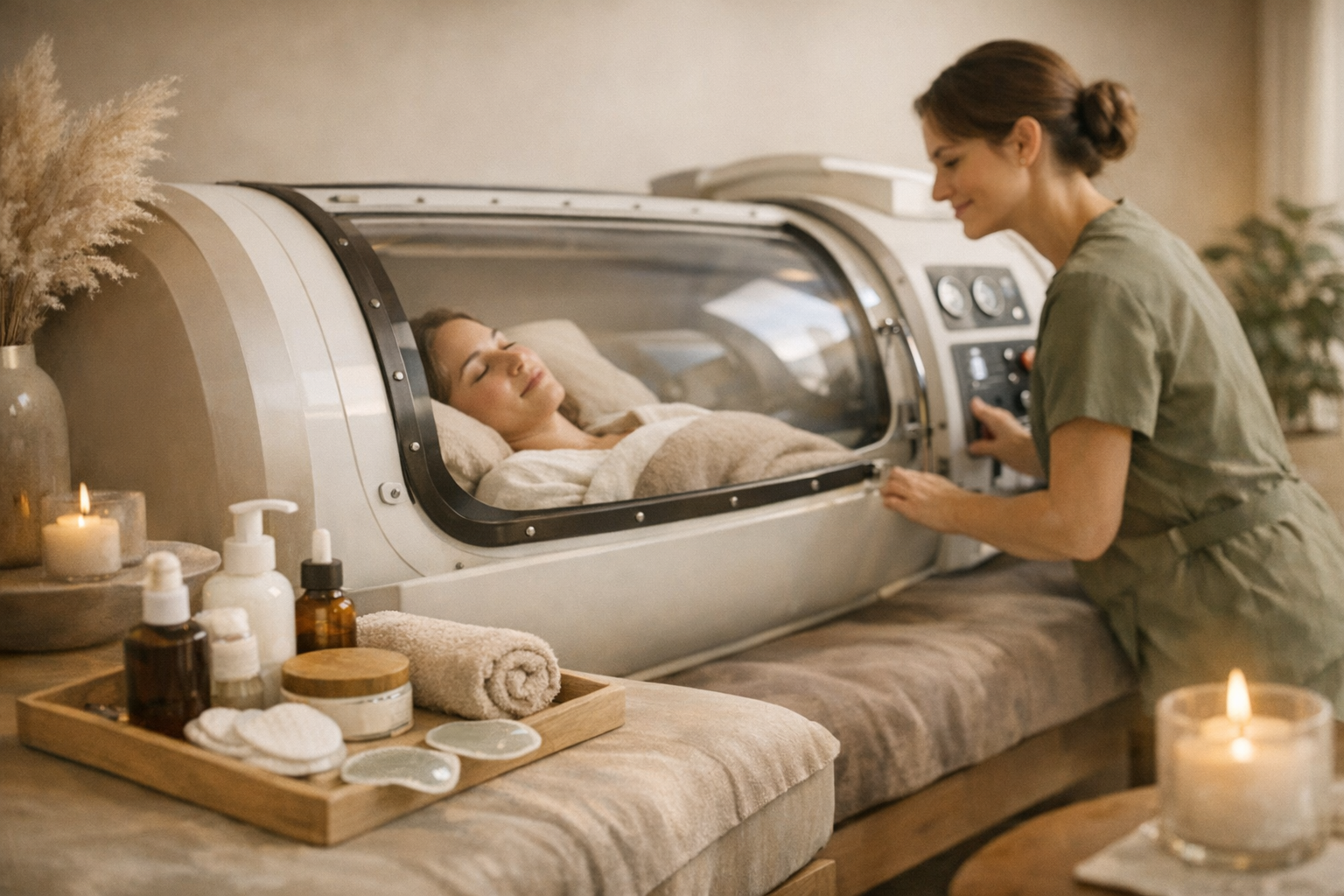
A typical session involves:
- A short pre-check (how you’re feeling, any ear/sinus symptoms)
- Entering the chamber and getting comfortable
- Gradual pressurisation (you’ll feel pressure changes like in a plane; you’ll be guided on ear equalisation)
- Breathing oxygen for a set period, often 60–90 minutes
- Gradual depressurisation
Most people read, listen to audio, or simply rest. After aesthetic treatments, rest is a feature, not a flaw.
Side effects and safety: what to watch for
Most side effects are mild and related to pressure changes:
- Ear discomfort or “blocked” feeling
- Sinus pressure
- Temporary fatigue
Less common risks (typically associated with higher pressures/longer protocols) include oxygen toxicity and vision changes, which is why protocols and screening matter. Always tell your provider if you feel ear pain, dizziness, or anxiety during pressurisation—small adjustments can make a big difference.
How HBOT fits with your post-treatment skincare
Think of HBOT as “internal environment support”, while skincare is your “external barrier support”. You need both.
A sensible post-aesthetic recovery checklist
Always follow your treating clinician’s instructions first. In general, these steps tend to support healing:
- Protect the skin barrier
- Use a gentle, fragrance-free cleanser
- Keep skincare minimal: bland moisturiser, barrier creams as advised
- Avoid harsh actives (retinoids, exfoliating acids) until cleared
- Be serious about UV protection
- Broad-spectrum SPF daily once appropriate
- Physical protection (hat, shade)
- Don’t “pick” the process
- No scratching, rubbing, or peeling flakes early
- Let shedding happen naturally
- Support recovery with basics that actually work
- Prioritise sleep (7–9 hours if possible)
- Hydrate adequately
- Eat protein-rich meals (amino acids support tissue repair)
- Keep alcohol minimal in early healing, as it can impair sleep and fluid balance
- Use heat, exercise, and sauna cautiously
- If your provider advises avoiding overheating or intense exercise for a period, take it seriously—swelling and flushing can increase.
HBOT can complement these steps, but it can’t replace them.
Combining HBOT with other supportive therapies (smart pairing)
At LIVBETTER, clients often ask what pairs well with HBOT post-treatment. Options that may complement recovery—depending on timing and your clinician’s advice—include:
- Red light therapy (photobiomodulation): may support inflammation modulation and tissue repair
- Lymphatic-focused recovery (gentle techniques): may help with swelling in some people
- Breathwork and stress down-regulation: stress chemistry can affect healing; simple practices can help
The key is sequencing: some therapies are best delayed until the skin barrier is stable.
Frequently asked questions
Is HBOT safe after injectables (Botox/fillers)?
Generally, HBOT is not known to “dissolve” fillers or reverse neuromodulators. That said, timing depends on swelling, bruising risk, and your injector’s preferences. If you bruise easily, your clinician may suggest waiting a short period.
Will HBOT prevent pigmentation issues after laser or peels?
It cannot guarantee this. Pigment risk is influenced by skin type, sun exposure, inflammation, and aftercare. HBOT may support a healthier healing environment, but diligent UV avoidance and clinician-guided skincare are the main factors.
Can I do HBOT the same day as my treatment?
Sometimes, yes—particularly if the treatment is earlier in the day and you feel well. However, many people prefer starting within 24–48 hours. Your treating practitioner’s guidance should lead.
How many sessions do I need?
For post-aesthetic recovery, many people explore a short series (often 3–10 sessions) around a treatment. The right number depends on intensity, your skin’s healing patterns, and your schedule.
Will I look “better” immediately after the first session?
Some people feel calmer and less swollen; others mainly notice improved wellbeing (sleep, energy). Skin remodelling still takes time—HBOT supports the biology, not the calendar.
Choosing an HBOT provider: what to look for
HBOT is a medical-grade modality. Look for:
- Proper screening and contraindication checks
- Trained staff who can manage pressure equalisation issues
- Clear protocols and realistic expectations
- Clean, comfortable environment (you’re there to recover)
- Good communication with your aesthetic practitioner when needed
At LIVBETTER, HBOT is offered as part of a broader performance-and-recovery approach—helping busy people stack small, evidence-informed advantages without turning wellness into a second job.
Action plan: a simple way to decide if HBOT is right for you
If you’re considering HBOT for skin repair after an aesthetic treatment, use this quick framework:
- Rate your treatment intensity
- Mild: minimal downtime expected
- Moderate: visible redness/swelling for several days
- High: deeper resurfacing or significant tissue disruption
- Review your healing history
- Do you stay red longer than others?
- Do you swell significantly?
- Do you have a demanding schedule that makes downtime stressful?
- Choose a conservative protocol
- Consider 1–2 sessions to see how you respond, then expand if helpful
- Keep your fundamentals consistent
- Sleep, protein, hydration, and sun protection are non-negotiables
- Coordinate
- Tell your aesthetic clinician you’re considering HBOT
- Choose a provider that screens you properly
Final thoughts
Aesthetic treatments can be a great tool—but the recovery window is where your results are protected, refined, and stabilised. HBOT is one of the more science-aligned options for supporting tissue oxygenation and recovery, particularly after higher-intensity procedures.
If you’re curious, think of HBOT as a supportive layer: not a replacement for good aftercare, but a structured way to help your body do what it’s already trying to do—repair, rebuild, and settle.
If you’d like guidance on whether HBOT fits your treatment plan, LIVBETTER can help you map a recovery schedule that’s realistic, safe, and aligned with your skin goals.
Next Steps
Want to learn more? Check out these articles:
HBOT for Skin Repair After Aesthetic Treatments: A Clinician’s Guide
HBOT and Compression Therapy for Recovery: A Practical Guide
HBOT Recovery Routines After Treatments: A Practical Guide
Check out our Therapies to see which options fit your goals.