
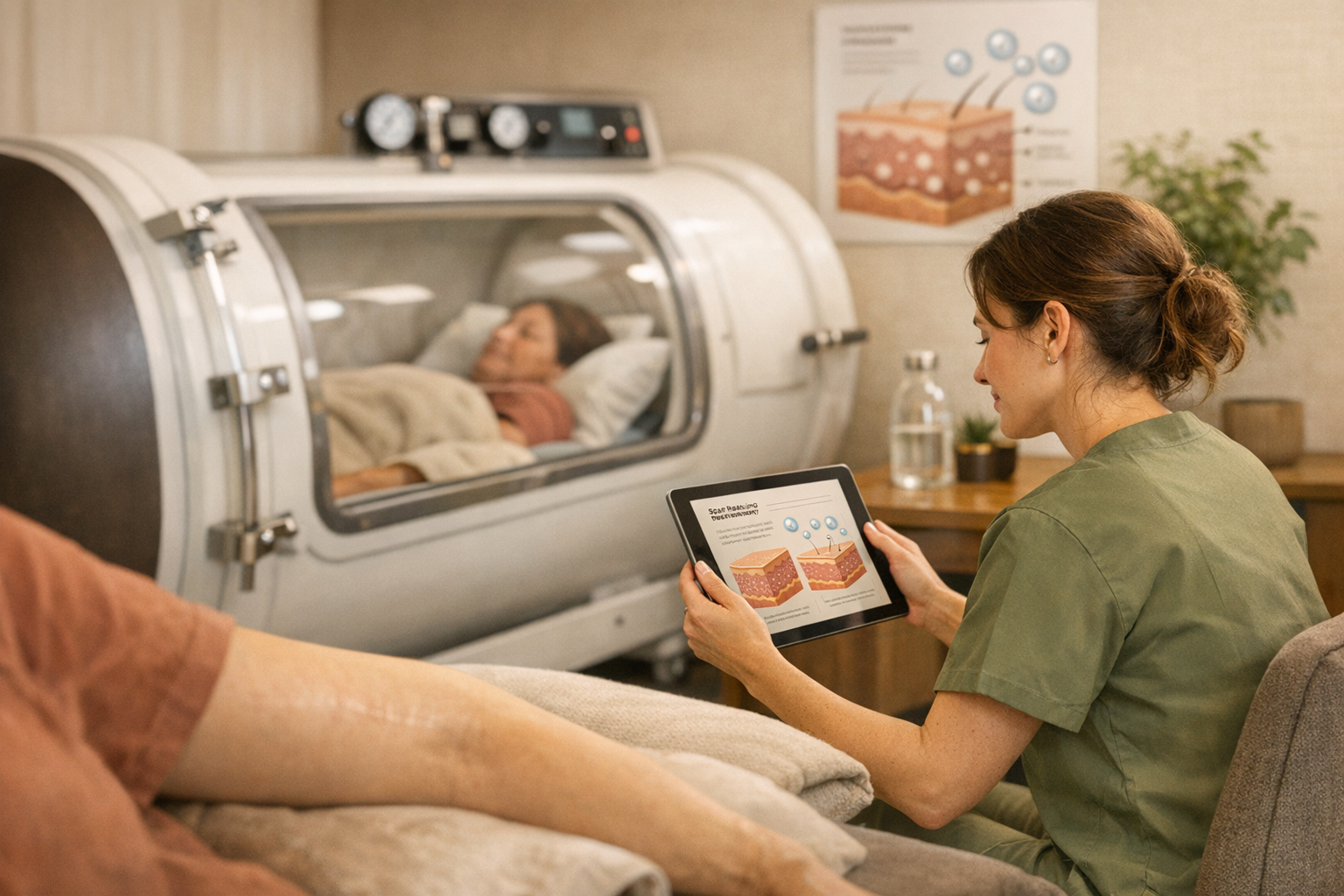
HBOT for Scar Recovery Support: A Science-Backed Guide
Introduction
Most scars fade quietly into the background. Others stay “loud” — raised, tight, itchy, sensitive, or simply more visible than you expected. If you’ve ever wondered why two people can have similar injuries yet heal so differently, you’re not alone. Scar recovery is influenced by oxygen supply, blood flow, inflammation, skin tension, infection risk, genetics, and even sleep and stress.
Hyperbaric oxygen therapy (HBOT) is best known in medical settings for supporting wound healing in specific situations. But it’s increasingly being discussed as an option for scar recovery support — especially when healing feels slow, tissue is struggling, or you want to optimise the conditions that help skin repair well.
In this guide, we’ll explain what HBOT is, how scar tissue forms, what the science suggests HBOT may do for healing tissues, who it may (and may not) suit, and what you can do day-to-day to support better scar outcomes. Consider this your clinically grounded, practical starting point.
First principles: what a scar actually is
A scar is not “failed healing”. It’s the body’s fast, functional repair strategy. When skin (or deeper tissue) is injured, your body prioritises closing the gap, preventing infection, and restoring basic strength — often at the expense of perfect texture and colour match.
The phases of wound healing (and where scars are made)
Scar formation is tied to a normal, staged healing process:
- Haemostasis (minutes to hours): clotting and sealing the wound.
- Inflammation (days): immune cells clear debris and reduce infection risk. Swelling, heat and tenderness are common.
- Proliferation (days to weeks): new tissue forms. Fibroblasts lay down collagen, and new blood vessels grow (angiogenesis).
- Remodelling (weeks to months): collagen reorganises and strengthens, and the scar gradually matures.
If these phases are disrupted — for example, by poor oxygen delivery, infection, excessive tension, repeated trauma, smoking, uncontrolled blood glucose, or certain medications — scars may be more noticeable, stiff, or slow to settle.
Different scar types respond differently
It helps to name what you’re dealing with:
- Flat, pale scars: common after minor wounds; usually improve over time.
- Hypertrophic scars: raised, red scars that stay within the original wound edges; often improve but can remain thick or itchy.
- Keloid scars: raised scars that extend beyond the original wound; more common in some skin types and body areas.
- Atrophic scars: indented scars (e.g., some acne scars) caused by loss of underlying collagen.
- Contracture scars: can tighten the skin and restrict movement, often after burns.
HBOT isn’t a “scar eraser”. If a scar is mature and stable, other modalities (like silicone, laser, microneedling, or steroid injections for hypertrophic/keloid scars) may be more directly targeted. Where HBOT can be relevant is earlier in the healing journey, or when tissue quality is compromised and needs support.
What is HBOT, in plain English?
Hyperbaric oxygen therapy involves breathing oxygen in a pressurised chamber. Under increased pressure, more oxygen dissolves into your blood plasma. This can raise oxygen availability in tissues — including areas where circulation is reduced or healing demands are high.
Why oxygen matters for tissue repair
Oxygen isn’t just “nice to have” for healing; it’s a core ingredient. Adequate oxygen supports:
- Collagen synthesis: oxygen-dependent steps are needed to stabilise new collagen fibres.
- Angiogenesis: growth of new micro-blood vessels to nourish healing tissue.
- Immune function: certain bacteria-killing mechanisms in white blood cells depend on oxygen.
- Energy production: cells involved in repair are metabolically active and need fuel.
In a simplified way: if your healing tissue is “under-oxygenated”, it may struggle to remodel smoothly and robustly.
How HBOT may support scar recovery
HBOT is not primarily marketed as a cosmetic scar treatment, and it’s important to keep expectations realistic. That said, there are plausible, evidence-informed reasons it may support the environment in which a better-quality scar can form — especially when healing is at risk.
1) It may improve oxygen delivery to vulnerable tissue
Following surgery, trauma, or burns, local swelling and microvascular damage can reduce oxygen delivery. HBOT increases dissolved oxygen in plasma, which can diffuse into tissues even when blood flow is not perfect. This is one of the core reasons HBOT is used in certain wound-care pathways.
2) It may support new blood vessel growth
Angiogenesis is critical during the proliferation phase of healing. Some research suggests HBOT can stimulate processes involved in neovascularisation, potentially helping tissues transition from a fragile, inflamed state to a more stable, nourished one.
3) It may modulate inflammation (without “switching it off”)
Inflammation is necessary — but prolonged or dysregulated inflammation can contribute to thicker, more symptomatic scars. HBOT has been studied for its effects on inflammatory signalling and oxidative stress balance. The goal is not to eliminate inflammation, but to help it resolve in a timely way as healing progresses.
4) It may support infection control in specific situations
For wounds at higher risk of infection or with impaired healing, improved tissue oxygenation can support immune function and may help certain antibiotics work more effectively. Infection and prolonged wound breakdown are both associated with poorer scar outcomes.
5) It may support the “quality” of healing, not just speed
People often focus on how fast a wound closes. Clinically, we also care about the strength, flexibility, comfort, and long-term appearance of the healed tissue. By supporting collagen formation, vascular health, and inflammation resolution, HBOT may help create better conditions for scar maturation.
Important note: evidence is strongest for HBOT in defined medical indications (for example, certain non-healing wounds, radiation-injured tissue, compromised grafts/flaps). For general scar optimisation, the evidence base is emerging and outcomes vary by scar type, timing, and the individual’s health factors. A good clinician will help you decide whether HBOT is relevant to your specific situation.
When HBOT may be considered for scar recovery support
HBOT is most rational when your scar is connected to a healing process that is challenged — not simply when you dislike the look of a mature scar. Situations where HBOT may be discussed include:
- Post-surgical recovery where tissue is slow to settle or swelling is persistent (under clinical guidance).
- Traumatic wounds with bruising, crush injury, or compromised microcirculation.
- Burn recovery, particularly when contracture risk and tissue quality are concerns.
- Skin grafts or flaps that need optimal oxygenation to integrate (a well-established medical use case).
- People with risk factors for impaired healing (e.g., smokers, diabetes, vascular issues) — as part of a broader plan, and only when clinically appropriate.
Timing can matter. Many supportive strategies have the biggest impact when applied during active healing and early remodelling. If your scar is many years old, you may get more noticeable change from targeted scar therapies, while HBOT may play a smaller role.
What an HBOT course can look like (and what it feels like)
Protocols vary depending on goals and clinical context, but HBOT is typically delivered as a series of sessions rather than a one-off.
During a session
- You’ll be in a pressurised chamber breathing oxygen.
- You may feel pressure changes in your ears similar to take-off/landing on a flight; staff will guide you on equalising comfortably.
- Sessions commonly last around 60–90 minutes depending on the protocol.
- Most people read, listen to audio, or simply relax.
How many sessions might be used?
For medical wound indications, courses can range from 10 to 40 sessions depending on severity and response. For scar recovery support outside acute medical indications, the appropriate number should be decided case-by-case, with progress reviews built in. At LIVBETTER, the emphasis is on measured, goal-oriented plans rather than open-ended schedules.
Safety, suitability, and when HBOT isn’t the right tool
HBOT is generally well-tolerated when properly screened and delivered by trained professionals, but it is not for everyone.
Common considerations and potential side effects
- Ear/sinus pressure discomfort: the most common issue; usually manageable with technique and pacing.
- Temporary vision changes: can occur in longer courses; typically resolves after the course ends.
- Fatigue or light-headedness: occasionally reported, often mild.
Who needs careful screening
You should be assessed for contraindications and risk factors, which may include (not exhaustive):
- Untreated pneumothorax (a key absolute contraindication).
- Significant lung disease or a history of certain thoracic issues.
- Seizure disorders (requires careful risk assessment).
- Ear problems or inability to equalise pressure.
- Pregnancy (HBOT is used in specific medical contexts, but elective use requires specialist input).
- Claustrophobia (often manageable, but worth discussing in advance).
If your scar concern is primarily pigment change, minor textural variation, or a long-healed flat scar, you may be better served by topical scar care, laser, or other dermatology-led options. HBOT works best when there is a meaningful physiological reason to increase tissue oxygenation.
What you can do at home to support scar quality (evidence-informed)
HBOT can be a helpful adjunct for the right person, but the basics still do most of the heavy lifting. These are simple, high-impact actions that support scar maturation.
1) Respect the timeline: scars can take 6–18 months to mature
Early scars are often red, raised, or firm because collagen is being laid down and reorganised. With time, many scars flatten and fade. Try not to judge the “final result” too early.
2) Use silicone (when the wound is closed)
Silicone gel or silicone sheets are among the better-supported over-the-counter options for hypertrophic scar prevention and symptom reduction. They work best with consistent use over weeks to months. Apply only to fully closed skin, and follow product guidance.
3) Protect from UV exposure
UV can worsen discolouration and make scars more noticeable. Practical approach:
- Cover the scar when possible.
- Use a broad-spectrum SPF 30–50 on exposed areas daily.
4) Gentle massage and mobility (when appropriate)
Once the wound has closed and your clinician confirms it’s safe, gentle scar massage may help with pliability and sensitivity, especially for tighter scars. If a scar crosses a joint, guided mobility can reduce stiffness and protect function. If you’ve had surgery, follow your post-op guidance carefully.
5) Support protein intake and key micronutrients through food
Healing requires building blocks. Aim for balanced meals with:
- Protein (e.g., eggs, yoghurt, fish, poultry, tofu, legumes)
- Vitamin C (peppers, citrus, berries, broccoli)
- Zinc (seafood, meat, beans, nuts)
Supplements are not automatically necessary; targeted supplementation can be considered if dietary intake is low or a clinician identifies a deficiency.
6) Sleep and stress: underrated scar-support tools
Poor sleep and chronic stress can impair immune function and tissue repair. Two realistic steps that help many busy people:
- Set a consistent “wind-down cue” (same time, dim lights, no work tabs for 20 minutes).
- Keep caffeine earlier (many people sleep better when caffeine stops by late morning).
How to decide if HBOT belongs in your scar plan
If you’re considering HBOT for scar recovery support, a good decision process looks like this:
Step 1: Clarify the goal
- Is the goal comfort (itch, pain, sensitivity)?
- Function (tightness, reduced movement)?
- Quality of healing after surgery/trauma?
- Appearance (texture/colour) of an established scar?
HBOT tends to make most sense when the goal is supporting tissue recovery and healing quality rather than changing the appearance of a mature scar in isolation.
Step 2: Identify “healing risk” factors
HBOT is more likely to be considered if any of the following apply:
- Delayed healing or recurrent breakdown
- Compromised circulation
- Significant swelling and bruising after trauma
- History of problematic scarring with previous wounds
- Smoking/vaping (even temporarily affects microcirculation)
- Metabolic factors (e.g., blood glucose control)
Step 3: Combine therapies intelligently
Scar recovery is rarely one-dimensional. Depending on your scar type and stage, HBOT may be paired with:
- Silicone gel/sheets
- Physiotherapy for mobility and tissue function
- Dermatology treatments (e.g., laser for redness, microneedling for texture)
- Clinician-led scar injection for selected hypertrophic/keloid scars
Think of HBOT as a tool that may improve the tissue “terrain”, while other therapies address the surface characteristics and mechanics of the scar.
What to expect realistically
With any scar-support plan, realistic expectations are a form of self-care. Even with excellent treatment, scars rarely disappear completely. The aim is typically one or more of the following:
- Better comfort (less tight/itchy/tender)
- Improved pliability and function
- Healthier healing trajectory after surgery or injury
- Gradual improvement in redness and texture as the scar matures
Progress is often incremental. Photos taken in consistent lighting every 2–4 weeks can help you notice changes that are easy to miss day-to-day.
HBOT at LIVBETTER: a modern, measured approach
At LIVBETTER, HBOT is positioned as part of a broader performance-oriented recovery toolkit. If you’re exploring HBOT for scar recovery support, we focus on:
- Proper screening for safety and suitability
- Clear goals (comfort, function, recovery quality)
- Progress reviews to keep plans efficient and evidence-informed
- Foundations first (sleep, nutrition, stress load, and smart scar care)
If you’re unsure whether your scar concern is best suited to HBOT, a consult can help you map the most logical next step — even if that means a different modality is more appropriate.
Key takeaways
- Scars are a normal part of healing, influenced by oxygen delivery, inflammation, tension, and overall health.
- HBOT increases oxygen availability in tissues and is used in specific clinical scenarios to support healing.
- For scar recovery support, HBOT may be most relevant when healing is compromised or tissue quality needs extra support (e.g., post-trauma, burns, grafts/flaps, high-risk healing).
- Scar outcomes improve most when HBOT is paired with fundamentals: silicone (once closed), UV protection, gentle mobilisation, good nutrition, sleep, and stress management.
- The best results come from realistic expectations and an individualised plan.
Frequently asked questions
Does HBOT remove scars?
HBOT does not “remove” scars. It may support the healing environment, which can contribute to better scar maturation in certain contexts. For established scars, targeted dermatology treatments are often more directly effective.
When is the best time to consider HBOT?
HBOT is typically most relevant during active healing and early remodelling, or when there are signs tissue is struggling (slow healing, compromised circulation, complex trauma). Your clinician can advise on timing based on your wound and overall health.
Can I do HBOT alongside silicone gel or sheets?
In many cases, yes — they work through different mechanisms. Silicone supports the surface environment of the scar, while HBOT supports oxygen delivery and tissue physiology. Always ensure the skin is fully closed before applying topical scar products.
Is HBOT safe?
For most appropriately screened people, HBOT is well-tolerated. The most common issue is ear pressure discomfort. A proper medical screening is essential to rule out contraindications and tailor the plan.
What should I do if my scar is getting more raised, itchy, or spreading?
If a scar is becoming progressively raised, very itchy, painful, or extending beyond the wound edges, it’s worth getting assessed early. Hypertrophic and keloid scars have specific treatments that can help, and early management can improve comfort and outcomes.
Next Steps
Want to learn more? Check out these articles:
HBOT and Infrared Sauna for Smarter Recovery Planning
HBOT for Travel Recovery: Jet Lag, Sleep and Wellness Reset
HBOT for Recovery Between Demanding Work Weeks [Guide]
Check out our Therapies to see which options fit your goals.