
HBOT for Recovery Between Demanding Work Weeks [Guide]
By Thursday afternoon, your brain feels like it’s running on 12% battery. Your body’s doing that subtle “wired but tired” thing. And even if you’re sleeping, you don’t always feel restored. If that sounds familiar, you’re not alone—many high-performing professionals aren’t lacking discipline; they’re dealing with recovery debt.
In a world of longer workdays, constant notifications, and compressed weekends, the limiting factor often isn’t motivation—it’s physiology. Your nervous system, muscles, connective tissues, and even your cognition need time and resources to repair. When the week is demanding, recovery has to become intentional.
That’s where HBOT (hyperbaric oxygen therapy) comes in. It’s a clinical therapy used in various medical settings, and it’s increasingly being explored in performance and wellness contexts for its potential to support recovery, inflammation balance, and tissue repair processes—without requiring you to overhaul your life.
This guide breaks down what HBOT is, what it may help with between demanding work weeks, what the science suggests (and what it doesn’t), who it’s suitable for, and how to build a realistic recovery routine that fits a busy schedule.
Why modern work creates “recovery debt”
Let’s define the problem clearly. Recovery debt is the gap between what your body needs to restore and what it actually gets. It’s not just about sleep quantity, either. You can get seven hours and still feel flat if your system hasn’t switched out of stress mode.
Common contributors in demanding work weeks include:
- Chronic low-grade stress (deadlines, decision fatigue, constant availability)
- Sleep disruption (late-night screen exposure, travel, alcohol, early starts)
- Sedentary compression (long sitting hours with bursts of intense training)
- Cognitive overload (meetings, multitasking, context switching)
- Inflammation load (stress hormones, poor recovery, inconsistent nutrition)
Over time, recovery debt can show up as:
- Brain fog or slower processing speed
- Reduced exercise performance or persistent soreness
- More frequent headaches
- Irritability or low mood resilience
- Feeling “tired but unable to switch off”
This is where evidence-based recovery tools can be helpful—not as a replacement for fundamentals, but as a strategic support layer.
What is HBOT (hyperbaric oxygen therapy), simply explained?
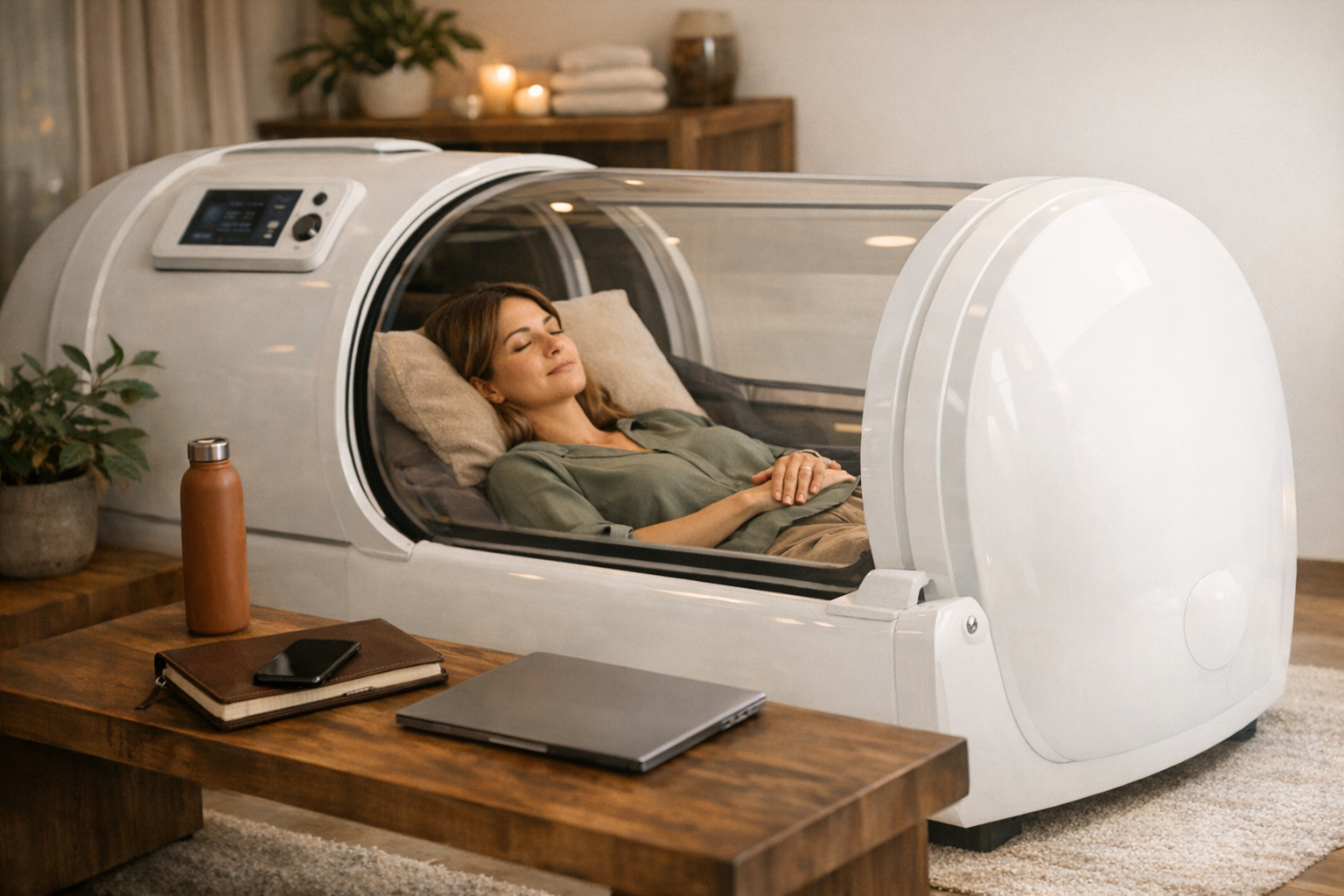
HBOT involves breathing oxygen in a pressurised chamber. The increased pressure allows more oxygen to dissolve into the plasma (the fluid part of blood), which can increase oxygen delivery to tissues.
In practical terms, HBOT may support the body’s recovery environment by:
- Increasing oxygen availability to areas with higher demand
- Supporting tissue repair processes (oxygen is a key input for healing)
- Helping modulate inflammation pathways in certain contexts
- Supporting angiogenesis (formation of new blood vessels) in some protocols
Clinically, HBOT has established uses for specific medical indications (for example, certain wound-healing contexts). In a wellness or performance setting, people often explore it for recovery, fatigue management, and cognitive support—while understanding that responses vary and benefits are rarely “overnight”.
Pressurised oxygen vs “oxygen bars”
HBOT is not the same as inhaling oxygen at normal pressure. The key mechanism is the combination of oxygen plus increased atmospheric pressure, which changes how much oxygen can be transported in the blood plasma. That’s why HBOT is delivered in a chamber with clinical protocols and safety screening.
HBOT for recovery between demanding work weeks: where it may fit
If your week is intense and your weekend is short, you want recovery inputs that are:
- Time-efficient
- Low-effort (you can literally lie down)
- Compatible with training rather than competing with it
- Supportive of both body and brain
HBOT can be considered as one tool within a comprehensive recovery plan, particularly for people who:
- Train hard while working long hours
- Travel frequently or experience disrupted sleep routines
- Feel persistently “run down” despite reasonable habits
- Need sharper mental performance early in the week
At LIVBETTER, we tend to view advanced therapies like HBOT the way a good clinician would: not as a magic bullet, but as a supportive lever when the basics are already being addressed—or when life temporarily makes the basics harder.
The science: what HBOT may support (and what to be cautious about)
It’s important to set realistic expectations. Research on HBOT spans many medical and performance-related areas. However, outcomes depend heavily on the protocol (pressure, oxygen concentration, session length, number of sessions) and the person’s baseline health, sleep, stress load, and training demands.
1) Tissue oxygenation and repair support
Oxygen is a critical resource for tissue repair. By increasing oxygen availability, HBOT may support the physiological processes involved in recovery—particularly when tissues are under strain.
This is one reason HBOT is used in specific clinical scenarios. In a workweek recovery context, the question becomes: can increased oxygen availability support your body’s “reset” between Monday and Monday? For some people—especially those juggling training with high workloads—it may be a useful adjunct.
2) Exercise recovery and soreness
Some people explore HBOT for post-training recovery, especially when they’re stacking strength sessions, endurance work, and long sedentary desk hours (a combination that can leave hips, lower back, and neck feeling perpetually tight).
What to expect realistically:
- You may feel more “recovered” subjectively after sessions, but experiences vary.
- HBOT is not a substitute for smart programming, mobility, and adequate protein.
- It may be most useful when used consistently across a period of heavy load.
3) Inflammation balance and stress physiology
Inflammation isn’t the enemy—it’s part of normal adaptation. But chronic, poorly resolved inflammation can contribute to fatigue, aches, and that dull “not quite right” feeling.
HBOT has been studied for its effects on inflammatory signalling in various contexts. In a demanding workweek scenario, the goal isn’t to “switch inflammation off”; it’s to support a healthier recovery cycle so you can train, work, and sleep with more ease.
4) Cognitive performance and mental clarity
People often ask about HBOT and brain function—particularly when they feel mentally sluggish after long weeks. Oxygen availability and cerebral blood flow are relevant to cognition, and there is growing interest in how hyperbaric exposure may influence neurological function and recovery processes.
That said:
- Not everyone notices a cognitive change.
- Benefits, when they occur, may be subtle and cumulative rather than dramatic.
- It’s still essential to address the core cognitive stressors: sleep, screens, workload design, and breaks.
What HBOT is unlikely to do
To keep this grounded, HBOT is unlikely to:
- Override chronic sleep deprivation
- Fix burnout without workload boundaries
- Replace strength training, nutrition, hydration, or physiotherapy where needed
- Provide instant, guaranteed outcomes after one session
Think of HBOT as a potential recovery amplifier—useful, but not a free pass.
Who might benefit most from HBOT between work weeks?
HBOT tends to be explored by people with high recovery demands and limited recovery time. You might be a good candidate if:
- You have periods of intense workload (project deadlines, quarter-end, shift work)
- You combine work stress with high training volume
- You experience persistent muscle fatigue and feel you’re not bouncing back
- You value structured, clinic-based recovery that doesn’t rely on willpower
It may be particularly attractive if your weekends are packed and you want a recovery tool that doesn’t require you to “do more”.
Who should be cautious or seek medical advice first
HBOT is generally safe when properly delivered with screening and supervision, but it isn’t for everyone. You should discuss suitability with a qualified clinician, particularly if you have:
- Uncontrolled respiratory conditions or severe asthma
- Ear or sinus issues that make pressure changes difficult
- Certain lung conditions (your provider will screen for risk factors)
- Claustrophobia (many people do fine with support, but it’s worth mentioning)
At LIVBETTER, a proper consultation and safety screening is the baseline. A high-performance mindset should always include high standards.
What a typical HBOT session feels like
If you’re imagining something intimidating, most people find it surprisingly straightforward.
A session typically includes:
- Pre-check and briefing (comfort, contraindications, what to expect)
- Pressurisation phase (you may feel pressure in the ears, similar to flying)
- Time in the chamber breathing oxygen at the prescribed pressure
- Decompression and post-session check
Most people use the time to relax—listening to an audiobook, meditating, or simply switching off. That “forced pause” can be a meaningful part of recovery in itself.
Common, normal sensations
- Ear pressure that resolves with swallowing/yawning
- A calming, slightly sleepy feeling during or after
- Occasional mild fatigue post-session (some people prefer evening sessions)
Your provider should guide you on what’s normal and what isn’t.
How to use HBOT strategically during heavy work periods
For recovery between demanding work weeks, consistency and timing matter more than a one-off session. Here are practical, realistic ways to integrate it.
Option A: “Sunday reset” for Monday readiness
If Mondays hit hard, consider using HBOT towards the end of the weekend to support a sense of reset.
- Best for: people who feel depleted by Sunday evening
- Pair with: early night, hydration, simple meal prep
Option B: Midweek recovery to stop the slide
If Wednesday is when you start to fray, a midweek session may help you feel more resilient across the back half of the week.
- Best for: high-output weeks, heavy training blocks, frequent travel
- Pair with: light mobility and an earlier wind-down
Option C: Short course during peak load
During exceptionally demanding periods (launches, events, exams, intense travel), some people choose a short course of sessions. The idea is to support recovery while load is high, rather than waiting until you’ve already crashed.
Your clinician should advise the right protocol for your goals and schedule.
Your “between work weeks” recovery stack (simple, science-led)
HBOT works best when it’s part of a broader recovery system. Here’s a practical stack you can implement without turning your life into a wellness project.
1) Protect sleep like a meeting with your most important client
Sleep is still the master recovery tool. If you do nothing else, do this:
- Set a consistent wake time (even on weekends)
- Get 10–20 minutes of outdoor light in the first hour of the day
- Cut caffeine 8 hours before bed if sleep is fragile
- Keep the bedroom cool, dark, and quiet
2) De-load your nervous system daily (10 minutes)
When work is intense, your body may stay in a sympathetic (“go mode”) state. Try one:
- Physiological sighs for 2–3 minutes
- Box breathing (4-4-4-4) for 5 minutes
- NSDR (non-sleep deep rest) for 10 minutes
Small, consistent downshifts add up—especially if you’re relying on willpower to keep performing.
3) Train for recovery, not punishment
If you’re already under work stress, your training should be intelligently dosed.
- Include at least 1 lower-intensity session per week
- Avoid stacking multiple maximal days when sleep is compromised
- Prioritise mobility and posterior chain work if you sit a lot
If you use HBOT, it can complement training recovery—but it can’t compensate for pushing your nervous system into the ground.
4) Eat for stability (not perfection)
Between demanding work weeks, the goal is steady energy and adequate building blocks.
- Aim for protein at each meal (to support muscle repair)
- Build meals around fibre-rich plants for gut and metabolic health
- Hydrate consistently; add electrolytes if you sweat heavily or travel often
If your nutrition is chaotic Monday–Friday, even a calm, structured Saturday and Sunday can make Monday feel more manageable.
HBOT vs other recovery tools: how to choose
People often ask whether HBOT is “better than” other therapies. In reality, it depends on what you’re trying to support.
HBOT may be a good fit if you want:
- A passive recovery session that supports tissue oxygenation
- A structured protocol during high-load weeks
- Support for overall recovery alongside training and stress management
You might prioritise other options if your main issue is:
- Muscle tightness and movement limitation: physiotherapy, sports massage, targeted mobility
- Stress overload and poor sleep: CBT-I strategies, breathwork, evening routine redesign
- Low fitness base: zone 2 cardio and progressive strength training
At LIVBETTER, we often find the best outcomes come from a blended plan: fundamentals first, then targeted therapies like HBOT where appropriate.
How to know if HBOT is working for you
Because the effects can be subtle, it helps to track a few meaningful markers for 2–4 weeks.
Simple markers (no gadgets required)
- Morning energy (1–10)
- Perceived muscle soreness (1–10)
- Afternoon slump frequency
- Sleep quality and ease of falling asleep
- Mood resilience under pressure
If you like data
- Resting heart rate and HRV trends
- Sleep duration and awakenings
- Training readiness scores (if you use a wearable)
The goal isn’t perfection—it’s noticing whether your baseline shifts in a positive direction.
A realistic “recovery weekend” plan for busy professionals
If your weeks are demanding, your weekends need to restore rather than just entertain. Here’s a simple template you can adapt.
Saturday
- Morning: easy movement (walk, light cycle, mobility)
- Midday: social time or errands (keep it enjoyable)
- Evening: screen-light reduction + protein-forward dinner
Sunday
- Morning: outdoor light + hydration
- Midday: HBOT session (if you’re using it as a reset)
- Afternoon: 60 minutes “life admin” to reduce Monday stress
- Evening: early wind-down and a consistent bedtime
This isn’t about being rigid. It’s about creating just enough structure that Monday doesn’t feel like a shock to the system.
Where LIVBETTER fits in
LIVBETTER exists for people who want high standards in their health without turning wellness into a second job. If you’re considering HBOT for recovery between demanding work weeks, we can help you:
- Understand whether HBOT is appropriate for your goals
- Choose a sensible protocol and schedule
- Combine advanced therapies with realistic nutrition and recovery practices
We’ll always prioritise safety, evidence, and a plan that fits your actual life—not an idealised one.
Key takeaways
When work is intense, recovery has to be planned—otherwise you end up borrowing energy from next week.
- HBOT involves breathing oxygen in a pressurised chamber, which increases oxygen availability in the body.
- It may support recovery by helping create conditions favourable for tissue repair and inflammation balance, and some people report benefits in energy and clarity.
- It works best as part of a comprehensive plan including sleep, stress downshifts, intelligent training, and stable nutrition.
- Results are individual and tend to be cumulative rather than instant.
If you’re navigating demanding work weeks and want a practical, science-led way to support recovery, HBOT may be a worthwhile option to explore—especially when paired with a few simple habits that keep your physiology on your side.
Next Steps
Want to learn more? Check out these articles:
HBOT and Sleep Quality During Recovery: What Science Suggests
HBOT for Injury Recovery Support: What to Expect
HBOT for Skin Repair and Wellness Recovery: What to Expect
Check out our Therapies to see which options fit your goals.