
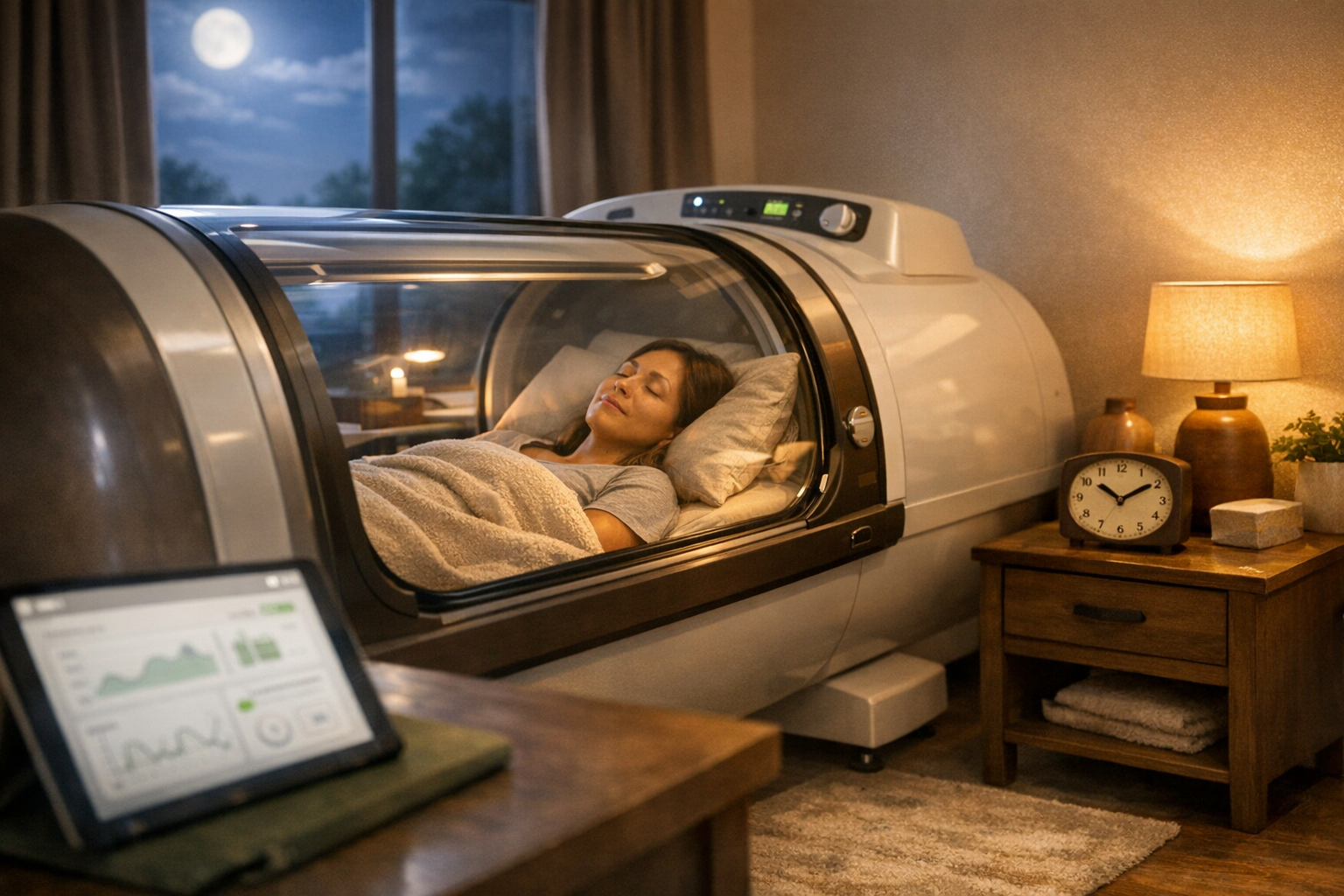
HBOT and Sleep Quality During Recovery: What Science Suggests
Sleep is when recovery actually happens. Training adaptations consolidate. Tissue repair accelerates. The nervous system downshifts. And yet, when you’re under physical or mental load—post-injury, post-competition, after surgery, or simply in a high-stress season—sleep can become frustratingly fragile. You might feel exhausted but wired, fall asleep quickly then wake at 3 am, or track “enough hours” yet still wake unrefreshed.
This is where people start asking smarter questions than “How do I sleep more?” A better question is: “How do I improve sleep quality while my body is recovering?” One therapy that often comes up in performance and recovery circles is hyperbaric oxygen therapy (HBOT). It’s well-established in certain medical settings, and it’s increasingly used to support recovery and resilience. But can HBOT influence sleep quality?
In this article, we’ll unpack what HBOT is, the physiological links between oxygen, inflammation, and sleep, what the research suggests (and what it doesn’t), and how to think about HBOT as part of a comprehensive recovery plan—alongside practical sleep strategies you can start tonight.
What is HBOT (and what does it actually do)?
Hyperbaric oxygen therapy (HBOT) involves breathing oxygen in a pressurised chamber. Under increased atmospheric pressure, more oxygen dissolves into the blood plasma, which can increase oxygen delivery to tissues. Clinically, HBOT has established uses for specific conditions (for example, decompression sickness and certain hard-to-heal wounds), and it’s being studied in wider recovery contexts.
At a basic level, HBOT may support recovery by influencing a few key biological processes:
- Tissue oxygenation: Higher oxygen availability can support cellular energy production (ATP) and tissue repair processes.
- Inflammation signalling: Oxygen levels can influence inflammatory pathways; in some contexts HBOT is associated with shifts in inflammatory markers.
- Blood vessel and tissue responses: Research explores HBOT’s effects on angiogenesis (new blood vessel formation) and wound healing cascades.
- Oxidative balance: HBOT can transiently increase reactive oxygen species; paradoxically, this may trigger adaptive antioxidant responses in the body (a hormetic effect) in certain protocols.
None of this automatically guarantees better sleep. But it does map onto the biology of recovery—and sleep is one of the most sensitive readouts of recovery status.
Why sleep quality often drops during recovery
If you’ve ever slept poorly during a period of healing, it’s not in your head—though your brain is certainly involved. Recovery can disrupt sleep through multiple channels:
- Pain and discomfort: Even mild pain can fragment sleep and reduce deep sleep continuity.
- Inflammation and immune activity: Inflammatory signalling can change sleep architecture. Acute inflammation often increases sleepiness, but ongoing inflammation may lead to more fragmented sleep.
- Stress load and hyperarousal: Injury, time off training, work demands, and uncertainty can elevate cortisol and sympathetic nervous system activity.
- Reduced daytime movement: Less physical activity can lower sleep drive and shift circadian timing.
- Medication effects: Some pain medications can suppress REM sleep or alter sleep stages.
In other words, sleep quality during recovery is not just about “good habits”—it’s physiology meeting real-life pressure.
The physiological link: oxygen, inflammation, and sleep
To understand why HBOT might influence sleep, it helps to know what regulates sleep quality beyond routines.
1) Sleep and the autonomic nervous system
High-quality sleep generally requires a shift towards parasympathetic (rest-and-digest) dominance. When you’re injured, stressed, or inflamed, your system may stay in a more sympathetic (fight-or-flight) state—making sleep lighter and more easily disrupted. Anything that supports downregulation, comfort, and perceived safety may help sleep quality indirectly.
2) Sleep and inflammatory signalling
Sleep and inflammation are a two-way conversation. Poor sleep can raise inflammatory markers, and inflammation can, in turn, impair sleep continuity. This is one reason sleep often worsens during intense training blocks or after injury.
HBOT is being studied for its potential to modulate inflammation in certain contexts. If a protocol reduces excessive inflammatory signalling for an individual, that could plausibly support better sleep. The key word is “could”—because not every type of inflammation is the same, and individuals respond differently.
3) Sleep and oxygenation
Breathing and oxygen status do affect sleep. Obstructive sleep apnoea is the clearest example, where impaired breathing reduces oxygen saturation and fragments sleep. HBOT is not a treatment for sleep apnoea. However, optimising tissue oxygenation during recovery might influence how the body repairs and regulates itself, which may have downstream effects on sleep quality.
What does the research say about HBOT and sleep quality?
The honest answer: the evidence base is emerging, and it’s mixed depending on the population studied and the outcomes measured.
Most HBOT research is not primarily designed to assess sleep. Sleep outcomes are often secondary or observational—meaning we should be careful not to overinterpret. That said, several themes appear in the wider literature and clinical observations:
Theme 1: People sometimes report improved sleep when overall recovery improves
In recovery-focused settings—rehabilitation, post-injury care, persistent symptom management—some individuals report better sleep quality over a course of HBOT sessions. This may reflect reduced discomfort, improved daytime function, or a calmer nervous system rather than a direct “sleep switch” effect.
Theme 2: HBOT can affect fatigue and cognitive function in some contexts
Sleep quality is tightly linked with fatigue, mental clarity, and mood regulation. Research investigating HBOT for certain post-injury or neurological symptom clusters sometimes includes fatigue and quality-of-life measures. Where those measures improve, sleep often improves too—but causality is hard to establish.
Theme 3: Timing and individual response matter
Some people feel deeply relaxed after a session. Others feel energised. Both can be “normal” depending on the person, their baseline stress state, and the protocol. This matters for sleep: a session that leaves you alert at 8 pm may not be ideal if you’re aiming for an early bedtime.
Clinical takeaway: HBOT may support sleep quality during recovery for some people, but it’s best framed as a therapy that supports recovery physiology, with sleep as a potential downstream benefit—rather than a standalone sleep treatment.
HBOT vs “mild hyperbaric” and other oxygen approaches
You might see a range of terms used online: hyperbaric therapy, mild hyperbaric oxygen, oxygen chambers. The details matter because pressure and oxygen concentration influence the biological effect.
- Medical-grade HBOT typically uses higher pressures and controlled oxygen delivery protocols in clinical settings.
- Mild hyperbaric may use lower pressures; experiences and outcomes can differ and are not interchangeable with the clinical HBOT evidence base.
At LIVBETTER, the key principle is clarity: the protocol should match your goal, your health status, and your recovery timeline. If sleep quality is your priority, we look at the whole picture—training load, stress physiology, pain, circadian rhythm, and daytime energy patterns—so the plan is coherent rather than random.
How HBOT might support sleep during recovery (realistic mechanisms)
Let’s translate the physiology into practical, realistic pathways. HBOT may support sleep quality during recovery by:
- Supporting tissue repair: If pain and discomfort reduce, sleep continuity often improves.
- Influencing inflammatory balance: In some cases, shifting excessive inflammatory signalling can reduce nighttime restlessness.
- Improving daytime function: Better energy and clearer cognition can reduce late-day napping and help rebuild sleep drive.
- Creating a “recovery ritual”: A structured recovery intervention can reduce perceived stress and improve behavioural consistency (both sleep-friendly).
Important caveats:
- HBOT is not a replacement for addressing sleep-disordered breathing, insomnia patterns, or mental health drivers of poor sleep.
- More is not always better; protocols should be individualised.
- Some people may feel temporarily stimulated after HBOT, which can affect bedtime timing.
Who might consider HBOT when sleep is affected by recovery?
HBOT may be worth discussing with a clinician if your sleep quality is suffering in the context of recovery such as:
- Post-injury rehabilitation where discomfort, swelling, or persistent symptoms are affecting rest
- High training load or competition blocks where recovery capacity is stretched and sleep fragmentation appears
- Post-procedure recovery when sleep disruption is linked to healing demands (always with medical clearance)
- High-stress professionals combining cognitive load, travel, and inconsistent routines—where sleep quality falls as resilience drops
HBOT is not suitable for everyone. Certain conditions (for example, untreated pneumothorax) are contraindications, and you should be screened appropriately. If you’re pregnant, have specific ear/sinus issues, or have concerns about oxygen exposure, it’s particularly important to seek clinical guidance.
Practical: how to integrate HBOT with a sleep-first recovery plan
If you’re exploring HBOT for recovery and hoping your sleep improves, you’ll get better results by pairing it with a sleep strategy that targets the fundamentals. Here’s a pragmatic framework.
Step 1: Choose a clear sleep metric (not just hours)
Pick one primary indicator for 2–3 weeks:
- Time to fall asleep (sleep onset latency)
- Number of awakenings
- Time awake after sleep onset
- Morning refresh score (0–10)
Wearables can help, but your subjective morning rating is often the most meaningful.
Step 2: Align HBOT timing with your nervous system
People respond differently. Consider:
- If you feel relaxed post-session: late afternoon may support a smoother evening wind-down.
- If you feel energised post-session: morning or lunchtime may be better.
Consistency matters. Changing session times daily can destabilise circadian rhythm in sensitive sleepers.
Step 3: Protect your light environment
Light is the strongest lever for sleep timing.
- Morning: aim for outdoor light exposure within 60 minutes of waking for 5–15 minutes (longer on cloudy days).
- Evening: dim bright overhead lights 2–3 hours before bed; reduce screen glare and consider warm lighting.
Step 4: Use temperature strategically
Core body temperature needs to drop for sleep initiation.
- A warm shower 60–90 minutes before bed can promote a cooling rebound.
- Keep the bedroom cool and well ventilated.
Step 5: Build a “recovery dinner” that supports sleep
Food timing and composition can influence sleep quality. A simple approach:
- Eat your final substantial meal 2–3 hours before bed.
- Include protein and fibre for stable blood sugar.
- If you train late, add a recovery-focused carbohydrate portion to reduce nocturnal wake-ups driven by hunger or stress hormones.
Avoid making alcohol your sleep tool—it may shorten sleep onset but often fragments sleep later in the night.
Step 6: Have a plan for 3 am wake-ups
If you wake and your mind starts working:
- Keep lights low.
- Try 5 minutes of slow nasal breathing (a slightly longer exhale than inhale).
- If you’re awake >20 minutes, get up briefly and do something calm (paper book, gentle stretching) until sleepy.
This reduces the brain’s tendency to associate bed with wakefulness.
What to expect: timelines and realistic outcomes
Recovery interventions rarely deliver a single dramatic shift overnight—especially when sleep is involved. If HBOT is helpful for your sleep quality, improvements often show up as subtle but meaningful changes:
- Fewer awakenings
- Less “wired but tired” feeling at bedtime
- Better morning refresh
- More consistent sleep timing
It’s also normal to have variability. Sleep responds to stress, training load, travel, pain, and hormones. Look for trends over 2–4 weeks rather than judging by one night.
How LIVBETTER approaches HBOT and sleep optimisation
At LIVBETTER, we treat sleep as a performance foundation, not a luxury. If you’re considering HBOT to support recovery and sleep quality, we’ll typically:
- Screen suitability and discuss your recovery context
- Clarify the outcome you care about (sleep continuity, morning energy, late-night waking, etc.)
- Align session timing with your daily schedule and stress profile
- Pair therapy with evidence-based sleep and nutrition fundamentals so the effect isn’t diluted by avoidable habits
HBOT can be a valuable part of a modern recovery toolkit—but it works best when it sits inside an integrated plan: intelligent training (or rehab), smart nutrition, stress regulation, and a sleep environment your nervous system actually trusts.
Frequently asked questions
Can HBOT treat insomnia?
HBOT is not a first-line treatment for insomnia. If your main issue is persistent insomnia, cognitive behavioural therapy for insomnia (CBT-I) is the most evidence-based approach. HBOT may support sleep indirectly if recovery physiology is a driver of your sleep disruption.
Will HBOT make me sleepy?
Some people feel calm or sleepy after a session; others feel alert. Your response can depend on timing, baseline stress, and your recovery state. This is why session scheduling matters.
Is HBOT safe?
HBOT is generally well tolerated when properly screened and delivered under appropriate supervision, but it isn’t for everyone. Ear/sinus pressure issues can occur, and there are contraindications. Always discuss your medical history and current medications with a qualified provider.
What else should I do alongside HBOT to improve sleep during recovery?
Prioritise light exposure, consistent wake time, pain management strategies, a supportive training/rehab plan, and a wind-down routine. If anxiety is high, structured breathing or mindfulness-based approaches can help, and CBT-I is highly effective for insomnia patterns.
The bottom line
“HBOT and sleep quality during recovery” is a sensible topic because sleep and recovery physiology are tightly linked. HBOT may support sleep quality for some people by improving aspects of recovery such as tissue oxygenation, inflammation balance, and overall resilience—especially when sleep is being disrupted by pain, stress load, or recovery demand.
The most effective approach is not to expect HBOT to “knock you out”, but to use it as one part of a wider plan that protects circadian rhythm, calms the nervous system, and supports healing. If you want help tailoring that plan to your schedule and recovery goals, LIVBETTER can guide you through evidence-based options that fit modern life—without guesswork.
Next Steps
Want to learn more? Check out these articles:
HBOT for Injury Recovery Support: What to Expect
HBOT for Skin Repair and Wellness Recovery: What to Expect
HBOT for Active Recovery and Cellular Health Explained Clearly
Check out our Therapies to see which options fit your goals.