
HBOT for Skin Repair and Wellness Recovery: What to Expect
After a long week (or a long year), you can often see “life” on your skin before you feel it anywhere else: dullness, slower healing, lingering redness, dryness, or that generally tired look that no serum seems to shift. At the same time, your body might feel as if it’s running on a lower battery—sleep debt, stress load, training fatigue, or post-illness recovery can all leave you feeling a step behind your usual pace.
Hyperbaric oxygen therapy (HBOT) is one of the more talked-about advanced wellness therapies for recovery and skin support, and for good reason: it’s grounded in a clear physiological principle—temporarily increasing oxygen availability to tissues. Used medically for specific indications for decades, HBOT is now being explored in wider performance and wellness contexts as part of a comprehensive recovery plan.
This guide explains what HBOT is, how it may support skin repair and wellness recovery, what the evidence suggests (and what it doesn’t), and how to decide if it makes sense for you.
What is HBOT (and what does it actually do)?
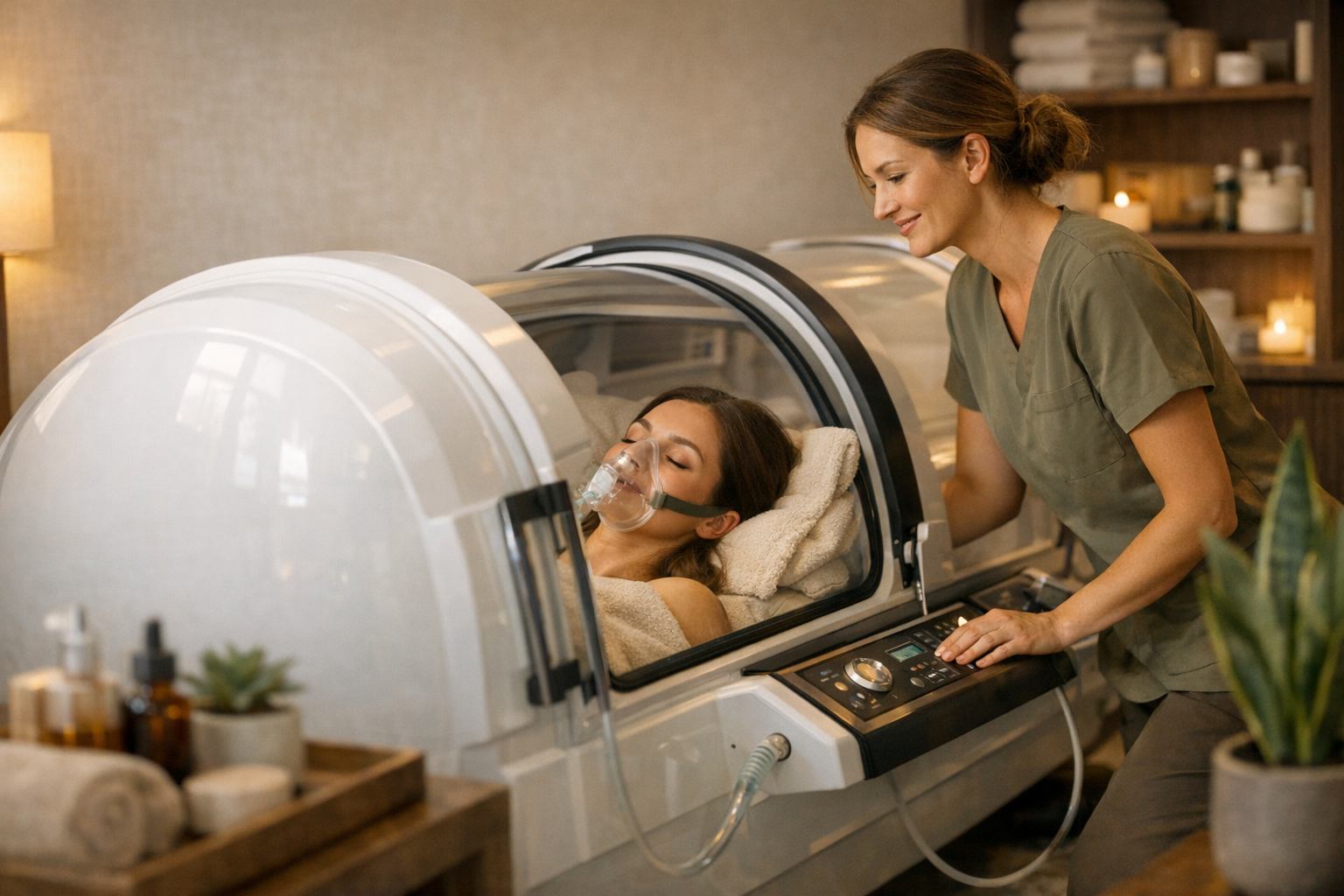
HBOT involves breathing oxygen in a pressurised chamber. The increased ambient pressure allows more oxygen to dissolve into your plasma (the liquid component of blood), which can enhance oxygen delivery to tissues for the duration of the session. Think of it as creating a temporary “oxygen-rich” environment for your body’s repair and recovery processes.
In hospital settings, HBOT is an established treatment for certain medical conditions (for example, decompression sickness and specific hard-to-heal wounds). In wellness settings, the intention is usually to support recovery, resilience, and tissue repair mechanisms—not to “treat” disease.
Key physiological effects associated with HBOT
- Improved oxygen availability: More oxygen dissolved in plasma can reach areas with reduced circulation or higher demand.
- Support for tissue repair pathways: Oxygen is central to collagen formation and wound healing physiology.
- Inflammation modulation: Research suggests HBOT can influence inflammatory signalling, though effects vary by context.
- Antimicrobial support in specific settings: In medical use, high oxygen levels can help the body’s defences in certain wound scenarios.
These effects help explain why HBOT is often discussed for skin repair and recovery. But it’s important to stay realistic: HBOT is not a replacement for foundational health habits or dermatology care, and outcomes depend on your starting point, goals, and overall plan.
HBOT for skin repair: why oxygen matters
Your skin is metabolically active tissue. When it’s repairing—whether from a procedure, minor injury, environmental stress, or general wear and tear—it needs energy, nutrients, and oxygen to coordinate the complex steps of rebuilding and remodelling.
Oxygen plays a role in:
- Collagen synthesis: Collagen formation requires oxygen-dependent enzymatic steps.
- Angiogenesis: The growth of new microvessels that improve local circulation over time.
- Barrier recovery: Repairing the skin barrier after irritation or disruption.
- Wound healing stages: Including immune activity, tissue formation, and remodelling.
For these reasons, HBOT is sometimes used in medical wound care and is increasingly discussed in aesthetic and recovery circles. In a wellness context, the goal is usually to support your body’s normal repair capacity—particularly if you’re under-recovered, run down, or healing more slowly than you’d like.
Skin concerns HBOT may support (realistic framing)
Depending on the person and the context, HBOT may support:
- Post-procedure recovery (for example, after certain aesthetic treatments) by supporting tissue oxygenation and recovery processes
- General skin vitality when fatigue, stress, or heavy training has you looking “flat” or dull
- Slow-to-settle inflammation in some cases, as part of a wider recovery approach
However, HBOT is not a guaranteed solution for pigment concerns, acne, rosacea, or “anti-ageing” in the simplistic sense. If those are your priorities, it’s best to combine a targeted skincare strategy with clinician-led guidance and consider HBOT as an adjunct rather than the centrepiece.
HBOT for wellness recovery: beyond the skin
When people talk about “recovery”, they often mean one (or more) of the following:
- Physical recovery from training, busy travel, or long work hours
- Mental recovery from stress, cognitive load, and disrupted sleep
- Immune resilience after periods of strain
- Overall energy and clarity when life has been relentless
HBOT is being explored because oxygen availability can be a limiting factor for repair in certain tissues, and because oxygen signalling is intertwined with inflammation and cellular stress responses. In practical terms, many people pursue HBOT for how it may support:
- Recovery after intense training blocks (alongside smart programming, rest, and nutrition)
- Feeling “back online” after prolonged stress or poor sleep
- General restoration during demanding seasons of life
It’s worth noting: “feeling better” is a valid goal, but it’s also subjective. A good clinic will help you define measurable markers (sleep quality, training readiness, perceived recovery, skin healing timeline, etc.) rather than relying on vague promises.
What does the evidence say (and what’s still emerging)?
HBOT has robust evidence in specific medical indications, particularly in wound care and certain hypoxic (low oxygen) tissue states. For broader wellness and skin vitality in otherwise healthy individuals, the evidence base is growing but more variable—because goals, protocols, and populations differ widely.
What we can say responsibly is:
- There is a strong mechanistic rationale for HBOT supporting tissue oxygenation and aspects of healing physiology.
- In medical contexts, HBOT has been shown to support wound healing in certain scenarios, under medical supervision and specific protocols.
- For general wellness recovery and aesthetic goals, HBOT may support recovery and resilience as part of a broader plan, but it should not be positioned as a standalone fix.
If you’re considering HBOT mainly for skin repair, it’s sensible to ask a provider how they integrate it with evidence-based skincare, nutrition, sleep support, and appropriate clinical oversight—because those elements often determine the baseline you’re working from.
What an HBOT session feels like
Most people’s first question is simple: “What happens in the chamber?” A typical HBOT session involves:
- Pre-session screening: You’ll be asked about medical history, current medications, and any contraindications.
- Pressurisation: As the chamber pressure increases, you may feel a change in your ears (similar to take-off in a plane). You’ll be coached on equalising comfortably.
- Breathing oxygen: You’ll relax for the session duration. Many people read, listen to audio, or simply switch off.
- Depressurisation: Pressure gradually returns to normal.
Most sessions are calm and surprisingly restful. The key is good coaching and a protocol tailored to you—especially if you’re new to pressure changes.
Commonly discussed sensations and after-effects
- Ears popping/fullness: The most common sensation; usually manageable with guidance.
- Relaxation or mild fatigue: Some people feel pleasantly tired afterwards, others feel more alert.
- Hydration needs: It’s sensible to arrive well-hydrated, particularly if your schedule is intense.
If you have anxiety in enclosed spaces, let the team know. A good clinic can talk you through what to expect and help you feel in control throughout.
How many sessions do you need for skin repair and recovery?
There isn’t a one-size-fits-all number because the “right” protocol depends on your goal, baseline health, and what else you’re doing to support recovery. In medical use, HBOT is often delivered in structured blocks. In wellness settings, people may do a short series to support a specific recovery period, then occasional maintenance.
As a practical guide, consider these questions:
- Is your goal time-bound? (e.g., post-procedure recovery, a demanding work period, or a heavy training phase)
- Are you addressing the basics? (sleep, protein intake, hydration, stress management, and skincare consistency)
- How will you measure progress? (photos of healing, skin comfort, training readiness, sleep metrics, perceived energy)
At LIVBETTER, we typically encourage a plan-led approach: align sessions with your recovery window, track outcomes you care about, and reassess rather than committing blindly.
Who HBOT may be suitable for (and who should be cautious)
HBOT can be a supportive option for many people, but it’s not appropriate for everyone. Proper screening matters.
You might consider HBOT if you:
- Are recovering from a period of high stress, heavy training, or poor sleep and want structured recovery support
- Are healing from a skin-related procedure and want to support recovery (in coordination with your treating clinician)
- Want a science-led therapy to complement a broader wellness programme
You should seek medical advice and careful screening if you:
- Have certain lung conditions, untreated pneumothorax, or significant respiratory issues
- Have frequent ear or sinus problems that make pressure equalisation difficult
- Are pregnant, or have complex medical conditions requiring specialist oversight
- Are taking medications where oxygen/pressure environments require caution
A reputable provider will always prioritise safety and suitability. If a clinic skips screening or overpromises outcomes, that’s a sign to pause.
How to maximise results: simple, high-impact steps
HBOT works best when it’s part of a bigger “recovery ecosystem”. Here are evidence-informed steps that support skin repair and wellness recovery alongside HBOT:
1) Prioritise sleep like it’s a treatment
- Aim for consistent sleep and wake times.
- Keep your bedroom cool and dark.
- Reduce late-night screen exposure when possible.
Skin barrier function, collagen dynamics, and inflammation regulation are all influenced by sleep quality—so this is not optional if skin repair is your goal.
2) Eat for repair (not perfection)
- Include a quality protein source with each meal to support tissue repair.
- Choose colourful plants daily for polyphenols and micronutrients.
- Don’t fear healthy fats; they support skin barrier integrity.
No supplement stack can outwork inconsistent nutrition. If you want guidance, a clinician-led nutrition approach is typically more effective than guessing.
3) Keep skincare boringly consistent
If you’re supporting skin repair, the basics often outperform the complicated routines:
- Gentle cleanser (especially after sweating or city exposure)
- Barrier-support moisturiser (look for ceramides, glycerin, hyaluronic acid)
- Daily SPF (one of the best-supported interventions for long-term skin quality)
If you’re post-procedure, follow your practitioner’s instructions—this is not the moment for experimentation.
4) Train smart during recovery windows
- Match training intensity to your actual recovery capacity.
- Include low-intensity movement and mobility work to support circulation.
- Plan deload weeks—your skin and nervous system will thank you.
HBOT may support recovery, but it won’t override chronic under-recovery from relentless intensity.
HBOT vs other recovery and skin-support therapies
In modern wellness clinics, HBOT often sits alongside other advanced options. The best choice depends on your goal:
If your priority is inflammation and muscle recovery
- Cold therapy may support soreness and perceived recovery, though timing matters if you’re chasing muscle adaptation.
- Compression and mobility work remain surprisingly effective.
If your priority is skin quality and collagen support
- LED light therapy has evidence for supporting skin repair and inflammation reduction in certain contexts.
- Clinician-led skincare plans often deliver the most reliable changes over time.
If your priority is nervous system reset
- Breathwork and relaxation training can meaningfully improve recovery when done consistently.
- Structured stress management (yes, including boundaries) is still the most powerful tool.
HBOT can complement these approaches, particularly when your aim is whole-body recovery with a skin-support angle.
What to look for in a high-quality HBOT provider
Because HBOT involves pressure and oxygen, provider standards matter. Look for:
- Thorough screening: medical history, contraindications, and clear consent.
- Transparent protocols: session length, pressure level, and why it’s chosen for your goal.
- Qualified supervision: trained staff who can support you through equalising and comfort issues.
- Outcome tracking: a plan to assess whether it’s helping you (not just “keep going”).
- Integration: willingness to coordinate with your GP, dermatologist, or other clinician when appropriate.
At LIVBETTER, our approach is simple: safety first, science-led protocols, and a personalised plan that respects your time. HBOT is offered as one tool within a broader recovery and performance strategy—because that’s how people get the most meaningful, sustainable results.
Frequently asked questions
Is HBOT safe?
For appropriately screened individuals under professional supervision, HBOT is generally well-tolerated. The most common issue is ear pressure discomfort, which can often be managed with proper coaching. As with any therapy, suitability and supervision are key.
Will HBOT make my skin look younger?
HBOT may support aspects of skin repair and recovery physiology, but it’s not a guaranteed “anti-ageing” solution. If skin quality is your goal, HBOT is best viewed as complementary to consistent SPF, a barrier-supportive routine, and clinician-led treatments where appropriate.
Can I combine HBOT with other treatments?
Often yes, depending on the treatment and your health status. If you’re combining HBOT with aesthetic procedures or performance therapies, it’s wise to plan timing with a clinician so you’re supporting recovery rather than overloading your system.
A grounded way to think about HBOT for skin and recovery
If you’re curious about HBOT for skin repair and wellness recovery, the healthiest mindset is: HBOT can be a useful amplifier, not a substitute. It may support the conditions your body needs to repair—particularly oxygen availability and recovery signalling—but your baseline habits and clinical plan still do most of the heavy lifting.
If you’d like to explore whether HBOT fits your goals, consider starting with a clear aim (skin recovery support, post-stress restoration, training block recovery), a sensible session plan, and simple tracking. And if you’re working with LIVBETTER, we’ll help you build a programme that feels high-touch, evidence-led, and realistic—so you can think better, feel better, and truly LIVBETTER.
Next Steps
Want to learn more? Check out these articles:
HBOT for Active Recovery and Cellular Health Explained Clearly
HBOT and Inflammation Recovery: A Practical Science Guide
HBOT for Recovery After Intensive Training: Evidence-Based Guide
Check out our Therapies to see which options fit your goals.