
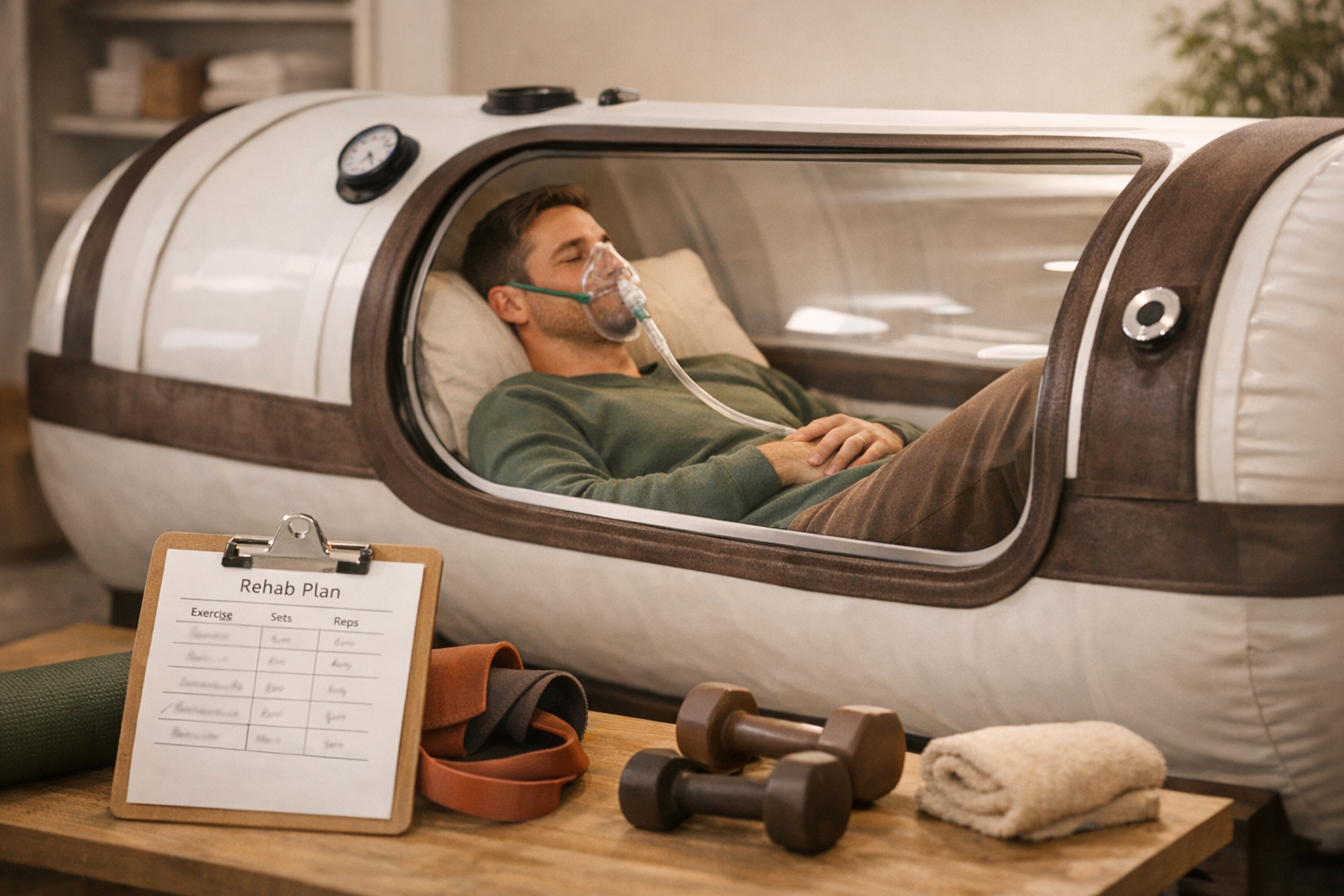
HBOT for Injury Recovery Support: What to Expect
When you’re recovering from an injury, the frustrating part often isn’t the diagnosis—it’s the waiting. You might be doing “all the right things”: physio, progressive loading, good sleep, solid nutrition… and yet the tissue still feels slow to settle. If you’ve been wondering whether hyperbaric oxygen therapy (HBOT) could help, you’re not alone. HBOT has moved from being a niche hospital-based intervention to a more widely used, technology-enabled recovery tool—especially for people who want to support healing while staying sharp, active, and on top of a busy schedule.
This article breaks down what HBOT is, how it may support injury recovery, what the evidence says (and doesn’t say), who it might be suitable for, and how to get the best results as part of a comprehensive plan. No hype—just practical, science-backed guidance.
What is HBOT (hyperbaric oxygen therapy)?
HBOT involves breathing oxygen in a pressurised chamber. Under increased atmospheric pressure, more oxygen dissolves into your blood plasma (not just carried by haemoglobin). This can increase oxygen delivery to tissues—particularly helpful when an area is inflamed, bruised, swollen, or has compromised microcirculation.
In simple terms: HBOT creates a temporary “high-oxygen environment” in the body, which may support physiological processes involved in recovery.
Key basics to know
- Pressure: Sessions are delivered at higher-than-normal atmospheric pressure (the exact pressure depends on clinical goals and protocols).
- Oxygen: You breathe oxygen during the session, supporting higher dissolved oxygen levels in plasma.
- Session time: Commonly 60–90 minutes per session (protocol-dependent).
- Course length: Often a series of sessions rather than a one-off—because tissue recovery is a process, not an event.
How HBOT may support injury recovery
Injury recovery is essentially the body coordinating a complex repair project: controlling inflammation, clearing debris, building new tissue, and restoring function. Oxygen is a key ingredient in many of those steps. HBOT may support recovery through several mechanisms that are biologically plausible and increasingly studied.
1) Supporting tissue oxygenation
After an injury, swelling and microvascular disruption can reduce local oxygen delivery. By increasing dissolved oxygen in plasma, HBOT may help oxygen reach tissues even when circulation is not at its best. This can be relevant in the early phases of recovery when swelling, bruising, and pain are prominent.
2) Modulating inflammation (without “switching it off”)
Inflammation is necessary for healing—but it needs to be well-regulated. Research suggests HBOT may influence inflammatory signalling and oxidative stress balance. The goal isn’t to eliminate inflammation; it’s to support a healthier inflammatory response so repair can progress.
3) Supporting collagen formation and tissue repair
Oxygen is required for collagen synthesis and cross-linking—important for tendons, ligaments, skin, and connective tissue. HBOT may support the cellular environment that allows repair processes to run more effectively, particularly when recovery is slow or complicated.
4) Promoting angiogenesis (new blood vessel formation)
Over a course of sessions, HBOT has been associated with signalling that may support angiogenesis. More robust microcirculation can be helpful for longer-term recovery and tissue resilience.
5) Supporting recovery from certain complex or slow-healing situations
Clinically, HBOT is well-established for specific medical indications (often managed in hospital settings), and it’s also used as supportive care in some recovery programmes. In performance and wellbeing contexts, it may be considered as an adjunct when someone wants to optimise the conditions for healing—particularly if progress has plateaued despite good basics.
What injuries might HBOT help with?
It’s important to be precise here: HBOT is not a “cure” for injuries, and it won’t replace good diagnosis, rehabilitation, and appropriate medical management. That said, HBOT may support recovery in scenarios where oxygen delivery and tissue repair processes are key constraints.
Common recovery contexts people explore HBOT for
- Soft tissue injuries: muscle strains, contusions, and recovery after significant bruising or swelling
- Tendon and ligament issues: where a slow-healing connective tissue environment is part of the challenge
- Post-operative recovery support: where supporting tissue oxygenation and repair may be beneficial (always with surgeon approval)
- Persistent recovery plateaus: when fundamentals are solid but progress has slowed
If you’re unsure whether HBOT is relevant to your injury type, the best next step is a clinical screening and a clear recovery plan that includes rehabilitation milestones—not just treatments.
What does the evidence say about HBOT for injury recovery?
The research on HBOT is strongest for certain medical indications (for example, specific types of non-healing wounds and radiation tissue injury). For sports and musculoskeletal injuries, evidence is emerging but mixed—partly because injuries vary, protocols differ, and studies measure different outcomes (pain, swelling, time-to-return, functional strength, imaging changes, etc.).
A balanced takeaway is this: HBOT has plausible mechanisms and some supportive data for aspects of recovery (like swelling and tissue repair signalling), but outcomes depend heavily on the type of injury, timing, total number of sessions, and whether HBOT is paired with a structured rehab programme.
How to interpret claims you may see online
- Be cautious of “faster healing guaranteed” language. Biology doesn’t work on guarantees.
- Look for functional outcomes. Better movement quality, strength, and return-to-activity tolerance matter more than a single marker.
- Protocol matters. One session is unlikely to be meaningful for most injuries.
- Adjunct is the key word. HBOT works best when it supports, not replaces, progressive rehab.
What a HBOT session feels like (and what to expect)
Most people describe HBOT as surprisingly straightforward—more like a calm “recovery appointment” than a medical procedure. You’ll typically sit or recline comfortably while the chamber pressurises.
During pressurisation
You may feel pressure in your ears, similar to take-off/landing in an aeroplane. You’ll be guided on simple equalising techniques (swallowing, yawning, gentle Valsalva if appropriate). This phase is usually the only part that feels “different”.
During the session
Once at pressure, you can relax. Many people read, listen to an audiobook, or practise calm breathing. It’s a good time to downshift your nervous system—something recovery often needs as much as it needs exercise.
After the session
Most people return to normal activity straight away. Some feel pleasantly relaxed; others feel energised. As with any intervention, responses vary.
Safety, suitability, and who should avoid HBOT
HBOT is generally well-tolerated when appropriately screened and supervised. But it’s not for everyone, and safety should always come first.
Common considerations and possible side effects
- Ear or sinus barotrauma: discomfort or injury if pressure cannot be equalised well
- Temporary fatigue or light-headedness: occasionally reported
- Claustrophobia: some people feel anxious in enclosed spaces (many modern chambers are designed to feel more open, and coaching helps)
Important contraindications (examples)
Some conditions require avoidance or specialist sign-off, such as certain untreated lung conditions, recent ear surgery, or specific chemotherapy agents. Because suitability is individual, HBOT should begin with a thorough screening and medical history review.
If you’re pregnant, have complex medical conditions, or take prescription medications, it’s especially important to have a clinician-led assessment.
How many HBOT sessions do you need for injury recovery support?
This is one of the most common questions—and the most honest answer is: it depends on your injury, your baseline health, your timeline, and how your body responds.
However, most supportive recovery protocols involve a series of sessions. Tissue remodelling and microvascular adaptations typically require repeated exposures.
Practical guidance (without overpromising)
- Acute injuries: some people explore a short cluster of sessions early on to support swelling and tissue stress
- Persistent issues or post-operative support: a longer course may be considered to support repair and rehabilitation capacity
- Reassessment matters: you should review progress against functional goals every 1–2 weeks, not just “complete a package”
At LIVBETTER, the most sensible approach is goal-led: we look at what you’re trying to return to (training, sport, pain-free daily movement, or simply feeling normal again) and build a plan that complements your rehab.
How to get better results: HBOT as part of a recovery system
HBOT is best thought of as a recovery amplifier—not a standalone fix. If you want to get the most value from it, pair it with the fundamentals that actually drive tissue capacity.
1) Align HBOT with your rehab loading plan
Your physiotherapist or clinician should be guiding progressive loading (the gradual increase in stress that tells tissue how to rebuild). HBOT may support the environment for repair, but load is what restores function. Keep these aligned:
- Do your key rehab exercises consistently
- Track pain and function trends (not just day-to-day fluctuations)
- Use HBOT around heavier rehab phases if recovery feels like the limiting factor
2) Prioritise sleep as your “baseline hyperbaric”
Sleep is where much of your recovery signalling happens. If sleep is short or fragmented, even the best therapies struggle to shine. Aim for:
- Consistent sleep and wake times (even on weekends)
- A cool, dark bedroom
- Reducing alcohol and late caffeine if they affect your sleep quality
3) Eat for repair (not perfection)
You don’t need a complicated supplement stack. Most people do better with a few evidence-based nutrition anchors:
- Protein: include a protein source at each meal to support tissue repair
- Colour and fibre: fruit, vegetables, legumes, and wholegrains to support micronutrients and gut health
- Hydration: especially if you’re returning to training
If your appetite is low due to pain or stress, a simple strategy is to make breakfast protein-forward and add an easy protein snack in the afternoon.
4) Manage stress because it changes recovery physiology
High stress doesn’t just “feel bad”—it can influence sleep, pain sensitivity, and immune function. Consider a small, consistent daily practice:
- 10 minutes of nasal breathing or a guided relaxation track
- A short walk outdoors after lunch
- Light mobility work in the evening (if it doesn’t aggravate symptoms)
HBOT vs other recovery options: how does it compare?
Many people exploring HBOT are also considering therapies like red light therapy, compression, cryotherapy, sauna, massage, or IV nutrient therapy. The best choice depends on what’s limiting your recovery.
A practical way to choose
- If swelling, bruising, or tissue oxygenation feels like a constraint: HBOT may be worth discussing
- If nervous system stress and sleep are the main issue: breathwork coaching, relaxation-focused strategies, and sleep optimisation may give the biggest return
- If you need to rebuild capacity: rehab loading and strength work remain foundational
At LIVBETTER, we like stacking therapies thoughtfully—choosing the smallest number of interventions that make the biggest difference, and reviewing outcomes regularly.
When to consider HBOT (and when to wait)
HBOT may be a good option to explore if:
- You have a clear injury diagnosis and a rehab plan, but recovery is slower than expected
- You’re returning to demanding work or sport and want to support recovery capacity
- You’re post-procedure and your clinician agrees supportive therapies are appropriate
You may want to wait or focus elsewhere if:
- Your injury has not been properly assessed (rule out red flags first)
- You’re not yet consistent with rehab basics (strength, mobility, graded exposure)
- Sleep and stress are significantly disrupted and unaddressed
Practical next steps: a simple recovery plan you can start this week
If you want a grounded way forward, here’s a realistic plan you can implement immediately—whether or not you choose HBOT.
Step 1: Define your “return-to” goal
- What specific activity do you want back (e.g., running 5 km, pain-free squats, tennis twice weekly)?
- What does “good enough” look like in 4–6 weeks?
Step 2: Track two objective markers
- Function: a repeatable movement or task (e.g., step-downs, grip strength, range of motion)
- Recovery: sleep quality or morning stiffness score (0–10)
Step 3: Build a weekly rhythm
- Rehab exercises 3–5 days/week (as prescribed)
- Two short recovery practices (10 minutes each)
- One review point weekly: are you trending better over time?
Step 4: If you add HBOT, add it with intent
- Start with a clinician-led screening
- Agree on the number of sessions to trial before reassessing
- Measure outcomes against your markers—not just how you “feel” on the day
How LIVBETTER approaches HBOT for injury recovery support
LIVBETTER exists for people who want high-end, science-backed wellness and performance support that fits real life. If you’re considering HBOT, our approach is straightforward: clinical screening, personalised protocol, and integration with the habits that actually drive results—sleep, stress regulation, nutrition, and smart training/rehab.
If you’d like help deciding whether HBOT makes sense for your injury recovery, a short consultation can clarify suitability, timing, and what a realistic course might look like for your goals.
Final thoughts
Recovering from an injury can be humbling—even when you’re otherwise healthy and proactive. HBOT is not a magic switch, but it may support the physiological conditions that help recovery move forward, especially when paired with a clear rehab plan and good fundamentals. If you’re curious, start with proper assessment, set measurable goals, and choose interventions that complement the work you’re already doing.
Next Steps
Want to learn more? Check out these articles:
HBOT for Skin Repair and Wellness Recovery: What to Expect
HBOT for Active Recovery and Cellular Health Explained Clearly
HBOT and Inflammation Recovery: A Practical Science Guide
Check out our Therapies to see which options fit your goals.