
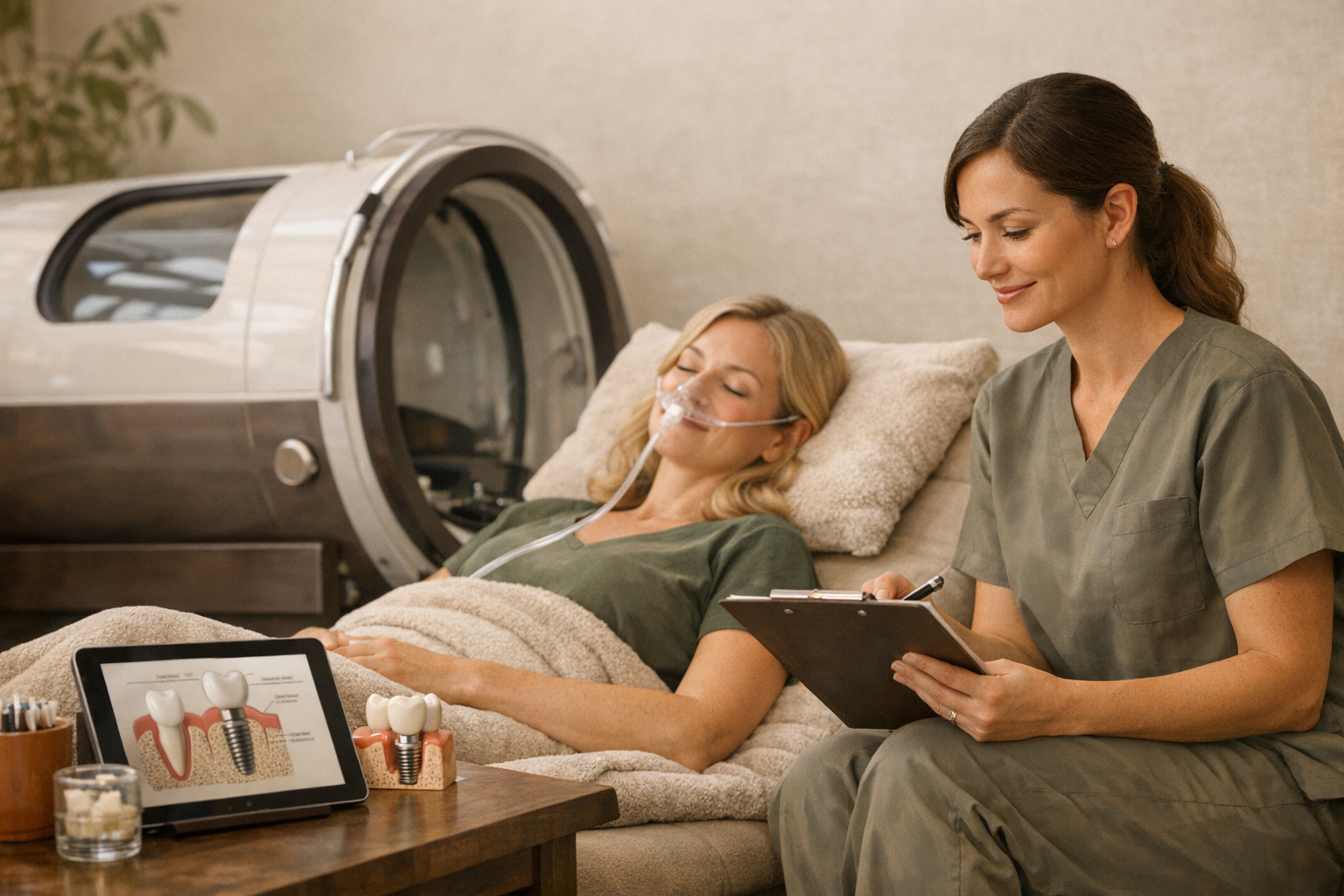
HBOT for Dental Implant Recovery: Healing, Swelling and Comfort
Dental implants are brilliantly engineered — but your body still has to do the most important part: heal. After surgery, it’s completely normal to have swelling, tenderness, bruising, and that slightly “puffy” feeling that makes you wonder if recovery could be smoother. If you’ve been searching for HBOT for dental implant recovery, you’re likely looking for a science-backed way to support tissue repair, protect the surgical site, and feel more like yourself sooner — without gimmicks.
Hyperbaric Oxygen Therapy (HBOT) has a long clinical history in supporting wound healing in specific situations, and it’s increasingly discussed in dentistry and oral surgery circles — especially for more complex cases. In this guide, we’ll explain what HBOT is, how it may support implant recovery, who it’s most relevant for, what the evidence suggests, and what you can do at home to give your implant the best possible environment to integrate.
What “recovery” actually means after a dental implant
Implant treatment isn’t just about placing a titanium post — it’s about your body building stable, healthy support around it. Recovery has two overlapping phases:
1) Early healing (days to 2 weeks)
- Blood clot formation and early tissue sealing of the gum (gingiva)
- Inflammation (a normal, necessary phase) that brings immune cells and signalling molecules to the area
- Swelling and bruising depending on the surgical complexity and your individual response
- Soft tissue repair as the gum remodels
2) Osseointegration (weeks to months)
- The jaw bone gradually forms a close functional connection with the implant surface
- This process is influenced by blood supply, bone quality, surgical technique, bite forces, and overall health
Your dentist or oral surgeon will guide timelines, but a helpful mindset is: the first fortnight is about calming and protecting the site; the following weeks are about supporting steady bone remodelling and avoiding setbacks.
What is HBOT (Hyperbaric Oxygen Therapy)?
HBOT involves breathing near-100% oxygen inside a pressurised chamber (higher than normal atmospheric pressure). Under these conditions, oxygen dissolves more readily into the plasma (the liquid part of blood), increasing oxygen delivery to tissues — including areas with compromised circulation.
In practical terms, HBOT aims to temporarily increase the amount of oxygen available for:
- Cellular energy production (oxygen is required for efficient ATP generation)
- Tissue repair processes, including collagen formation and angiogenesis (new blood vessel development)
- Immune function, as certain white blood cells use oxygen-dependent mechanisms
It’s already used in mainstream medicine for specific indications (such as certain non-healing wounds and radiation tissue injury) under defined protocols. In dental implant recovery, its role is more nuanced: it may be supportive in selected scenarios rather than a routine requirement for everyone.
How HBOT may support dental implant recovery
After implant surgery, oxygen demand increases locally — healing tissue is metabolically active. If oxygen delivery is limited (for example, due to reduced microcirculation), healing can be slower or more complicated. HBOT may support recovery through a few mechanisms that are particularly relevant to oral tissues.
Improved tissue oxygenation in the surgical area
Pressurised oxygen increases the diffusion of oxygen into tissues. This can be helpful where swelling temporarily compresses small blood vessels, or where baseline circulation is not ideal. More available oxygen may support the early phases of repair when tissues are under stress.
Support for angiogenesis (new micro-vessels)
Healing depends on restoring and expanding microcirculation. HBOT has been associated with signalling pathways that can support angiogenesis. In the context of implants, this may be relevant for soft tissue healing and for the environment in which bone remodelling takes place.
Collagen production and soft tissue integrity
Collagen is a key structural protein for gum and connective tissue repair. Oxygen is required for several enzymatic steps in collagen synthesis. While your body will produce collagen regardless, improved oxygen availability may support efficient tissue remodelling.
Inflammation modulation (not “switching off” healing)
Inflammation isn’t the enemy — it’s the first chapter of healing. The goal is a well-regulated inflammatory response rather than one that lingers or escalates. HBOT has been studied for its potential to modulate inflammatory signalling. In recovery terms, that may translate to improved comfort for some people, though experiences vary.
Supportive role in infection risk management (adjunctive)
HBOT is not a substitute for sterile surgical technique, good oral hygiene, or antibiotics when indicated. However, oxygen is involved in certain immune defence mechanisms, and HBOT is sometimes used as an adjunct in challenging wound/infection contexts in broader medicine. For implant recovery, think of HBOT as a potential support rather than a guarantee.
What does the evidence say about HBOT and dental implants?
The honest answer: evidence is promising in certain higher-risk contexts, but HBOT is not universally required for straightforward implant cases.
Research and clinical discussion tend to focus on scenarios such as:
- Implant placement in irradiated bone (after head and neck radiotherapy), where tissue oxygenation and vascularity can be significantly compromised
- Compromised healing capacity due to complex medical history
- Extensive bone grafting or more demanding reconstructive cases
For routine, uncomplicated implants in healthy individuals, standard post-operative care (and time) is typically sufficient. Where HBOT may earn a place is when your clinician is proactively trying to optimise the healing environment or reduce risk in a complex plan.
If you’re considering HBOT, it’s best approached as part of a coordinated conversation between you, your dentist/oral surgeon, and the HBOT provider — with clear goals (e.g., supporting tissue viability, improving comfort, supporting recovery capacity) and realistic expectations.
Who might consider HBOT for dental implant recovery?
HBOT isn’t “one-size-fits-all”. The people most likely to discuss it meaningfully with their clinician include those who:
- Have a history of radiotherapy to the jaw or nearby tissues
- Are undergoing complex oral surgery (multiple implants, significant grafting, sinus lift, or revision procedures)
- Have factors associated with slower healing (for example smoking — ideally stopped — or certain metabolic/vascular issues)
- Have had previous complications with oral wound healing
- Want a structured recovery plan and have the time to commit to multiple sessions
Just as important: many people won’t need HBOT. If your case is straightforward, you may get excellent outcomes by focusing on fundamentals: meticulous hygiene, good nutrition, sleep, and following your dentist’s post-op instructions.
What an HBOT course may look like (and what you’ll feel)
Protocols vary depending on goals, medical context, and provider. Sessions commonly last around 60–90 minutes. You’ll sit or lie comfortably in a pressurised chamber and breathe oxygen throughout the session. You may notice a pressure change in your ears similar to flying; staff will guide you on equalising techniques.
Commonly reported experiences
- A feeling of pressure in the ears that settles with swallowing/yawning
- Gentle warmth or relaxation during the session
- Some people feel energised afterwards; others feel pleasantly tired
Recovery from implant surgery is already a lot; HBOT should feel like supportive downtime, not another stressor. A good clinic will make the process calm, monitored, and straightforward.
Safety considerations and who should avoid HBOT
HBOT is generally well-tolerated when appropriately screened, but it’s still a medical-grade therapy. Safety depends on proper assessment and supervision.
Potential side effects
- Ear/sinus barotrauma (pressure discomfort or, rarely, injury) if equalisation is difficult
- Temporary vision changes in some people after repeated sessions (usually reversible)
- Fatigue or light-headedness in a minority of clients
Typical contraindications or situations needing medical clearance
- Untreated pneumothorax (collapsed lung)
- Certain lung conditions that increase risk with pressure changes
- Some ear/sinus problems
- Specific medications (your provider will review)
Always tell the HBOT team about your full medical history, medications, and any recent respiratory infections. If you’re recovering from dental surgery, your dentist’s guidance is central — particularly around timing relative to the procedure and any antibiotics or pain relief.
Practical recovery steps that make HBOT (and everything else) work better
Whether you do HBOT or not, these fundamentals create the conditions your body needs to heal well.
1) Protect the clot and the site (first 72 hours)
- Avoid vigorous rinsing, spitting, or using straws as advised — these can disturb the clot
- Stick to soft foods and chew away from the surgical side if possible
- Follow your clinician’s instructions on brushing and any prescribed mouth rinse
2) Use cold then heat strategically
- First 24–48 hours: cold packs can help manage swelling and discomfort (use intermittently)
- After 48 hours: some people find gentle warmth supports comfort (if your dentist agrees)
3) Prioritise protein and micronutrients
Healing is a building project. You need raw materials:
- Protein: aim for a protein source at each meal (eggs, yoghurt, fish, tofu, legumes)
- Vitamin C: supports collagen formation (berries, citrus, peppers, broccoli)
- Zinc: supports tissue repair (seafood, meat, beans, nuts)
If chewing is awkward, consider smoothies with Greek yoghurt, milk/kefir, oats, and fruit — but avoid using a straw in the immediate post-op period if instructed.
4) Sleep like it’s your job
Deep sleep supports immune regulation and tissue repair. For the first few nights:
- Sleep slightly elevated to reduce swelling
- Avoid alcohol (it can worsen sleep quality and dehydration)
- Keep the room cool and dark to protect sleep depth
5) Don’t negotiate with smoking or vaping
Nicotine and smoke exposure are strongly linked with poorer oral healing. If you’re planning implants, the most performance-oriented move you can make is to stop — even temporarily — and ask your clinician for practical cessation support.
6) Keep activity sensible
Light movement is generally fine, but heavy lifting and intense exercise can increase pressure and bleeding risk early on. Follow your clinician’s guidance, and treat the first week as a strategic deload.
Timing: when might HBOT be used around implant surgery?
Timing depends on your case and clinician preferences. In more complex plans, HBOT may be considered:
- Pre-operatively to support tissue oxygenation readiness in higher-risk tissues
- Post-operatively to support early healing and comfort
- Both in very specific, medically complex situations (for example, compromised tissue from prior radiotherapy)
There’s no universal schedule that fits everyone. A good plan is individualised: what procedure you’re having, how you typically heal, and what your risk profile looks like.
HBOT vs “mild hyperbaric”: what matters?
You may see different types of chambers marketed in wellness settings. Broadly, clinical HBOT is defined by specific pressure thresholds and oxygen delivery. Mild hyperbaric approaches use lower pressures and sometimes different oxygen delivery methods.
If your goal is to support a medically significant healing challenge, it’s worth asking detailed questions about:
- The chamber pressure used (ATA)
- Oxygen concentration and how it’s delivered
- Clinical oversight and safety protocols
- Experience with post-surgical clients
This isn’t about “more is better” — it’s about appropriate dosing, correct indications, and safety.
How LIVBETTER can support recovery (without overcomplicating it)
At LIVBETTER, we focus on high-end, technology-enabled therapies that fit into real lives — particularly when you want to stack small, sensible advantages in your recovery. If you’re exploring HBOT for dental implant recovery, we can help by:
- Providing a calm, clinically-informed HBOT experience with appropriate screening
- Helping you understand whether HBOT is a sensible adjunct for your situation
- Integrating HBOT into a broader recovery approach that also prioritises sleep, nutrition, stress reduction, and smart training load
We’ll always encourage you to coordinate with your dentist or oral surgeon so everyone is aligned on timing and expectations.
Frequently asked questions
Will HBOT make my implant heal faster?
HBOT may support the healing environment by improving tissue oxygenation, which can be valuable in certain contexts. But implant recovery depends on many variables (bone quality, surgical technique, oral hygiene, systemic health), so it’s best viewed as an adjunct rather than a guarantee of speed.
Can HBOT reduce swelling or pain?
Some people report improved comfort and reduced swelling, likely related to inflammation modulation and tissue oxygenation. However, responses vary, and it shouldn’t replace standard post-op care or prescribed pain relief.
Is HBOT safe after dental surgery?
For most suitable clients, yes — with proper screening and supervision. Ear pressure issues are the most common challenge. Your provider should assess you carefully, and your dental team should be kept in the loop.
How many sessions would I need?
It depends on your goals and risk profile. Some people may do a small series, while complex cases may require more structured protocols. A reputable provider will explain the rationale for any recommended schedule.
A sensible way to decide if HBOT is right for you
If you’re considering HBOT for dental implant recovery, use this simple checklist to guide the decision:
- Clarify your procedure complexity: single implant vs multiple implants, grafting, sinus lift, or revision.
- Review healing risk factors: smoking, past radiotherapy, metabolic health, previous wound issues.
- Ask your dentist/oral surgeon: “Do you see any reason I’d benefit from adjunctive oxygen therapy?”
- Choose a medically-minded provider: clear screening, monitored sessions, transparent protocols.
- Commit to fundamentals: sleep, protein, hygiene, and sensible activity matter as much as any add-on.
Dental implants are a long game in the best way: steady, quiet healing that builds a strong foundation. HBOT may be one useful tool in that process — particularly when the healing environment needs extra support — but the real win comes from combining good dentistry with smart recovery habits.
Next Steps
Want to learn more? Check out these articles:
HBOT for Energy and Recovery Optimisation [Evidence-Based Guide]
HBOT for Scar Recovery Support: A Science-Backed Guide
HBOT and Infrared Sauna for Smarter Recovery Planning
Check out our Therapies to see which options fit your goals.