
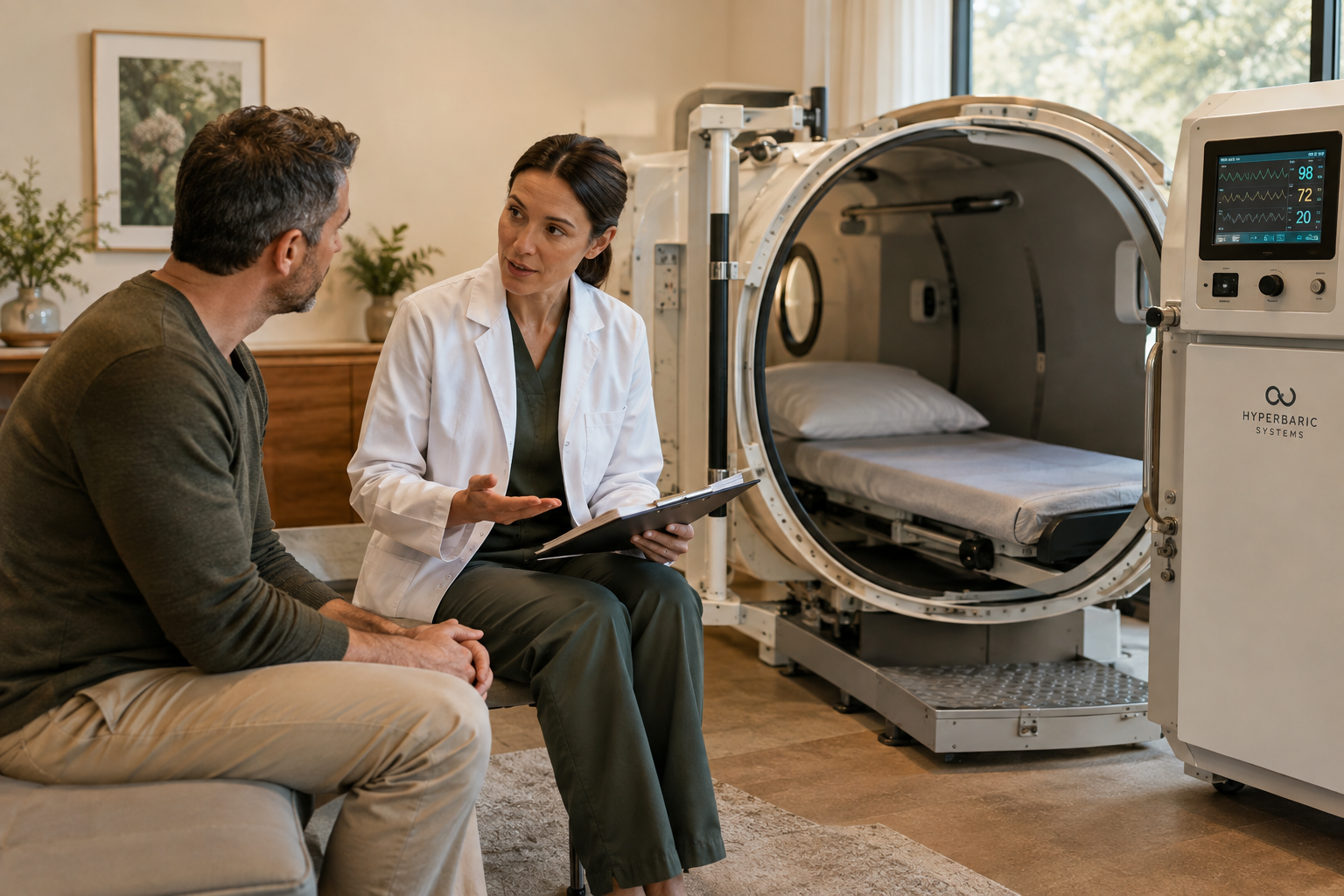
HBOT for Cellular Recovery: What to Know and How to Plan
Curious about hyperbaric oxygen therapy, but unsure whether it belongs in your recovery routine? You are not alone. Between demanding workdays, training sessions and less-than-perfect sleep, the idea of giving your cells extra support is understandably appealing.
The important question is what the science actually supports. Hyperbaric oxygen therapy, usually shortened to HBOT, changes how oxygen is delivered around the body. However, that does not mean it reliably improves energy, exercise recovery or long-term health in everyone.
This guide explains the biology, separates established medical use from emerging wellness research, and gives you a practical framework for deciding what to ask before booking.
What is HBOT, and how does it work?
HBOT involves breathing oxygen inside a chamber where the pressure is higher than normal atmospheric pressure. In clinical treatment, patients generally breathe 100% oxygen under a prescribed protocol, with appropriate supervision.
Most oxygen in your blood travels attached to haemoglobin, the protein inside red blood cells. A smaller amount dissolves directly into plasma, the liquid component of blood.
Raising pressure while breathing concentrated oxygen increases the amount dissolved in plasma. This can increase oxygen availability to tissues under the right clinical conditions. Think of it as changing the conditions of oxygen delivery, rather than simply taking a deeper breath.
Why pressure and oxygen concentration matter
Not every chamber-based experience provides the same exposure. Medical HBOT and lower-pressure services marketed as ‘mild hyperbaric’ can differ substantially in pressure, oxygen concentration, equipment and oversight.
Some lower-pressure chambers use compressed air rather than a high-concentration oxygen supply. Findings from one protocol should not automatically be applied to another.
Before comparing services, ask about:
- The chamber’s operating pressure, usually expressed in atmospheres absolute, or ATA.
- The oxygen concentration you would actually breathe.
- Who assesses suitability and supervises sessions.
- Whether the evidence being discussed matches that equipment and protocol.
Cellular recovery: what the biology tells us
Cells use oxygen to help generate adenosine triphosphate, or ATP, a molecule that powers many essential functions. Much of this production happens inside mitochondria, often described as the cell’s energy centres.
Oxygen is also involved in processes associated with tissue repair and immune function. However, healthy cells do not necessarily produce more useful energy simply because more oxygen becomes available.
Recovery depends on many interacting factors, including blood supply, nutrient availability, sleep, training load and underlying health.
More oxygen is not automatically better
If you are generally healthy, your blood oxygen saturation is usually already high at normal atmospheric pressure. HBOT still changes dissolved oxygen levels, but that physiological change is not proof that you will feel more energetic or recover faster.
Researchers are investigating how repeated hyperbaric exposures affect cell signalling, blood vessel formation and inflammatory pathways. Some findings are promising in specific populations. Translating them into reliable benefits for healthy people requires further well-designed studies.
Oxygen also has a biological trade-off. Higher exposures can increase reactive oxygen species: molecules that participate in normal signalling but can cause harm in excess. This helps explain why pressure, exposure time and medical screening matter.
A change in a biomarker is interesting. A meaningful improvement in how someone feels or functions is a separate question.
What does the evidence say about wellness benefits?
HBOT has recognised medical uses, supported to varying degrees by evidence for specific indications. Those uses involve clinical assessment and protocols selected for a particular problem.
General wellness is a different proposition. A study involving people with a defined medical condition cannot establish that the same approach helps an otherwise healthy person manage a busy week.
Exercise recovery and muscle soreness
Research into HBOT for sports recovery is limited and mixed. Studies differ in participant numbers, exercise protocols, chamber settings and the outcomes measured.
Current evidence does not justify promising faster muscle repair, consistently reduced soreness or improved athletic performance for healthy users.
If exercise recovery is your main goal, first review training progression, rest days, sleep and food intake. These are better-established foundations and remain important regardless of any additional therapy.
Energy, focus and healthy ageing
Claims about sharper thinking, increased vitality or ‘reversing biological age’ deserve careful scrutiny. Some studies explore cognitive outcomes or ageing-related markers, but their findings are not a general guarantee of benefit.
Small samples, selected populations and the challenge of creating a convincing placebo treatment can complicate interpretation. Changes in laboratory markers also do not necessarily translate into longer life or better daily functioning.
HBOT should not be presented as an established anti-ageing intervention or a routine solution for unexplained fatigue.
Persistent tiredness or changes in concentration are reasons to speak with a healthcare professional, rather than assume oxygen exposure is the missing ingredient.
What happens during an HBOT session?
Your experience will depend on the chamber, the protocol and your individual needs. A responsible service should explain each stage before you begin.
Before entering the chamber
Screening should cover your medical history, medicines, recent illness, previous surgery and any implanted devices. You should receive clear instructions about food, clothing and items that cannot enter the chamber.
Oxygen-rich environments require strict fire precautions. Follow the facility’s rules about electronic devices, cosmetics, oils and other potentially unsafe materials.
Tell the team if you have a cold, sinus congestion or difficulty equalising ear pressure. Trying to push through blocked ears can turn an elective session into an avoidable injury.
During pressurisation and oxygen exposure
As pressure rises, your ears may feel similar to how they do during an aircraft’s descent. Staff should teach you suitable equalisation techniques and explain how to communicate discomfort immediately.
Depending on the prescription, oxygen exposure may be interrupted by planned air breaks. Many clinical sessions involve roughly 60–120 minutes at treatment pressure, but timing varies and is not a universal wellness recommendation.
You should be monitored and able to contact trained staff throughout.
After the session
Pressure is reduced gradually before you leave. Report ear pain, dizziness, visual changes or any other unexpected symptoms.
Feeling relaxed after a session can be pleasant, but it does not prove that cellular repair has increased. Equally, having no noticeable sensation does not tell you whether a medical protocol is working.
Safety: who needs particular caution?
HBOT is not risk-free, even when it is offered in a comfortable wellness setting. The right question is not simply whether a chamber looks reassuring, but whether the service has appropriate clinical governance.
An untreated pneumothorax, meaning air trapped around a lung that can cause it to collapse, is a key contraindication. Other conditions require individual assessment rather than a generic online checklist.
Discuss the following before proceeding:
- Lung conditions, previous pneumothorax or chest surgery.
- Ear or sinus problems, recent respiratory illness or difficulty equalising pressure.
- Seizure history, pregnancy or significant claustrophobia.
- Diabetes, particularly if you use medicines that can cause low blood glucose.
- All medicines, cancer treatments and implanted medical devices.
Possible side effects and complications
Ear and sinus pressure injuries are important risks. Temporary changes in vision can occur, particularly with repeated exposures.
Less commonly, oxygen toxicity can affect the lungs or cause a seizure. Pressure-related lung injury is another potentially serious complication.
Fire is a rare but severe hazard where oxygen is used, making equipment maintenance, staff training and strict safety procedures essential.
Ask how the team manages both routine discomfort and emergencies. A provider should welcome these questions and explain when they would decline or postpone a session.
Four questions to ask before choosing HBOT
A thoughtful decision begins with a clear goal, not a package of sessions. Use these four questions to organise a conversation with a qualified clinician.
What am I hoping will change?
Be specific. ‘Improve wellness’ is difficult to assess. ‘Understand why I am struggling to recover between workouts’ creates a more useful starting point.
Your answer may reveal a need for changes in training, nutrition or medical assessment before considering HBOT.
How strong is the evidence for someone like me?
Ask whether relevant studies involved healthy adults or people with a particular condition. Check whether the chamber settings and number of sessions match the service offered.
Testimonials can describe someone’s experience, but cannot establish that HBOT caused the improvement.
What are the risks, alternatives and total commitment?
Discuss personal risk factors, likely appointment time, travel and overall cost. Ask about better-established alternatives and whether doing nothing beyond improving your foundations is reasonable.
There is no well-established, universal HBOT schedule for general wellness.
How will we decide whether to continue?
Agree on meaningful outcomes and a review point before starting. Avoid interpreting every good day as proof of benefit, particularly if you are changing sleep, exercise or nutrition at the same time.
An optional intervention should have a clear rationale, not become an indefinite routine by default.
Build the recovery foundations first
Whatever you decide about HBOT, your everyday habits remain central to recovery. They are not the less exciting substitute for advanced technology; they are the context in which any additional intervention operates.
Protect your sleep opportunity
Most adults need around seven to nine hours of sleep, although individual needs vary. Start with a consistent waking time and enough time in bed to meet your needs.
If evening work regularly spills into bedtime, set a realistic stopping point. Persistent insomnia, loud snoring or excessive daytime sleepiness warrant assessment rather than another recovery purchase.
Eat enough to support your activity
Regular meals containing protein, carbohydrate, healthy fats and a variety of plant foods help cover the basic requirements for recovery. Include a protein source across meals and replace fluids lost through exercise.
You do not need a complicated supplement stack to begin. If you follow a restrictive diet or train heavily, a registered dietitian can help identify gaps without unnecessary guesswork.
Match training stress with recovery time
More effort does not always mean more progress. Alternate demanding sessions with easier activity where appropriate, and allow time for adaptation.
A short walk, a lighter training day or a proper lunch break may be more useful than adding another appointment to an already overloaded schedule.
Where HBOT may fit in a personalised plan
For someone with a recognised medical indication, HBOT decisions belong within an appropriate clinical care pathway. For a generally healthy person exploring wellness, the discussion should be more cautious because benefits remain uncertain.
At LIVBETTER, technology-enabled wellbeing sits alongside real nutrition and sustainable habits. That perspective is useful when considering any advanced service: understand the purpose, check suitability and keep expectations proportionate to the evidence.
HBOT may be discussed as an optional part of a comprehensive plan where clinically appropriate. It should not replace investigation of symptoms, prescribed care or the daily behaviours that support health.
Choosing not to proceed is also a valid, informed decision.
Frequently asked questions
Can HBOT ‘recharge’ mitochondria?
That phrase oversimplifies the science. Oxygen is involved in mitochondrial energy production, and researchers study how hyperbaric exposure affects cellular processes. However, it is not established that HBOT reliably boosts mitochondrial performance in healthy people in a way that improves everyday energy.
How many sessions are needed for wellness?
There is no evidence-based universal answer. Protocols used for recognised medical indications should not be copied into a generic wellness package. Any proposed schedule needs a clear rationale, appropriate oversight and an honest explanation of uncertainty.
Is a mild hyperbaric chamber equivalent to medical HBOT?
Not necessarily. Pressure, oxygen delivery and supervision can differ. Ask for the exact specifications rather than relying on labels, and do not assume that studies of medical HBOT validate a different chamber experience.
Can I use HBOT instead of taking a rest day?
No intervention removes the need for recovery time. There is no reliable evidence that HBOT lets healthy people safely ignore excessive training load, sleep deprivation or inadequate food intake. Address those factors directly.
The takeaway: informed choices support better recovery
HBOT changes oxygen delivery in a scientifically meaningful way, but the leap from biological mechanism to everyday wellness benefit is not automatic. For healthy adults, claims about faster recovery, greater energy and healthy ageing remain ahead of the evidence.
Start with the foundations, seek assessment for persistent symptoms and ask clear questions about any proposed treatment.
Modern wellbeing is not about using every available technology. It is about choosing the right support, for the right reason, with realistic expectations.
Further reading
For information on recognised uses and safety, consult the Undersea and Hyperbaric Medical Society’s resources on HBOT indications and the US Food and Drug Administration’s guide, ‘Hyperbaric Oxygen Therapy: Get the Facts’. These resources provide context, not a substitute for individual clinical advice.
Next Steps
Want to learn more? Check out these articles:
HBOT for Training Recovery: A Guide for Busy Professionals
HBOT After Travel: Your Guide to Recovery in 4 Steps
HBOT for Soft Tissue Recovery: What You Need to Know
Check out our Therapies to see which options fit your goals.