
HBOT for Training Recovery for Busy Pros [Guide 2]
You know the feeling: you’ve managed to squeeze in a solid training session before work, you’re proud of yourself… and then your calendar punishes you for it. Meetings run late, you sit more than you planned, your hydration slips, and suddenly the recovery basics (sleep, food prep, mobility) feel like a second job.
This is where modern recovery tools can be genuinely useful—if you understand what they do, what they don’t do, and how to fit them into a real-life schedule. Hyperbaric oxygen therapy (HBOT) is one of the most talked-about options in performance and wellness circles. Used medically for specific conditions, it’s also increasingly explored as a supportive tool for training recovery.
This guide is written for busy professionals who train: people who want to perform, recover and stay consistent without turning recovery into an all-consuming hobby. We’ll cover how HBOT works, what the science suggests it may support, what a sensible protocol can look like, and how to build a recovery plan around it.
HBOT in plain English: what it is and why it’s different
Hyperbaric oxygen therapy involves breathing oxygen in a pressurised chamber. The increased pressure helps more oxygen dissolve into your blood plasma (the liquid portion of blood), which can improve oxygen delivery to tissues. This is the key distinction: it’s not just “more oxygen”, it’s oxygen delivered differently because of pressure.
Clinically, HBOT has established medical indications (for example, certain non-healing wounds, decompression sickness and carbon monoxide poisoning). In performance and training contexts, the interest is in whether temporary increases in oxygen availability may support recovery processes—particularly those related to tissue repair, inflammation modulation and overall physiological stress.
Soft chambers vs hard chambers: a practical note
You’ll see HBOT described in terms of chamber type and pressure:
- Hard chambers (often in hospitals or specialist clinics) can reach higher pressures and are used for medical-grade protocols.
- Soft chambers (often used in wellness settings) typically operate at lower pressures.
The type of chamber, the pressure used and the oxygen concentration all influence the physiological “dose”. That’s one reason HBOT research can look mixed—studies may use quite different protocols.
Why busy professionals struggle with recovery (even when they “do everything right”)
If you’re balancing training with a demanding job, your recovery challenges are often less about motivation and more about physiology meeting logistics.
The common professional-athlete mismatch
- High cognitive load (decision fatigue, long meetings, constant notifications) increases overall stress and can make switching off at night harder.
- Inconsistent fuelling (skipped meals, reactive snacking) can reduce protein and micronutrient intake that supports repair.
- Sleep compression (late emails, early training) reduces the very window where most recovery occurs.
- Travel and sitting can increase stiffness, reduce circulation and make it harder to feel “fresh”.
- Stacked stressors mean training stress isn’t happening in a vacuum; it’s layered onto work, family and life admin.
HBOT won’t replace the fundamentals, but it may support them—especially when your schedule makes perfect recovery unrealistic.
How HBOT may support training recovery: the science-backed mechanisms
Let’s keep this evidence-led and realistic. HBOT is not a magic switch for faster gains. The reason it’s interesting is that oxygen is central to repair and adaptation, and pressure changes oxygen availability in a measurable way.
1) Tissue oxygenation and repair support
After training—particularly strength work, high-impact running or high-volume sessions—your muscles and connective tissues are dealing with micro-damage and a local inflammatory response. Adequate oxygen supports energy production and cellular processes involved in repair.
By increasing dissolved oxygen in plasma, HBOT may help oxygen reach tissues more effectively, especially where circulation is temporarily compromised from swelling or local stress.
2) Inflammation modulation (not elimination)
Inflammation is not the enemy. It’s part of adaptation. The goal in recovery is appropriate resolution—not blanket suppression. Some research suggests HBOT may influence inflammatory signalling and oxidative stress pathways, potentially helping the body manage the post-training inflammatory phase more efficiently.
In practical terms, some people report feeling less “heavy” or sore after sessions. But responses vary, and the best approach is to track your own outcomes over time.
3) Nervous system downshift and perceived recovery
Many high performers live in a near-constant “on” state. Even when the body is physically able to recover, the nervous system may stay elevated (sympathetic dominance). Time in a quiet chamber, breathing rhythmically, can function as enforced stillness—something many professionals rarely get.
While this isn’t unique to HBOT, pairing physiological oxygen delivery with a structured decompression window may support better subjective recovery and readiness.
4) Training consistency: the most underrated performance tool
The best recovery tool is the one that helps you maintain consistent training without cycling through “push-crash-repeat”. If HBOT helps you feel more capable of showing up—particularly during high-workload weeks—that consistency can be meaningful. Think of HBOT as a potential support for your training rhythm, not a shortcut.
Who HBOT may be most useful for (and who should be cautious)
HBOT is not a universal “must”. It’s a tool. The question is whether it fits your training demands, recovery capacity and medical profile.
HBOT may be a good fit if you:
- Train 3–6 times per week and often feel you’re recovering “just enough” to get by.
- Have periods of intense workload and want additional recovery support during those blocks.
- Travel frequently and notice stiffness, fatigue or sleep disruption around flights.
- Are building back training volume after time off and want to support recovery habits.
- Value structured recovery time and benefit from guided routines.
Caution or medical clearance is sensible if you:
- Have ear or sinus issues that make pressure changes uncomfortable.
- Have certain lung conditions, a history of pneumothorax, or other relevant medical concerns.
- Are pregnant or have complex medical conditions—your clinician should advise.
- Feel unwell, have an acute infection, or aren’t sure what’s driving persistent fatigue (always worth assessing).
In a high-quality setting, you should be screened appropriately and guided through what to expect, including how to equalise ear pressure comfortably.
What an HBOT recovery session typically feels like
Most people’s first concern is comfort: “Will it feel claustrophobic?” “Will my ears hurt?” “Can I work in there?” The honest answer: it depends on the chamber type and your personal tolerance, but most clients find sessions straightforward once they know what to expect.
Common sensations
- Ear pressure changes similar to flying or driving up a steep hill. You’ll be coached on equalising techniques.
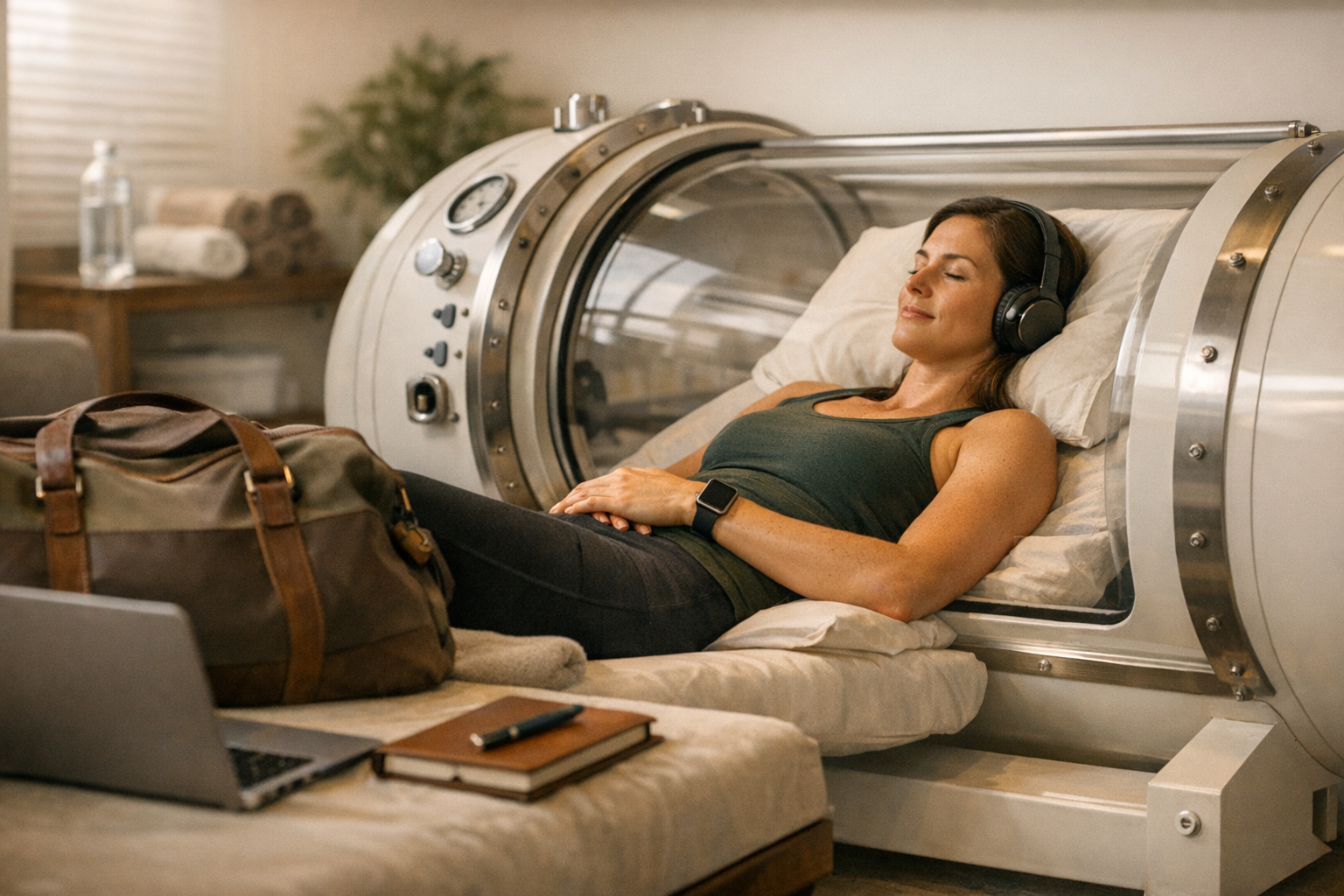
- A calm, quiet environment—many people use it for breathwork, mindfulness, or simply resting.
- Post-session clarity or relaxation is commonly reported, though not guaranteed.
Can you multitask?
From a recovery perspective, treating HBOT as protected downtime is often the point. If you must work, consider low-cognitive tasks (listening to an audiobook, reviewing notes). If your days are relentlessly switched-on, doing nothing may be the most performance-supportive choice you make all week.
HBOT for training recovery: a sensible “busy professional” protocol
Protocols vary, and the right plan depends on your training load, stress levels and how you respond. The aim here is to give a practical framework—something you can execute without turning recovery into a logistical puzzle.
Option A: Maintenance during steady training blocks
- Frequency: 1 session per week
- Best for: consistent training, moderate life stress, proactive recovery support
- Scheduling tip: place it after your hardest session or mid-week to reduce cumulative fatigue
Option B: Intensification during high-stress or high-volume weeks
- Frequency: 2–3 sessions per week for 2–4 weeks
- Best for: peak work deadlines, travel-heavy periods, increased training volume
- Scheduling tip: book in advance like meetings; otherwise it won’t happen
Option C: Post-event or “re-entry” support
- Frequency: 2–5 sessions across 7–14 days
- Best for: after a race, long hike, tournament weekend, or return to training after time off
- Scheduling tip: pair with sleep prioritisation and gentle mobility to consolidate recovery
Key principle: choose the smallest effective dose you can maintain. Recovery is only useful if it’s repeatable.
How to stack HBOT with other recovery tools (without overdoing it)
High performers sometimes fall into the “more recovery equals better recovery” trap—ice bath, sauna, massage, supplements, gadgets… and suddenly recovery becomes a full-time project. The goal is synergy, not exhaustion.
A simple recovery stack that works for most people
- Sleep anchor: consistent wake time + 7–9 hours opportunity in bed, most nights.
- Protein and hydration basics: evenly distributed protein across meals; adequate fluids and electrolytes around training.
- Mobility snack: 8–12 minutes on high-frequency areas (hips, calves, T-spine) 4–6 days per week.
- One “deep recovery” session: HBOT, massage, or guided breathwork—choose one per week and commit.
Where HBOT fits best
HBOT can be the “deep recovery” pillar, particularly when you want something time-efficient that doesn’t require extra physical effort. It pairs well with:
- Strength and conditioning blocks where muscle soreness accumulates
- High-stress work periods where sleep quality dips
- Travel weeks where circulation and routine suffer
What to avoid stacking mindlessly
- Too many intense hormetic stressors at once (e.g., hard training + sauna + ice + poor sleep). You can end up adding stress rather than resolving it.
- Using recovery tools to compensate for chronic under-sleeping. Nothing replaces sleep as the foundation.
Practical self-checks: how to know if HBOT is helping you
Because recovery is multifactorial, it’s worth tracking a few simple markers. Not obsessively—just enough to make an informed decision.
Track these for 2–4 weeks
- Morning readiness: energy on waking (1–10), willingness to train (1–10)
- DOMS severity: how sore you feel 24–48 hours after key sessions
- Sleep quality: time to fall asleep, night waking, how restored you feel
- Training consistency: did you complete sessions as planned without dragging?
- Mood and patience: often an early sign of overload in busy professionals
What “success” tends to look like
For many people, improvement is subtle but valuable: fewer days feeling flat, better ability to hit planned sessions, and less cumulative fatigue during demanding weeks. If you need dramatic changes to justify it, you may be missing easier wins in sleep, nutrition, programming, or stress management.
A realistic recovery plan for busy professionals (with and without HBOT)
If you want a plan that actually survives a busy diary, keep it simple, schedule it, and make it measurable.
The LIVBETTER-style weekly recovery blueprint
- 2–4 training sessions you can repeat for months (not a perfect plan you abandon in two weeks)
- 1–2 low-intensity movement sessions (walk, Zone 2 cycle, mobility flow)
- 1 deep recovery appointment (HBOT can sit here)
- 1 admin block for food shopping and prep basics (even 45 minutes helps)
- Daily 10-minute downshift (breathing, stretch, or a short wind-down routine)
Two sample schedules
Schedule 1: The “early meetings” week
- Mon: Strength (45 mins)
- Tue: Walk + mobility (20 mins)
- Wed: HBOT (recovery appointment)
- Thu: Intervals or tempo (35–45 mins)
- Fri: Walk + early night
- Sat: Longer session (60–75 mins)
- Sun: Rest + prep
Schedule 2: The “travel” week
- Mon: Strength (hotel gym, 30–40 mins)
- Tue: Walk + gentle mobility (15 mins)
- Wed: HBOT (if available) or guided breathwork (20 mins)
- Thu: Easy run/cycle (30 mins)
- Fri: Rest
- Sat: Session at home (45–60 mins)
- Sun: Rest + sleep catch-up
Frequently asked questions about HBOT for recovery
Is HBOT “legal” or considered doping?
HBOT is a medical therapy with legitimate clinical uses. In wellness and performance contexts, it’s generally approached as a recovery modality. If you compete under specific governing bodies, check their rules, but HBOT is not typically treated like a banned performance-enhancing substance.
How quickly will I notice a difference?
Some people report feeling a difference after the first session (often in relaxation or perceived freshness). For training recovery patterns, it’s more sensible to assess over 2–4 weeks alongside stable training and sleep habits.
Can HBOT replace rest days?
No. HBOT may support recovery, but adaptation still requires appropriate programming: rest days, deload weeks, and sensible intensity distribution.
Is HBOT safe?
When delivered by trained professionals with appropriate screening, HBOT is generally well-tolerated. As with any intervention, there are risks and contraindications—particularly related to pressure changes—so proper assessment matters.
How LIVBETTER approaches HBOT for high performers
At LIVBETTER, we view recovery as a performance strategy—not an indulgence. HBOT can be one part of a broader plan that also includes nutrition foundations, stress reduction and technology-enabled therapies designed to fit into a busy life.
If you’re considering HBOT for training recovery, the most helpful next step is a short conversation about your training week, work stress, sleep patterns and goals. From there, we can suggest a protocol that’s realistic, trackable and aligned with your lifestyle—whether that’s a weekly maintenance session or a short, focused block during intense periods.
Action steps you can do this week (even without HBOT)
If you’re reading this because you feel under-recovered, here are practical moves that usually make an immediate difference:
- Book one recovery appointment (HBOT, massage, or a guided session) and treat it like a client meeting.
- Set a sleep “last call”: pick a time 60 minutes before bed when screens and work stop.
- Hit protein early: include a protein source at breakfast to reduce the day’s nutritional stress.
- Add a 10-minute mobility snack after training or before bed—consistency beats complexity.
- Reduce training intensity for 7 days if you’re dragging. Keep frequency, lower intensity, and rebuild.
Then, if you want to explore HBOT, choose a 2–4 week trial and track the markers above. That’s how you make recovery decisions like a professional: structured, evidence-informed, and tailored to your real life.
Next Steps
Want to learn more? Check out these articles:
HBOT for Post-Travel Recovery [Guide to Reset Fast]
HBOT for Soft Tissue Recovery: A Practical Guide 2
HBOT for Scar Recovery Support: A Practical Guide for Healing
Check out our Therapies to see which options fit your goals.