
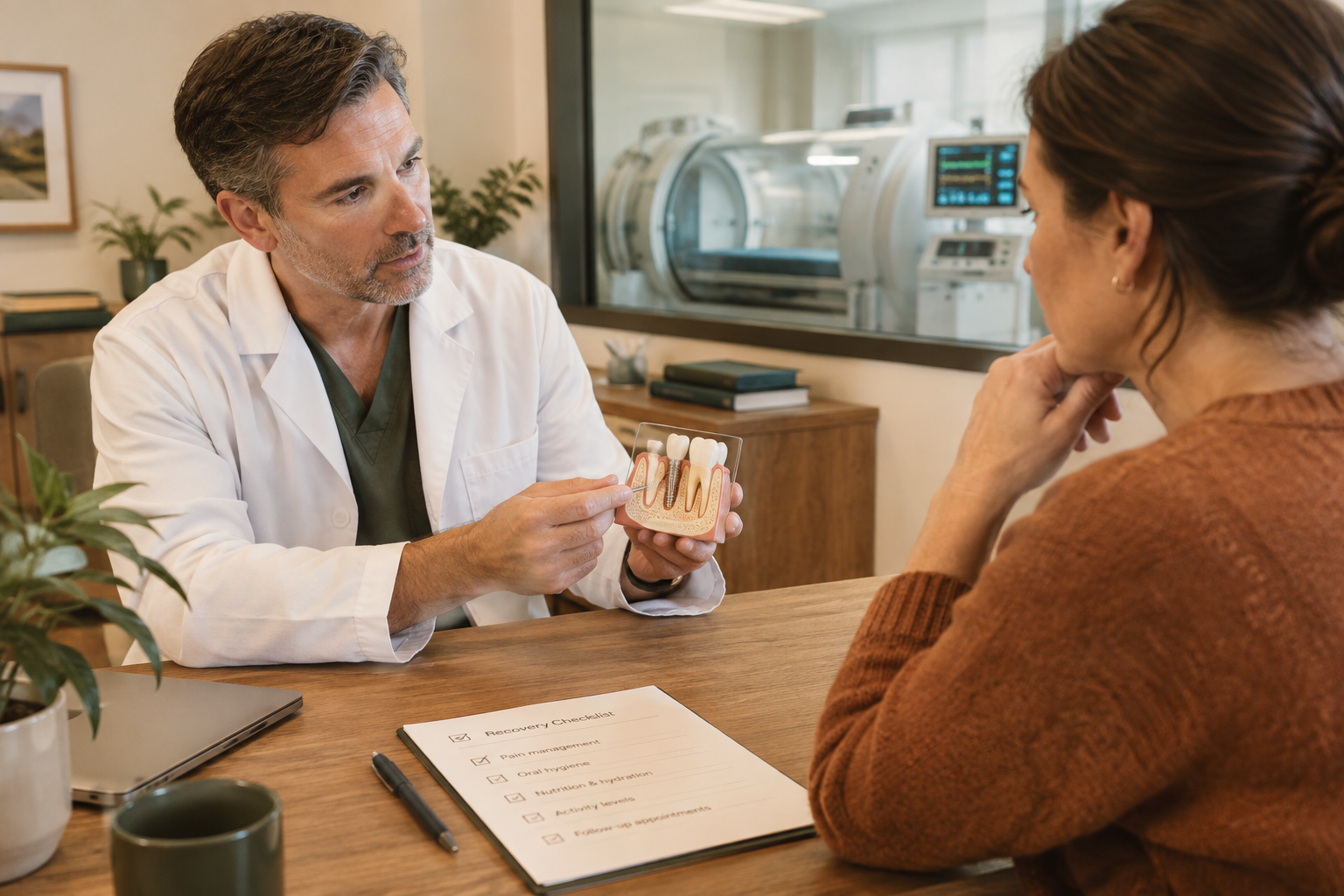
HBOT for Dental Implant Recovery: 4 Things You Need to Know
Dental implants are designed for the long term, but the first stage of recovery can make even patient people impatient. If you have been reading about hyperbaric oxygen therapy (HBOT), you may be wondering whether extra oxygen could help your gum and bone heal more effectively.
It is a reasonable question. Oxygen matters for wound healing, and HBOT has established uses in selected medical settings. However, that does not mean it has been shown to improve recovery after routine dental implant surgery.
This HBOT for dental implant recovery guide covers four essentials: what the therapy does, what the evidence supports, who needs particular caution, and how to build a sensible recovery plan. The aim is not to add another appointment to your diary. It is to help you understand whether there is a sound clinical reason to consider one.
1. Understand what HBOT can — and cannot — do
How hyperbaric oxygen therapy works
Medical HBOT involves breathing near-100% oxygen inside a chamber pressurised above normal atmospheric pressure. The increased pressure allows more oxygen to dissolve in the liquid part of your blood, temporarily increasing the oxygen available to tissues.
In appropriate clinical circumstances, this can support oxygen-dependent processes involved in wound repair. These include collagen formation, aspects of immune cell activity, and the development of small blood vessels over a course of treatment.
Those mechanisms are relevant to healing, but they are not proof that every healing wound benefits from HBOT. Healthy tissue with an adequate blood supply may not gain a meaningful clinical advantage from additional oxygen.
The distinction matters: a treatment can have a convincing biological explanation without having strong evidence that it improves a particular outcome.
Where oxygen fits into implant recovery
After an implant is placed, two overlapping processes take place. The gum tissue heals around the surgical site, while the surrounding bone gradually forms a stable connection with the implant surface. This second process is called osseointegration.
Early gum healing commonly progresses over the first couple of weeks. Bone integration usually takes longer, often several months, depending on the site, bone quality, any grafting, and your treatment plan. Your surgeon's timeline is more useful than a general estimate.
Recovery also depends on:
- A stable implant and appropriate surgical technique.
- Adequate blood supply and healthy surrounding tissues.
- Good plaque control without disturbing the surgical site.
- Avoiding smoking and following advice about vaping and nicotine.
- Managing relevant health conditions and attending reviews.
HBOT cannot compensate for an unstable implant, remove plaque, correct excessive loading, or replace treatment for a surgical complication. It should never be presented as insurance against implant failure.
Not all oxygen chambers deliver the same treatment
The term 'hyperbaric' is sometimes used broadly in wellness advertising. Lower-pressure chambers, including some that use compressed air, do not necessarily deliver the same oxygen exposure as hospital-based medical HBOT.
Evidence from a particular medical protocol cannot automatically be applied to a different chamber, pressure, or oxygen delivery system. Before comparing services, ask exactly what is being delivered and whether the supporting research matches that treatment.
Comfort and convenience matter, but they are not substitutes for an appropriate indication, medical screening, and qualified supervision.
2. Look at the evidence, not just the explanation
Routine dental implants: benefit remains uncertain
For otherwise healthy people having uncomplicated dental implant surgery, there is not strong, consistent clinical evidence that HBOT improves implant survival or meaningfully shortens recovery. It is not a standard part of routine implant aftercare.
Some research explores oxygen therapy and bone healing, including laboratory and animal studies. These can identify useful questions, but they do not establish that a person will experience less pain, faster osseointegration, or fewer complications.
Even human studies need careful interpretation. Small samples, different oxygen protocols, and differences in patients' underlying health can make results difficult to generalise.
A helpful question is: 'Has this been shown to improve an outcome that matters to someone having the same procedure as me?' A change in a laboratory marker is not the same as an implant lasting longer.
Previous head and neck radiotherapy changes the discussion
People who have received radiotherapy involving the jaws need a different level of assessment before implant surgery. Radiation can affect blood supply and the ability of bone and soft tissue to repair. One recognised complication is osteoradionecrosis, in which previously irradiated jawbone becomes damaged and fails to heal normally.
HBOT has historically been considered in some of these pathways. However, it should not be assumed to be necessary or effective for everyone with previous radiotherapy.
The 2024 ISOO–MASCC–ASCO guideline on osteoradionecrosis concluded that the use of HBOT for its prevention and management remains largely unjustified because supporting evidence is limited. The HOPON randomised trial also did not demonstrate a preventive benefit for osteoradionecrosis following dentoalveolar surgery in the irradiated mandible.
These findings do not mean every complex case is identical. They do mean that a previous cancer treatment is a reason for specialist planning, not an automatic reason to book oxygen sessions. Your oral and maxillofacial team should guide decisions using your radiation history, examination, imaging, and overall risk.
Complicated healing needs a diagnosis first
If a surgical site is not healing as expected, the priority is to identify why. Possibilities include infection, wound breakdown, mechanical problems, or other factors that require specific management.
In selected complex situations, a specialist may consider HBOT within a broader care plan. That decision should be tied to a recognised clinical problem and current guidance, rather than to the general idea of 'boosting recovery'.
Before agreeing, ask:
- What specific problem are we trying to address?
- What evidence supports HBOT for that problem?
- What are the alternatives, including standard care alone?
- How will we judge whether the plan is helping?
3. Check safety, suitability, and the practical commitment
Medical screening is essential
HBOT is a medical intervention, not simply a relaxation session with more oxygen. Pressure changes and high oxygen exposure create risks that need proper assessment.
An untreated pneumothorax, or collapsed lung, is an absolute contraindication. Other lung conditions, difficulty equalising ear pressure, recent ear surgery, certain medicines, and some implanted medical devices may require additional assessment or precautions.
Tell the clinician about your full medical history, current medicines, pregnancy, previous reactions to pressure changes, and any recent respiratory infection. People with diabetes may need blood glucose checks and an individual plan around food and medication.
A dental implant itself is not usually a barrier to HBOT, but that does not remove the need to review your surgery and wider health.
Side effects and chamber safety
Possible adverse effects include:
- Ear or sinus discomfort, including pressure-related injury.
- Temporary changes in vision during a treatment course.
- Anxiety or claustrophobia inside the chamber.
- Changes in blood glucose, particularly in people using glucose-lowering medication.
- Rare oxygen-toxicity seizures and other uncommon complications.
Oxygen-rich environments also carry a fire risk. A reputable service should have strict rules about clothing, electrical items, cosmetics, and other materials entering the chamber. Follow those instructions precisely.
Ask how staff monitor patients, manage ear equalisation difficulties, and respond to emergencies. Good clinical care includes being willing to postpone or decline treatment when it is not appropriate.
There is no universal dental recovery schedule
There is no evidence-based HBOT timetable suitable for everyone after implant placement. A generic recommendation to start immediately, attend a set number of sessions, or expect faster healing should prompt questions.
Where treatment is clinically indicated, the prescribing team determines the pressure, duration, frequency, and review points. Sessions may take a substantial part of the day once preparation and travel are included.
Discuss the total cost and time commitment alongside the uncertainty of benefit. For a straightforward recovery, protecting sleep, following aftercare, and attending dental reviews are more firmly grounded priorities than adding an unproven intervention.
4. Build a recovery plan around the essentials
Follow your surgeon's instructions first
Your aftercare should reflect the exact procedure you had. Implant placement alone, a bone graft, and a sinus lift can involve different restrictions. Written advice from your treating team takes priority over general online guidance.
A practical sequence is:
- Before surgery, share your medical history and clarify whom to contact with concerns. If you are considering HBOT, discuss it before booking.
- In the early recovery period, take prescribed medicines as directed and follow instructions for bleeding control, oral hygiene, rinsing, and activity.
- As comfort improves, maintain suitable nutrition and gradually return to normal activities within your surgeon's guidance.
- At review appointments, let your dental team assess healing and confirm when the implant can safely take more load.
Do not use reduced pain as proof that the bone has fully integrated. Gum comfort and implant stability are different things, and only your treating team can assess progress appropriately.
Eat to support repair, without overcomplicating it
Healing requires enough energy, protein, and a varied supply of nutrients. A restrictive diet or a cupboard full of supplements is not the answer.
Choose soft foods that fit your surgeon's instructions and include a source of protein across the day. Options may include yoghurt, scrambled eggs, soft fish, tofu, or smooth lentil soup once it has cooled sufficiently.
Stay hydrated and avoid chewing directly on the surgical area until advised otherwise. Follow any specific advice about hot foods, alcohol, straws, and foods that could irritate or lodge around the wound.
Supplements are not routinely necessary when your intake is adequate. If you have a diagnosed deficiency, a limited diet, or difficulty eating, ask your clinician or a registered dietitian for tailored advice.
Protect the basics that influence healing
Smoking increases the risk of implant complications. If you smoke, ask for practical cessation support before surgery rather than trying to manage it alone at the last minute. Discuss vaping and nicotine products with your dental team too; do not assume they are risk-free for recovery.
Prioritise regular sleep and allow time to recover. Resume exercise according to your surgeon's advice, especially after grafting or more extensive surgery. Keep cleaning the rest of your mouth while following the specific instructions for the operated area.
If you have diabetes or another condition relevant to healing, continue the management plan agreed with your healthcare team. HBOT should not displace that ongoing care.
Know when to contact your dental team
Some swelling, tenderness, and minor bleeding can be expected initially. What matters is the pattern: symptoms should generally settle rather than become progressively worse.
Contact your dental team promptly for worsening pain or swelling after initial improvement, fever, pus, a persistent unpleasant taste, wound opening, or a sense that the implant is moving. Persistent bleeding or numbness beyond what your team advised also warrants assessment.
Difficulty breathing or swallowing, rapidly spreading facial or neck swelling, or heavy bleeding that does not stop needs urgent emergency care.
Do not wait for an HBOT appointment to investigate these symptoms. Oxygen therapy is not a substitute for examining the surgical site and addressing the cause.
Making a confident, proportionate decision
For most people having routine dental implants, HBOT is not an established recovery essential. Its biological effects are interesting, but evidence of a meaningful additional benefit in uncomplicated cases remains insufficient.
If your circumstances are complex, the right next step is a conversation between your implant surgeon and an appropriately qualified hyperbaric clinician. Any recommendation should include a clear rationale, realistic expectations, alternatives, and a plan for review.
At LIVBETTER, our approach to technology-enabled wellbeing starts with the same principle: the right intervention should fit the person and the evidence. More treatment is not automatically better care.
Focus first on excellent dental aftercare, adequate nutrition, sleep, and timely reviews. If HBOT enters the discussion, you will be better equipped to ask not just 'Could it help?' but 'Is it justified for me?'
Evidence informing this guide
- ISOO–MASCC–ASCO clinical practice guideline, 2024: Prevention and Management of Osteoradionecrosis in Patients With Head and Neck Cancer Treated With Radiation Therapy.
- HOPON randomised controlled trial, 2019: hyperbaric oxygen for preventing osteoradionecrosis following dentoalveolar surgery in the irradiated mandible.
These sources address radiation-related jaw risk, not proof of benefit after routine implants. This guide provides general education and does not replace individual dental or medical advice.
Next Steps
Want to learn more? Check out these articles:
HBOT for Active Adults: A Guide to Recovery and Wellness
HBOT for Recovery After Demanding Weeks: A Practical Guide
Your HBOT Wellness Guide for Cellular Recovery and Better Energy
Check out our Therapies to see which options fit your goals.