
HBOT for Recovery After Demanding Weeks: A Practical Guide
Ever notice how one intense fortnight can linger in your body far longer than it “should”? The presentation, the travel, the late nights, the hard training block, the family logistics—then suddenly you’re back at your desk, doing the same workload with half the battery. Most high performers don’t need a motivational speech; they need a smarter recovery plan.
Hyperbaric Oxygen Therapy (HBOT) is one option that’s gained attention for supporting recovery when life has been demanding. It’s not a magic reset button, and it won’t replace sleep, nutrition, or sensible training. But used well, HBOT may support the body’s natural repair processes—particularly when you’re run down, inflamed, or simply struggling to feel like yourself again.
This guide breaks down what HBOT is, how it works, who it’s for (and who should avoid it), and how to build a realistic recovery routine around it—especially after those “all gas, no brakes” weeks.
What “recovery” really means after a demanding period
Recovery isn’t just sore muscles settling down. After a demanding stretch, people often experience a mixed picture:
- Physical fatigue: heavy legs, slower training times, reduced strength, niggling aches.
- Mental fatigue: brain fog, poor concentration, decision fatigue.
- Sleep disruption: wired-but-tired evenings, early waking, unrefreshing sleep.
- Stress load: higher resting heart rate, irritability, reduced resilience.
- Immune dips: frequent colds, feeling “run down”.
Under the bonnet, demanding weeks can increase inflammation, oxidative stress, and sympathetic nervous system activation (your “fight or flight” tone). Your tissues also need oxygen to repair—whether that’s from intense training micro-damage or simply the wear-and-tear of long hours and poor sleep.
The goal is not to “hack” your way out of this. The goal is to create conditions where your physiology can recover more efficiently.
What is HBOT (Hyperbaric Oxygen Therapy)?
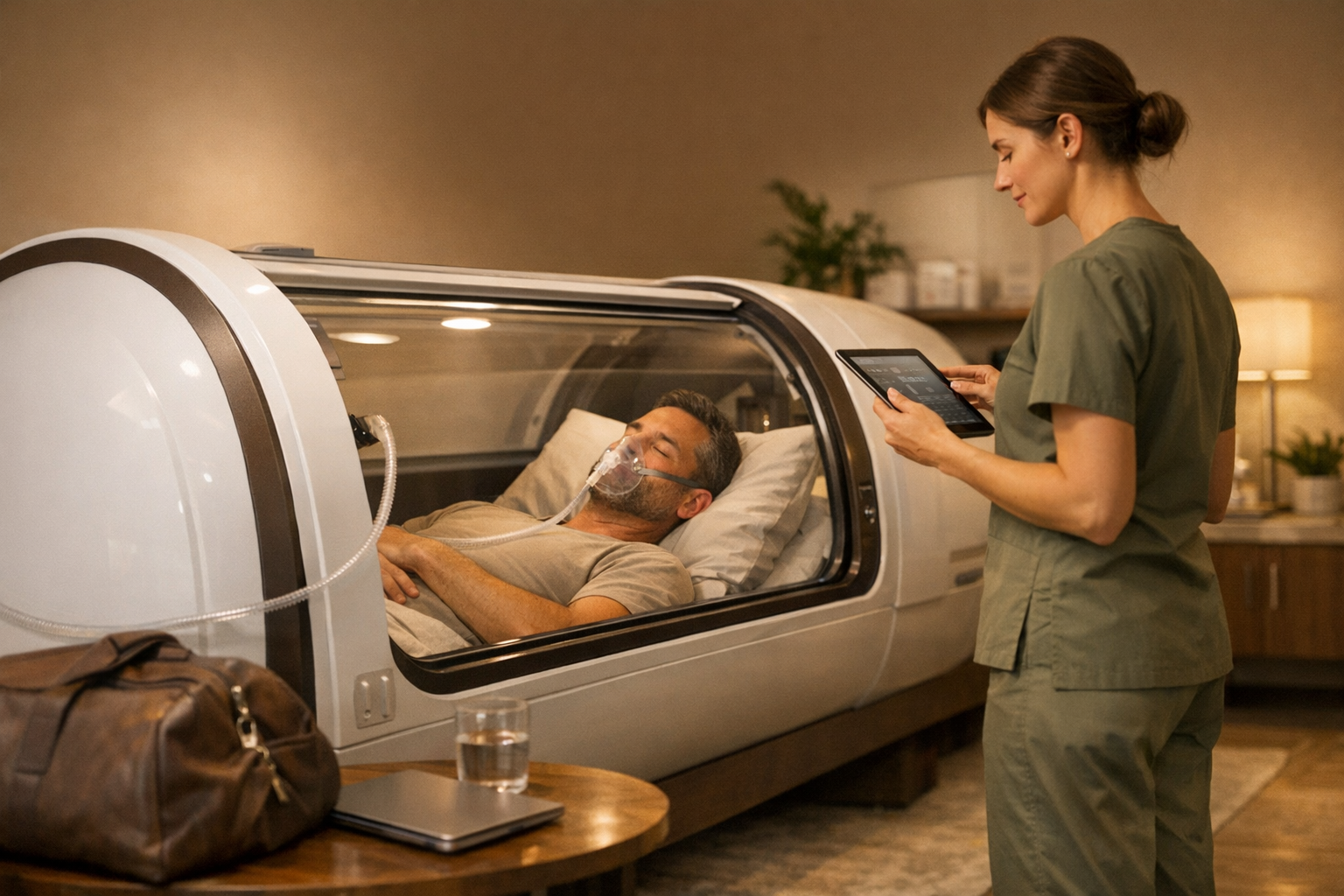
HBOT involves breathing oxygen in a pressurised chamber. Under pressure, more oxygen dissolves into the plasma (the fluid part of your blood), increasing oxygen delivery to tissues—beyond what’s possible at normal atmospheric pressure.
In medical settings, HBOT is used for specific conditions (for example, certain non-healing wounds). In performance and wellness contexts, many people use HBOT as a supportive tool when they feel depleted, inflamed, or slow to bounce back.
How HBOT may support recovery (in plain English)
Oxygen is central to repair. Adequate tissue oxygenation supports:
- Cellular energy production (mitochondrial function), which can influence stamina and recovery capacity.
- Tissue repair and regeneration processes.
- Inflammation modulation (helping the body shift from “stuck on” to “settle and repair”).
- Circulation and microvascular function (how well your smallest vessels deliver oxygen and nutrients).
Research in this space is evolving. The most responsible way to frame HBOT is: it may support recovery biology, and many people report feeling clearer and more energised when it’s used as part of a broader plan.
Who may consider HBOT after demanding weeks?
HBOT can be a sensible option if you’re generally healthy but feel as though your system hasn’t caught up with the pace you’ve been running at. Examples include:
- Busy professionals after extended high-pressure deadlines.
- Parents after disrupted sleep periods and “life overload”.
- Athletes after intense training blocks, competitions, or travel.
- People who feel slow to recover from knocks and niggles (without an acute injury that needs medical assessment).
- Anyone looking for a structured, technology-enabled recovery session they can actually fit into a busy week.
At LIVBETTER, we often see clients who aren’t “ill”—they’re simply under-recovered. They want a plan that respects real life, not an idealised routine that requires three-hour mornings and a personal chef.
Who should not use HBOT (or should speak to a clinician first)
HBOT isn’t for everyone. Safety matters, and screening is essential. You should avoid HBOT or get medical clearance if you have:
- Untreated pneumothorax (collapsed lung) or certain lung conditions.
- Some ear/sinus issues that prevent pressure equalisation (unless managed appropriately).
- Recent certain surgeries or infections where pressure is contraindicated.
- Uncontrolled seizure disorders.
- Specific medication considerations (a clinician should advise).
If you’re pregnant, have significant cardiovascular or respiratory disease, or you’re unsure, a proper medical screen is non-negotiable. A reputable provider will prioritise this.
What an HBOT session feels like (and what it doesn’t)
Most people’s first question is: “Will it feel claustrophobic?” The honest answer: it depends. Modern chambers are designed for comfort, but it’s still a contained space. During pressurisation you may feel ear pressure similar to take-off/landing in a plane. You’ll be guided through simple techniques to equalise, and sessions are monitored.
Common experiences people report
- Feeling relaxed during the session (some people nap).
- A “clear-headed” feeling afterwards.
- Improved readiness to train or work later that day (varies by person).
What not to expect
- Instant transformation after one session.
- Guaranteed outcomes—response is individual and depends on your baseline recovery habits.
- A replacement for sleep (HBOT can complement, not cancel out, poor rest).
The science basics: why pressure changes oxygen delivery
At normal atmospheric pressure, most oxygen is carried by haemoglobin in red blood cells. Under hyperbaric conditions, more oxygen dissolves directly into plasma. This matters because dissolved oxygen can reach areas with compromised circulation and can increase the overall availability of oxygen for cellular processes.
From a recovery perspective, better oxygen availability may support the body during periods of higher repair demand—after intense exercise, stress, travel, or sleep loss. Again, it’s a support tool. The foundations still drive the biggest outcomes.
HBOT for “demanding weeks”: a realistic use-case
Let’s make this practical. A demanding two-to-four-week period typically involves:
- Reduced sleep quantity and quality
- Less daylight and movement
- More caffeine and irregular meals
- Higher training load or more sitting (sometimes both)
- More alcohol or social events (for some)
- More screen time and mental load
Recovery becomes less about one perfect intervention and more about stacking small, high-yield actions. HBOT can be one of those actions because it’s structured: you turn up, you do the session, and your body gets a focused recovery input.
How to build an “HBOT-supported” recovery plan (7–10 days)
If you’ve just come through a demanding stretch, aim for a short, intentional reset window. Here’s a clinically sensible framework.
Step 1: Start with a quick recovery audit (10 minutes)
Before booking anything, ask:
- How many nights this week did I get 7–9 hours of sleep?
- How many days did I get daylight within an hour of waking?
- Am I hydrated (urine pale straw, not clear all day, not dark)?
- Have I eaten adequate protein and fibre most days?
- Have I moved at an easy pace (walking, cycling, mobility) at least 3 times?
- Is my training load appropriate—or am I trying to “catch up”?
If three or more are a “no”, your first wins are behavioural. HBOT can sit alongside them, but it shouldn’t be used to compensate for them.
Step 2: Choose your HBOT timing wisely
For many people, HBOT fits best:
- After the demanding period ends (not mid-crisis), when you can actually protect your sleep and nutrition.
- On lighter training days or rest days.
- Earlier in the day if you’re sensitive to feeling alert afterwards (individual).
If your goal is general recovery support, consistency usually matters more than intensity. Your provider can advise on an appropriate schedule based on your needs and medical screen.
Step 3: Pair HBOT with “non-negotiable” recovery behaviours
HBOT works best when it’s part of a system. For the 7–10 day reset, prioritise:
- Sleep anchors: fixed wake time, dim lights 60–90 minutes before bed, caffeine cut-off by late morning/early afternoon.
- Protein at breakfast: helps stabilise appetite and supports tissue repair. Aim for a meaningful portion (e.g., eggs/Greek yoghurt/tofu + fruit + oats).
- Daily low-intensity movement: 20–40 minutes walking is underrated for circulation, mood and stiffness.
- Hydration + electrolytes if needed: particularly after travel, heavy sweating, or lots of caffeine (food first; consider electrolytes if you’re cramping or training hard).
- Reduce “invisible stress”: one less high-stimulus input per day (doom-scrolling, late emails, intense training when exhausted).
Step 4: Keep training “easy enough” to actually recover
If you train, the most common mistake after demanding weeks is trying to win back fitness immediately. Instead:
- Keep intensity low for several sessions (Zone 2-style effort).
- Maintain strength work but reduce volume (fewer sets) for a week.
- Prioritise mobility and tissue tolerance over PBs.
This isn’t deconditioning. It’s strategic consolidation—where your fitness adapts because you finally allow recovery.
What results are realistic to expect?
With responsible expectations, people often use HBOT because they want to feel:
- Less “wired and tired”
- Clearer mentally
- More recovered after training
- Better able to handle a busy schedule without crashing
It’s important to say: these are supportive effects and vary person-to-person. If you’ve been under-sleeping for months, one or two sessions won’t rewrite physiology. But as part of a broader plan, HBOT may help you shift from “surviving” back to “functioning well”.
HBOT safety, side effects, and comfort tips
Most side effects are mild and related to pressure changes. A good provider will brief you thoroughly and monitor throughout.
Potential side effects (usually temporary)
- Ear discomfort or difficulty equalising pressure
- Sinus pressure
- Fatigue afterwards (some people feel sleepy)
- Light-headedness (less common)
Simple tips to improve your session
- Arrive hydrated and avoid heavy alcohol the night before.
- Don’t rush in stressed—give yourself 10 minutes to settle.
- Practise equalising (swallowing, yawning, gentle Valsalva if instructed).
- Dress comfortably and keep your schedule light afterwards if it’s your first time.
HBOT vs other recovery tools: where does it fit?
In a world full of recovery options, it helps to know what each tool does best.
HBOT may be a good fit if you want
- A structured, time-efficient recovery session
- Support for overall restoration after sustained stress
- A technology-enabled approach that complements training and work
Other tools that pair well (and when)
- Sauna/heat therapy: can support relaxation and circulation; best when you’re sleeping well and not already depleted.
- Cold exposure: can reduce soreness perception for some, but may not be ideal immediately after strength sessions if hypertrophy is a main goal; timing matters.
- Massage/manual therapy: excellent for tightness, pain modulation, and down-regulating stress.
- Breathwork and down-regulation: surprisingly powerful for sleep and HRV; free and immediate.
Think of HBOT as part of a “recovery stack” that you rotate based on what your body is signalling—rather than something you do compulsively.
A simple “demanding weeks” recovery checklist (save this)
If you want a clear plan for next time life gets heavy, use this checklist:
Within 24–48 hours of the demanding period ending
- Book two lighter days (reduce training intensity, reduce evening commitments)
- Prioritise two early nights
- Plan protein-forward meals (no guesswork)
- Schedule one recovery session you’ll actually attend (HBOT, mobility class, massage)
Over the next 7 days
- Keep wake time consistent
- Get morning daylight exposure most days
- Walk daily (20–40 minutes)
- Train at lower intensity than your ego wants
- Limit alcohol to support sleep architecture
- Consider HBOT sessions as part of your recovery plan (with proper screening)
When to seek medical advice instead of “more recovery”
Sometimes fatigue is a sign you need medical input, not another wellness session. Speak to a clinician if you have:
- Persistent exhaustion for several weeks
- Shortness of breath, chest pain, fainting, or palpitations
- Unexplained weight change, fevers, night sweats
- Significant mood changes or inability to function day-to-day
- New neurological symptoms (severe headaches, weakness, numbness)
High performance should never mean ignoring red flags.
How LIVBETTER approaches HBOT for modern recovery
At LIVBETTER, we see recovery as a skillset: physiology plus behaviour plus consistency. HBOT can be a helpful part of that, particularly when you’re coming out of a demanding period and want a clinically grounded, time-efficient way to support restoration.
If you’re considering HBOT, the best first step is a proper screen and a brief goal-based discussion: what has your last month looked like, what are you feeling now, and what would “better” realistically look like in two weeks? From there, an appropriate schedule can be suggested—alongside practical foundations like sleep timing, training load management, and nutrition basics.
Final thoughts: recovery is the performance advantage you can actually control
The modern world rewards output, but your body keeps the score. When you’ve had a demanding run, the most effective move is to recover deliberately—not perfectly, just consistently.
HBOT may support recovery by improving oxygen availability and helping create the internal conditions your body needs to repair and reset. Combine it with unglamorous fundamentals (sleep, movement, protein, and stress reduction) and you’ll give yourself the best chance of feeling energised, clear, and resilient again—ready for whatever the next demanding week brings.
Next Steps
Want to learn more? Check out these articles:
HBOT for Cellular Recovery and Wellness: A Practical Guide
HBOT for Training Recovery for Busy Pros [Guide 2]
HBOT for Post-Travel Recovery [Guide to Reset Fast]
Check out our Therapies to see which options fit your goals.