
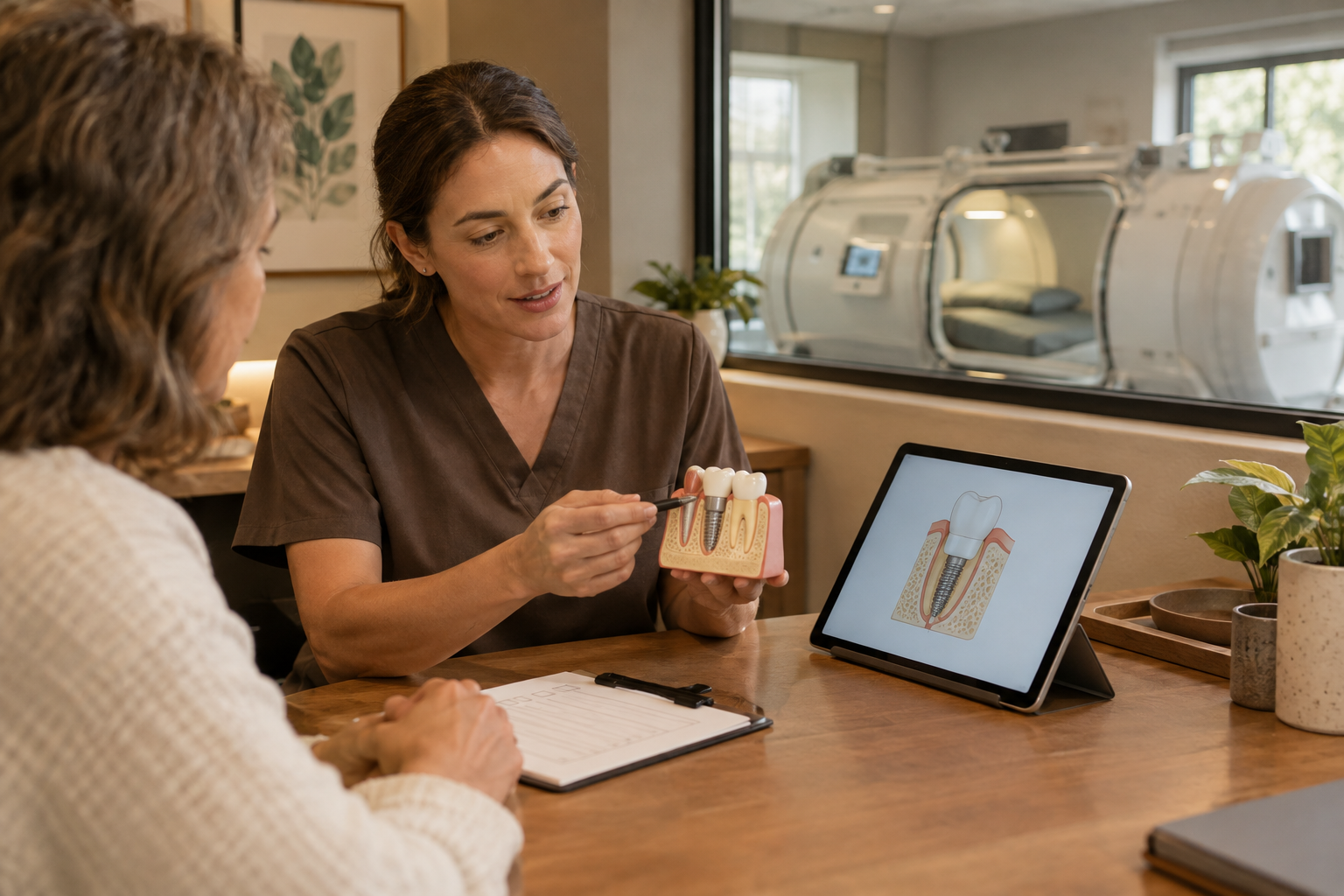
HBOT for Dental Implants: 5 Things to Know as You Heal
A dental implant may be small, but the recovery plan can feel surprisingly big. Between choosing soft foods, keeping the area clean and wondering when you can exercise again, it is understandable to look for ways to support healing.
Hyperbaric oxygen therapy, usually shortened to HBOT, sometimes enters that conversation. It increases oxygen delivery under controlled pressure and has established medical uses in selected circumstances. However, that does not mean it is necessary, or proven helpful, after an uncomplicated dental implant procedure.
This five-part guide explains where HBOT might fit, what the evidence can and cannot tell us, and which everyday recovery habits deserve your attention first. The aim is not to add another appointment to your diary. It is to help you make a confident, well-informed decision with your dental team.
1. Understand what HBOT does during recovery
Oxygen supports healing, but more is not always better
Healing tissues need oxygen. It supports cellular energy production, collagen formation and aspects of the immune response. After implant placement, your body also begins osseointegration: the gradual process through which bone forms a stable connection with the implant surface.
During medical HBOT, you breathe near-100% oxygen in a chamber pressurised above normal atmospheric pressure. This increases the amount of oxygen dissolved in your blood plasma, allowing more oxygen to reach tissues where circulation permits.
That mechanism can be useful in certain clinically defined situations, particularly when tissue oxygenation is compromised. But a plausible biological mechanism is not the same as evidence that every implant patient will recover faster.
If blood supply and healing are already adequate, additional oxygen exposure may not provide a meaningful benefit. It should not be presented as a shortcut around the normal process of bone healing.
Not every oxygen chamber offers equivalent treatment
You may encounter terms such as “mild hyperbaric”, “oxygen therapy” or “recovery chamber”. These do not necessarily describe the same intervention used in clinical research.
Chamber pressure, oxygen concentration, exposure time and medical supervision all matter. Some lower-pressure systems use compressed air rather than delivering the oxygen exposure associated with established medical protocols. Evidence from one setup cannot simply be transferred to another.
Before considering treatment, ask:
- What pressure and oxygen concentration are used?
- Is the proposed treatment comparable to the protocol behind the evidence being discussed?
- Who assesses suitability and supervises treatment?
- How will the provider communicate with my implant dentist or oral surgeon?
A credible provider should welcome these questions and explain the limits as clearly as the potential benefits.
2. Separate promising science from proven implant benefits
Routine recovery: the evidence is limited
Laboratory and animal studies have explored how hyperbaric oxygen affects bone formation, blood vessel development and implant integration. Some findings are encouraging, but they cannot establish what happens in people having everyday implant surgery.
Human research is limited and includes patients with very different clinical circumstances. Results involving irradiated jawbone, for example, should not be used to promise benefits for someone with healthy bone having a straightforward implant.
For uncomplicated dental implant recovery, there is not strong clinical evidence that routine HBOT reliably reduces pain, shortens swelling, speeds up osseointegration or improves long-term implant survival.
This matters because swelling and discomfort often improve naturally. Feeling better after an HBOT session does not, by itself, show that the treatment caused that improvement.
Be cautious with claims about guaranteed healing times, percentage improvements or getting your final tooth fitted sooner. The timing of implant loading should remain a clinical decision based on stability, bone quality and your surgeon’s assessment.
Previous radiotherapy changes the conversation
A history of head and neck radiotherapy can affect blood vessels and tissue resilience. Implant planning in previously irradiated areas therefore needs specialist assessment.
HBOT may be considered in selected cases involving late radiation tissue injury, but that is a separate clinical question from supporting routine implant recovery. Even here, the evidence needs careful interpretation.
The HOPON randomised trial, published in 2019, studied people undergoing dental extractions or implant placement in a previously irradiated lower jaw. It did not support routine preventive HBOT to reduce osteoradionecrosis, a serious complication involving damaged jawbone.
A 2023 Cochrane review of HBOT for late radiation tissue injury found possible benefits for some selected patients and outcomes, alongside important limitations and uncertainty. It did not establish a universal dental implant recovery protocol.
The practical takeaway is simple: a specialist indication may justify a discussion, but “oxygen supports healing” is not enough to justify treatment for everyone.
3. Work out whether specialist assessment is relevant
Start with your implant team, not a session package
Your dentist or oral surgeon knows details that an independent wellness assessment may not capture: the condition of the bone, whether a graft was needed, initial implant stability and what happened during surgery. They should be the starting point for any additional recovery intervention.
Share your full medical history, including previous radiotherapy, diabetes, smoking, prescribed medicines and any earlier healing problems. These factors can change your overall care plan, but none automatically means you need HBOT. Bone grafting or a sinus lift also does not, on its own, establish a reason to use it.
If you have previously received head and neck radiotherapy, assessment may involve your oral and maxillofacial surgeon, oncology team and a hyperbaric medicine specialist. The radiation location, dose and current tissue condition all matter.
Questions that make the decision clearer
Before agreeing to treatment, use this five-question checklist:
- What specific problem are we trying to address? Ask whether there is a recognised medical indication or only a theoretical recovery benefit.
- What evidence applies to someone like me? Findings from a different patient group or chamber protocol may not be relevant.
- What are the alternatives? Standard follow-up, local dental care or addressing an underlying risk factor may be more appropriate.
- What would meaningful improvement look like? Agree on clinical measures rather than relying only on how energised you feel afterwards.
- What would make us stop or reconsider? Discuss adverse effects, lack of benefit and changes in the dental assessment.
These questions are not about being sceptical of technology. They are about matching the right intervention to the right person.
Do not overlook the practical burden
HBOT can involve repeated visits, travel and time away from work. A medical session often occupies around 90 minutes to two hours, depending on the protocol and preparation required.
There is no well-established standard number of sessions for uncomplicated dental implant recovery. A fixed package should not be mistaken for a clinically validated plan. Ask about total costs and realistic benefits before committing.
4. Check safety, timing and treatment quality
HBOT needs proper screening
HBOT is generally well tolerated when appropriately prescribed and supervised, but it is not risk-free. Pressure changes can affect the ears and sinuses, while oxygen exposure has its own potential adverse effects.
Possible problems include:
- Ear discomfort or middle-ear barotrauma from difficulty equalising pressure.
- Sinus pain, particularly when congested.
- Temporary changes in vision during a course of treatment.
- Claustrophobia or anxiety inside the chamber.
- Changes in blood glucose in people with diabetes.
- Rare oxygen-toxicity events, including seizures.
An untreated pneumothorax, meaning air trapped around a lung, is a major contraindication to HBOT. Lung conditions, recent ear surgery, seizures, pregnancy and certain medicines also require careful review rather than assumptions about suitability.
Tell the clinical team about all prescribed medicines and supplements. If you develop a cold, blocked ears or new breathing symptoms before a session, contact the provider before attending.
Oxygen-rich environments also require strict fire-safety procedures. Trained staff, equipment maintenance and clear emergency arrangements are essential, not optional extras.
Timing must follow the clinical plan
There is no universal rule that HBOT should begin immediately after implant surgery. Timing depends on the reason for treatment, the procedure performed and the assessment of both dental and hyperbaric clinicians.
If you have had a sinus lift, sinus complications or difficulty equalising ear pressure, make this explicit before any chamber exposure. Do not assume that a comfortable session before surgery guarantees suitability afterwards.
Most importantly, HBOT should never delay examination of a possible implant complication. Contact your dental team promptly for worsening pain or swelling after initial improvement, fever, pus, persistent bleeding or an implant that feels loose. Do not repeatedly test the implant yourself.
Rapidly spreading swelling, difficulty breathing or difficulty swallowing needs urgent emergency assessment. These symptoms are not something to manage with an extra recovery session.
5. Build your recovery around the essentials
Follow the instructions tailored to your procedure
The strongest recovery plan is often less glamorous than the technology available to support it. Your surgeon’s guidance takes priority because recommendations vary with the implant site, grafting, sutures and your medical history.
Use this practical sequence:
- Protect the surgical area. Avoid chewing directly on the site until advised otherwise. Do not touch or probe the wound.
- Keep your mouth clean as instructed. Ask when and how to brush around the implant. Use prescribed rinses only as directed, and avoid vigorous rinsing early on if your team advises against it.
- Take medicines correctly. Follow the prescribed pain-relief plan. If antibiotics are prescribed, take them as directed; they are not automatically necessary for every implant procedure.
- Return to activity gradually. Avoid strenuous exercise for the period recommended by your surgeon, then build back up according to symptoms and advice.
- Attend follow-up appointments. Feeling comfortable does not confirm that the bone has fully integrated with the implant.
If something in your written instructions is unclear, call the practice. A two-minute clarification is more useful than trying to reconcile conflicting advice online.
Give healing tissues adequate nutrition
Choose foods that are gentle on the surgical site while still providing enough energy and protein. Depending on your instructions and comfort, options may include yoghurt, soft scrambled eggs, smooth lentil soup, porridge or soft fish. Allow hot food and drinks to cool as advised.
Include a range of foods over the following days rather than relying only on low-nutrient liquids. Fruit and vegetables, suitable protein sources and adequate fluids support normal nutritional needs during recovery.
There is no good reason to assume that high-dose vitamins or a “healing stack” will improve implant outcomes when you are already adequately nourished. Supplements may be appropriate for an identified deficiency or dietary need, but discuss them with a clinician rather than adding them automatically.
Address the habits that can undermine recovery
Smoking is associated with poorer dental implant outcomes. Ask your dental team for practical cessation support rather than treating smoking as an issue that extra oxygen can offset.
Vaping should not be assumed to be a safe alternative during healing. Discuss it openly, along with any nicotine products, so your team can give appropriate advice.
Prioritise regular sleep and follow guidance about alcohol, particularly while taking pain medicines or antibiotics. If you have diabetes, keep following your agreed management plan and discuss changes in eating with your care team.
These steps may sound ordinary, but they provide the foundation that optional therapies cannot replace.
A useful rule: add support, not uncertainty
If an extra treatment makes your recovery more complicated without a clear clinical rationale, pause. Ask whether the same time and resources would be better spent on follow-up care, nutritious food, smoking cessation support or rest.
Making an informed choice with LIVBETTER
At LIVBETTER, technology-enabled wellbeing should sit alongside sound clinical judgement, not ahead of it. An advanced therapy is most useful when its purpose, evidence and limitations are clearly understood.
For most people recovering normally after dental implant placement, HBOT is not an established requirement. For selected people with complex tissue problems, a specialist-led discussion may be appropriate, particularly when there is a recognised medical indication beyond the implant itself.
Start with your dental team, ask what additional support would genuinely change your care, and keep the fundamentals consistent. A good recovery plan does not need to include every available technology. It needs to be appropriate for you.
Evidence behind this guide
Key sources include the HOPON randomised controlled trial, published in the International Journal of Radiation Oncology, Biology, Physics in 2019; the 2023 Cochrane review, Hyperbaric oxygen therapy for late radiation tissue injury; and the Undersea and Hyperbaric Medical Society’s guidance on recognised HBOT indications.
These sources address different clinical questions and should not be interpreted as proof of benefit for routine implant recovery.
This article provides general education and does not replace personalised advice from your dentist, oral surgeon or hyperbaric medicine specialist.
Next Steps
Want to learn more? Check out these articles:
HBOT for Active Adults: A Guide to Recovery in 4 Steps
HBOT After a Demanding Week: A Guide to Rest and Reset
HBOT for Cellular Recovery: What to Know and How to Plan
Check out our Therapies to see which options fit your goals.