
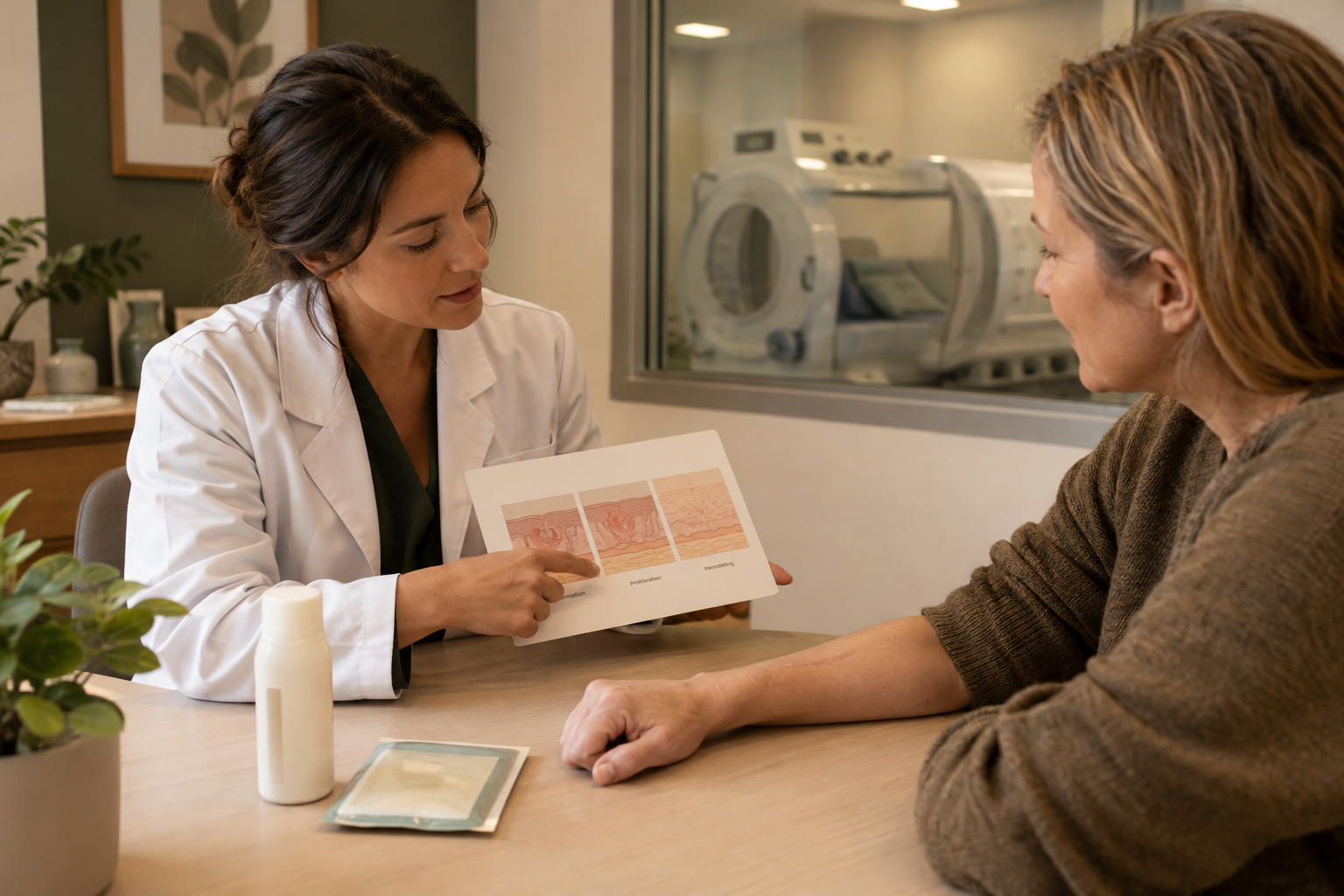
HBOT for Scar Recovery: 5 Things to Know Before You Start
A scar can be small and still take up a surprising amount of headspace. Whether yours follows surgery, an injury or a burn, it is natural to wonder what might help it settle, feel more comfortable and become less noticeable.
Hyperbaric oxygen therapy, usually shortened to HBOT, sometimes appears in that search. But there is an important distinction: supporting a wound that is struggling to heal is not the same as improving an established scar. The evidence for HBOT differs considerably between those situations.
This five-part guide explains how HBOT works, where it may have a role and why everyday scar care often deserves more attention than another treatment appointment. At LIVBETTER, our approach is to help you understand the options clearly, so any investment in recovery starts with a sound clinical reason rather than a big promise.
1. Understand whether you have a wound or a scar
The first question is not “How many HBOT sessions do I need?” It is “What stage of healing am I actually in?” That answer changes which support is appropriate.
Healing happens in overlapping stages
After an injury, the body controls bleeding, manages inflammation and builds new tissue. Once the surface closes, deeper repair continues as collagen, the structural protein in skin, is reorganised.
This remodelling phase can continue for 12–18 months, sometimes longer. A scar that initially looks pink, feels firm or seems slightly raised may gradually soften and fade without specialist intervention. Progress is rarely perfectly linear, and appearance alone does not tell the whole story.
Oxygen is involved in normal repair, including cellular energy production, collagen formation and immune defence. However, the fact that healing requires oxygen does not mean that extra oxygen improves every scar.
Different problems need different plans
- An open or persistently weeping wound needs assessment of healing, circulation, infection risk and wound care.
- A newly closed scar usually needs protection, time and advice suited to its location and the procedure involved.
- A thick, raised scar may be hypertrophic, staying within the original wound, or a keloid, extending beyond it.
- A scar that restricts movement, particularly after a burn, may require specialist rehabilitation or scar management.
- An older, flat scar with colour or texture changes raises different questions from an actively healing wound.
These categories can overlap. If you are unsure, a surgeon, GP or wound-care clinician can help identify what is happening before you commit to treatment.
A useful starting point is to define the concern: is it delayed closure, pain, itching, tightness or appearance? “Better recovery” becomes much more useful when it means something specific.
2. Know what HBOT can—and cannot—reasonably offer
Medical HBOT involves breathing oxygen in a chamber pressurised above normal atmospheric pressure. Under these conditions, more oxygen dissolves in the blood plasma, increasing oxygen delivery to tissues during treatment.
That mechanism can be useful in selected clinical situations. It is not evidence that HBOT smooths, lightens or removes ordinary scars.
Where the clinical rationale is stronger
Specialist hyperbaric services use HBOT for particular recognised indications. Some involve compromised healing, such as selected difficult-to-heal wounds, delayed radiation-related tissue injury and threatened skin grafts or flaps.
A graft or flap with a compromised blood supply is very different from a healthy surgical incision that has closed normally. Where HBOT is appropriate, it is an adjunct to the wider clinical plan—not a replacement for surgery, restoring blood flow, infection management or good wound care.
Even within recognised uses, eligibility depends on the diagnosis, severity, local guidance and clinical assessment. Benefits are not guaranteed, and the strength of evidence varies between conditions.
What the evidence means for scars
Research directly examining HBOT for routine scar appearance or prevention is limited and heterogeneous. Studies may involve different injuries, treatment protocols and outcome measures, making broad conclusions difficult.
Laboratory findings about oxygen, inflammation or collagen can help explain a possible mechanism. They cannot, by themselves, establish that a person with an uncomplicated surgical scar will achieve a better cosmetic result.
There is not strong clinical evidence to recommend routine HBOT solely to fade an established scar, flatten a keloid or prevent scarring after straightforward surgery. If this is your main goal, a scar-focused assessment is usually a more useful first step.
Also be cautious with before-and-after photographs. Scars naturally change over time, and lighting, camera angle, skincare and other treatments can influence the result. A photograph cannot show how much improvement came from HBOT rather than normal healing.
The most helpful question is: “What evidence supports this treatment for my type of wound or scar, at my stage of recovery?” A credible provider should welcome it.
3. Check that the treatment and provider match the evidence
Not every service described as “hyperbaric” delivers the same intervention. Chamber pressure, oxygen concentration, delivery method and clinical supervision all matter.
A lower-pressure chamber using air is not equivalent to a medical HBOT protocol using high-concentration oxygen. The results of a study using one setup should not automatically be applied to another.
Ask about the actual protocol
Rather than relying on terms such as “advanced oxygen” or “recovery chamber”, ask for a clear explanation of what you would receive and why.
- What is the clinical reason for recommending HBOT in my case?
- What pressure and oxygen delivery method will be used, and do these match the relevant evidence?
- Who assesses suitability, supervises treatment and manages complications?
- How will progress be measured, and when will the plan be reviewed?
- What are the alternatives, total likely costs and reasons to stop or reconsider?
You should also know whether the service communicates with your surgeon or wound-care team. This is particularly important when a wound is open, a graft is at risk or postoperative restrictions apply.
Expect an individual plan, not a preset promise
There is no established, evidence-based number of HBOT sessions for general “scar recovery”. A package of five sessions, for example, does not become clinically appropriate simply because it is convenient or easy to market.
For recognised indications, a hyperbaric specialist selects the schedule according to the condition and response. Some medical courses involve many appointments; others address urgent problems. A plan should have a clear purpose and review points.
If your goal is mainly cosmetic, ask whether a dermatologist or plastic surgeon would be better placed to advise. The right recommendation may be conventional scar care, observation or a different intervention altogether.
4. Put everyday scar care at the centre of recovery
Recovery often benefits from doing a few straightforward things consistently. These steps are not glamorous, but they are usually more relevant to an uncomplicated scar than adding an unproven treatment.
Always follow your surgical or wound-care team's instructions first. Advice changes depending on whether the skin is open, newly closed or fully healed.
Protect the skin and manage tension
- Follow dressing and cleaning instructions. Avoid adding creams, oils or devices to an open wound without clinical advice.
- Once healed, protect the area from sunlight with clothing and broad-spectrum SPF 30 or higher on exposed skin. This helps limit sun-related darkening and uneven colour.
- Ask about silicone gel or sheets for a raised scar. These are commonly recommended after the skin has fully closed, although evidence quality varies and results are not guaranteed.
- Return to movement gradually. Stretching or loading an incision too early can place unnecessary tension on healing tissue.
- Consider massage only when the wound is fully healed and your clinician agrees. It may help comfort or flexibility in some situations, but it is not a reliable way to erase a scar.
Scar location matters. A mark across a joint may need movement advice, while a scar under clothing may need protection from repeated rubbing. Small adjustments can make daily recovery more comfortable.
Support repair with food, sleep and sensible habits
Aim for regular meals with enough energy and protein. Useful protein sources include fish, eggs, yoghurt, beans, lentils and tofu. Include fruit, vegetables and varied whole foods rather than searching for a single “healing” ingredient.
Nutrients such as vitamin C and zinc contribute to normal repair, but high-dose supplements have not been shown to improve every well-nourished person's recovery. Supplements are best considered when intake is inadequate or a deficiency has been identified.
Prioritise a consistent sleep routine and follow activity restrictions. Smoking can impair wound healing; ask for cessation support, and discuss vaping or other nicotine use with your clinician rather than assuming they are risk-free.
If pain, low appetite or disrupted sleep is making these basics difficult, mention it. Practical support with those barriers may be more valuable than adding another recovery appointment.
5. Balance potential benefits with safety and realistic goals
HBOT is a medical intervention, not simply a more intensive version of taking a deep breath. For an appropriate indication, potential benefits may justify its demands and risks. For an ordinary mature scar, that balance is less convincing because benefit remains uncertain.
Understand the main risks
Pressure changes can cause ear or sinus discomfort and, occasionally, pressure-related injury. Some people experience claustrophobia. Temporary changes in vision can occur during a treatment course.
Less common but important risks include oxygen toxicity, which can cause seizures, and lung injury related to pressure changes. Oxygen-rich environments also create a serious fire risk, so facility safety rules are essential.
An untreated pneumothorax—a collapsed lung—is an absolute contraindication to HBOT. Other lung conditions, ear problems, recent procedures, pregnancy, medicines and relevant medical history require individual assessment. People using glucose-lowering medication may also need blood glucose monitoring.
Tell the assessing clinician about all prescribed medicines, over-the-counter products and supplements. Do not stop medication independently to make yourself eligible for a session.
Know when to seek medical help instead
Do not book a wellness appointment to investigate a wound that appears to be deteriorating. Seek prompt medical advice for increasing redness, warmth, swelling, worsening pain, pus, fever or a wound that reopens.
A surgical graft or flap that becomes unusually pale, dusky, cold or increasingly painful needs urgent review by the surgical team. Rapid deterioration or feeling seriously unwell warrants emergency assessment. HBOT, if appropriate, must sit within that urgent clinical pathway.
Measure what matters to you
For a closed scar, useful goals might include less itching, easier movement or reduced sensitivity. For an open wound, your clinical team may monitor dimensions, tissue condition and closure. These are different outcomes and should not be treated as interchangeable.
If you take photographs, use similar lighting and distance, and compare them over weeks rather than checking repeatedly each day. Avoid treating normal day-to-day fluctuations as proof that a treatment is working—or failing.
It is also reasonable to factor in travel, time away from work, comfort and cost. An uncertain benefit can still carry a very real burden.
Your next step: choose assessment before intervention
If you are considering HBOT for scar recovery, start by identifying whether you have an active healing problem or a closed scar that is still maturing. Then ask which options have evidence for that specific concern.
HBOT may support selected, clinically assessed wound-healing problems as part of a comprehensive plan. It is not a proven shortcut to an invisible scar, and routine cosmetic scar care is not an established reason to use it.
At LIVBETTER, we believe technology-enabled wellbeing should begin with clarity: what is the goal, what does the evidence support and what is the least burdensome sensible next step? Sometimes that means specialist input. Often, it means consistent care and giving your body time.
Further reading
For patient information, explore NHS guidance on scars and the British Association of Dermatologists' information on keloids. For recognised hyperbaric indications, consult the Undersea and Hyperbaric Medical Society. Availability and referral criteria vary by location.
This guide provides general education and does not replace advice from your treating clinician.
Next Steps
Want to learn more? Check out these articles:
HBOT for Sports Injuries: 5 Things to Know Before You Go
HBOT for Dental Implants: 5 Things to Know as You Heal
HBOT for Active Adults: A Guide to Recovery in 4 Steps
Check out our Therapies to see which options fit your goals.