
HBOT for Post-Travel Recovery: A Practical Guide (2026)
If you’ve ever stepped off a long-haul flight feeling like your brain is still somewhere over the Atlantic, you’ll know “travel tired” is not just being a bit sleepy. Jet lag, cabin dehydration, puffy ankles, sinus pressure, disrupted digestion, and that low-grade “wired but flat” feeling can linger for days—especially when you’re straight back into work and life.
This guide is your science-informed, real-life roadmap to post-travel recovery, with a particular focus on HBOT (hyperbaric oxygen therapy). We’ll cover what’s happening in your body after travel, what actually helps (and what’s mostly myth), and how HBOT may support recovery as part of a comprehensive plan. Think of it as a practical checklist you can use after any trip—whether you’ve crossed time zones for business, returned from an active holiday, or travelled somewhere with a very different climate.
What travel really does to your body (and why you feel it)
Travel stress isn’t just about the flight. It’s a full-body stimulus: altered light exposure, disrupted sleep timing, reduced movement, unfamiliar food, noise, dehydration, and the mental load of schedules and security queues. The effects show up in a few predictable systems.
Your circadian rhythm gets out of sync
Your circadian rhythm is your internal 24-hour clock, guided mainly by light exposure. When you jump time zones, your brain’s “master clock” (in the suprachiasmatic nucleus) is suddenly out of step with your destination.
Common signs include:
- Difficulty falling asleep or staying asleep
- Early waking
- Daytime sleepiness
- Reduced concentration and decision-making speed
- Mood changes (irritability, flatness, anxiety)
You become relatively dehydrated and inflamed
Aircraft cabins typically have low humidity. Combine that with caffeine, alcohol, salty food, and less water intake (because nobody loves the aisle trek), and you can end up relatively dehydrated.
Dehydration and prolonged sitting can contribute to:
- Headaches
- Constipation
- Dry eyes/skin
- Increased perceived exertion during exercise
- Puffy hands/feet
Your circulation and lymphatic flow slow down
Long periods of sitting reduce lower-limb muscle contractions that normally help venous return and lymphatic flow.
You may notice:
- Swollen ankles
- Heavy legs
- General “sluggishness”
Your upper airways and ears take a hit
Pressure changes, dry cabin air, and exposure to circulating viruses can irritate the respiratory tract.
You may experience:
- Sinus congestion
- Ear fullness
- Scratchy throat
- Increased susceptibility to minor infections
Your gut is sensitive to routine changes
Your gut has its own circadian rhythm. Travel disrupts meal timing, food choices, and stress levels, and that can affect digestion.
Typical symptoms include:
- Bloating
- Reflux
- Constipation or loose stools
- Appetite changes
Where HBOT fits in: the essentials
Hyperbaric oxygen therapy (HBOT) involves breathing near-100% oxygen in a pressurised chamber. Under pressure, more oxygen dissolves into the plasma (the liquid part of blood), which can increase oxygen delivery to tissues beyond what haemoglobin alone carries.
In clinical medicine, HBOT has established uses for specific indications (such as decompression sickness, certain non-healing wounds, radiation tissue injury, and carbon monoxide poisoning). In wellness and performance contexts, people explore HBOT for recovery support, fatigue, and resilience—areas where the evidence base is still evolving and should be approached with realistic expectations.
A simple way to think about it:
- More dissolved oxygen in the blood may support tissue oxygenation.
- Better tissue oxygenation may support recovery processes that rely on oxygen availability.
- The pressurised environment may also influence circulation dynamics.
What HBOT may support after travel (realistic, evidence-aligned)
Post-travel recovery is multi-factorial, so no single intervention does everything. HBOT can be a useful adjunct for certain goals, particularly if you’re feeling run-down, you’ve had poor sleep, or you’re returning to training after time away.
1) Fatigue and “brain fog”
Travel fatigue often reflects sleep debt, circadian disruption, dehydration, and stress physiology. HBOT may support subjective energy and mental clarity in some people, potentially by improving oxygen availability to the brain and supporting recovery from systemic stress. The degree of benefit varies from person to person.
Practical expectation:
- Many people report feeling “clearer” or more refreshed after a session.
- It’s not a replacement for sleep, but it may support you while you catch up.
2) Recovery from physically demanding trips
If your travel included long hikes, skiing, intense walking, or you’re returning straight to training, muscle recovery and inflammation management become priorities.
HBOT has been studied in relation to recovery and tissue repair processes, with mixed findings depending on protocol and population. In a wellness setting, it may be considered as part of a recovery plan alongside smart training, hydration, protein intake, and sleep.
Practical expectation:
- May help you feel less “heavy” and more ready to move.
- Best used with a structured recovery routine, not as a standalone fix.
3) Supporting skin and tissue recovery after sun, heat, or long flights
Travel can stress skin: sun exposure, dry air, disrupted sleep, and dehydration. HBOT may support tissue oxygenation and recovery mechanisms that contribute to healthier-looking skin over time.
Practical expectation:
- Think “supportive” rather than transformative overnight.
4) General resilience after a stressful itinerary
If you’ve been in back-to-back meetings, running on adrenaline, or dealing with travel chaos, your nervous system may be stuck in high alert.
While HBOT is not a mental health treatment, many people find sessions restful due to the quiet, still environment and intentional breathing.
Practical expectation:
- A good option when you need a reset moment that also has physiological rationale.
Who might consider HBOT after travel?
HBOT may be worth considering if:
- You’ve done long-haul travel and feel unusually depleted
- You need to return to high cognitive performance quickly
- You’re resuming training and want additional recovery support
- Your trip involved high physical demands
- You’re looking for a non-pharmaceutical, clinic-based recovery tool
It may be less relevant if:
- You simply need one or two good nights’ sleep and better hydration
- Your main issue is a clear infection (fever, chest symptoms, worsening sinus pain) that needs medical assessment first
A practical post-travel recovery plan (with and without HBOT)
Below is a structured plan you can start the day you land. Use it as a menu: choose what’s relevant, and keep it simple.
Step 1: Reset your body clock (first 24–72 hours)
The goal is to anchor your circadian rhythm with light, movement, and meal timing.
Action steps:
- Get outdoor light within 60 minutes of waking (10–20 minutes is a good start).
- Move gently early in the day: a brisk walk, easy cycle, or mobility work.
- Eat meals in line with local time, even if appetite is off.
- Keep naps short (20–30 minutes) and before mid-afternoon.
- Aim for a consistent bedtime for three nights, even if sleep quality is imperfect.
Step 2: Rehydrate intelligently (not just “drink more”)
After flights, hydration is about fluids plus electrolytes, especially if you sweat, drink alcohol, or have diarrhoea.
Action steps:
- Start with 500–750 ml water on landing day.
- Include mineral-rich foods (soups, fruit, yoghurt, leafy greens).
- Consider an electrolyte drink if you’ve had significant fluid loss (choose one with moderate sugar and a sensible sodium level).
Step 3: De-puff and restore circulation
If your ankles are swollen or your legs feel heavy, focus on circulation.
Action steps:
- Do 5 minutes of calf raises and ankle circles morning and evening.
- Add a 20–30 minute walk at a comfortable pace.
- Elevate legs for 10 minutes if swelling is noticeable.
- If you are at risk of blood clots or have persistent one-sided swelling or pain, seek urgent medical advice.
Step 4: Support digestion gently
Travel gut issues often improve with routine.
Action steps:
- Prioritise warm, simple meals for 24–48 hours (soups, stews, oats, eggs, rice).
- Increase fibre gradually (especially if constipated), paired with fluids.
- Limit alcohol for the first 48 hours if sleep and digestion are off.
- If you develop severe abdominal pain, blood in stool, or persistent symptoms, get assessed.
Step 5: Restore training without overreaching
You’ll recover faster if you avoid going from zero to hero.
A simple return-to-training ladder:
- Day 1–2: walking + mobility
- Day 2–4: light cardio + technique work
- Day 4–7: resume strength training at 60–80% typical volume
- Week 2: normal training, adjusting based on sleep and energy
Where HBOT can slot in
If you’re using HBOT, timing matters. A common approach is:
- First session: within 24–72 hours of landing (especially after long-haul)
- Follow-ups: 2–5 sessions over 1–2 weeks depending on how you feel and your workload
This is not a rigid rule. Some people prefer a session the day after landing once they’ve slept, eaten, and rehydrated.
What a post-travel HBOT session feels like (so you’re not guessing)
If you’re new to HBOT, it helps to know what to expect.
Typical experience:
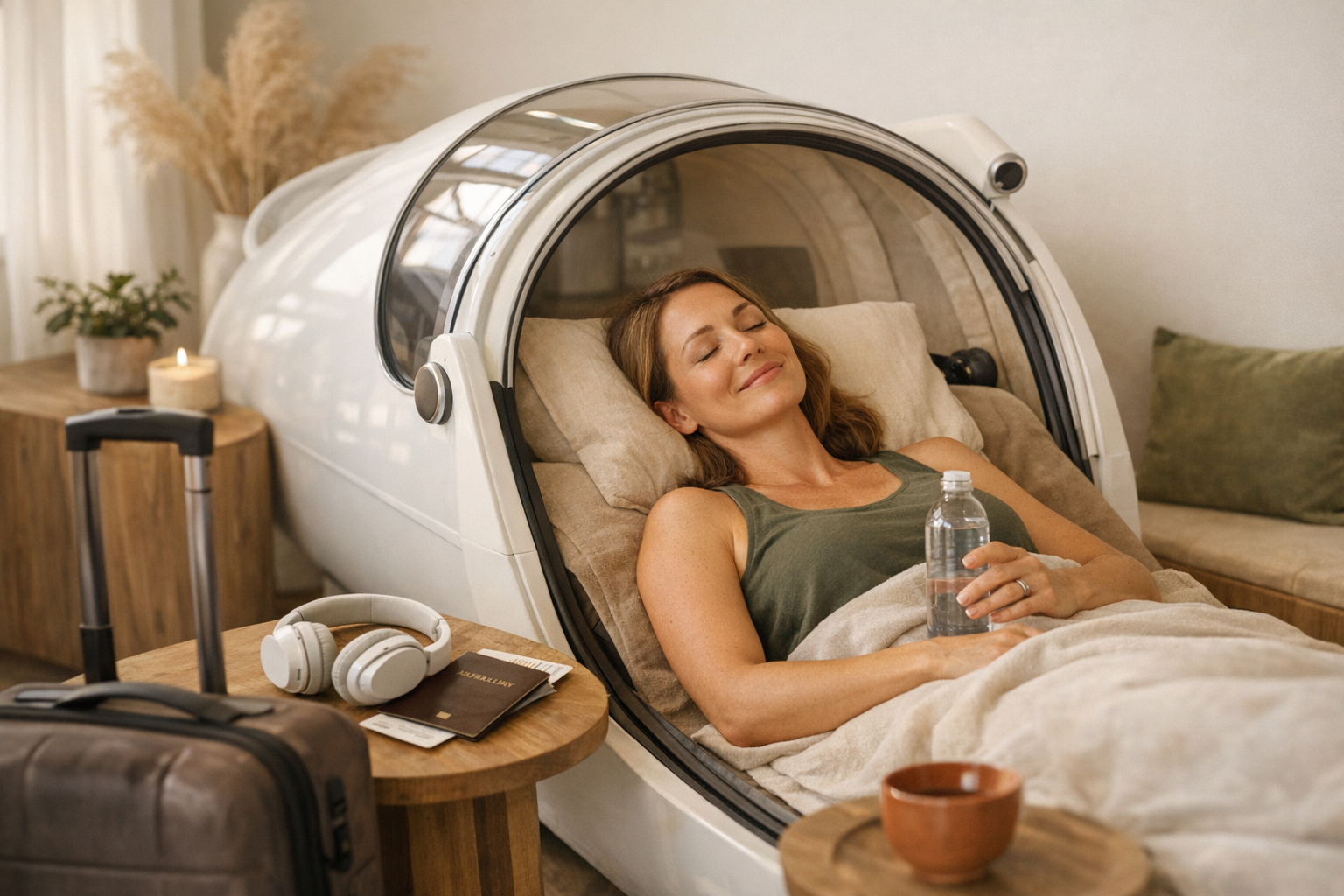
- You’ll sit or recline in a pressurised chamber.
- You may feel ear pressure changes (like take-off/landing). The team will guide you on equalising.
- You’ll breathe oxygen for the duration of the session.
- Many people read, listen to audio, or simply rest.
Afterwards:
- You may feel relaxed, clearer, or ready for an early night.
- Some people feel tired initially—often a sign they were running on stress and finally paused.
Safety, suitability, and sensible precautions
HBOT is generally well-tolerated when appropriately screened and supervised, but it is not for everyone.
You should discuss suitability if you have:
- Ear or sinus issues that make pressure equalisation difficult
- Certain lung conditions (e.g., history of pneumothorax)
- Uncontrolled seizures
- Significant claustrophobia
- Current respiratory infection or fever
Travel-specific note: If you suspect you’ve picked up an infection (fever, worsening cough, chest tightness, severe sinus pain), prioritise clinical assessment. Recovery tools are supportive, not a substitute for medical care.
A three-day “travel reset” schedule (copy/paste friendly)
Day 1 (arrival day)
- Morning/afternoon: hydrate + light walk
- Late afternoon: easy meal, keep caffeine early
- Evening: shower, screen dimming, early bedtime
- Optional: HBOT if you feel depleted and can equalise ears comfortably
Day 2
- Morning: outdoor light + 20–30 min walk
- Midday: protein-forward lunch + fruit/veg
- Afternoon: short nap if needed (max 30 min)
- Optional: HBOT session for recovery support
Day 3
- Morning: light cardio or strength technique session
- Midday: rehydrate + normal meal timing
- Evening: aim for consistent bedtime
- Optional: HBOT if you’re returning to high performance work or training
Common post-travel recovery mistakes (and what to do instead)
Mistake 1: Chasing sleep with alcohol
Better: Use light exposure, routine, and a cool dark room. If needed, choose calming habits: reading, breathwork, or a warm shower.
Mistake 2: Hammering caffeine to “power through”
Better: Keep caffeine to the morning only for the first two days. Pair it with water and breakfast.
Mistake 3: Doing an intense workout to “sweat it out”
Better: Start with movement, then build intensity after sleep stabilises.
Mistake 4: Ignoring ear/sinus symptoms
Better: Prioritise hydration, nasal saline, and gentle equalisation. If pain persists or you have hearing changes, seek assessment before any pressurised therapy.
How LIVBETTER approaches post-travel recovery
At LIVBETTER, we see post-travel recovery as a performance-health problem: your brain, sleep, hydration, mobility, and stress load all need a coordinated reset. HBOT can be a helpful option within that plan, particularly when you want a clinically grounded tool that doesn’t rely on stimulants.
If you’re considering HBOT after travel, we recommend:
- A quick suitability screen (especially for ear/sinus and lung history)
- A realistic session plan aligned with your schedule and symptoms
- Pairing sessions with foundational recovery habits (light, hydration, movement, nutrition, and sleep)
Final thoughts
Travel is often non-negotiable, but feeling awful afterwards doesn’t have to be. The fastest recoveries come from doing the basics extremely well—then adding targeted therapies when they make sense.
HBOT isn’t a magic wand, but for the right person at the right time, it may support energy, clarity, and recovery when your body is catching up from time zones, stress, and long periods of sitting. Start with the three-day reset, listen to your symptoms, and consider HBOT as a supportive tool in a bigger, sensible plan to help you feel like yourself again—wherever you’ve just been.
Next Steps
Want to learn more? Check out these articles:
HBOT for Soft Tissue Recovery: A Practical Guide (2026)
HBOT for Scar Recovery Support: Your Guide to Healing
HBOT for Sports Injury Recovery Guide [Step-by-Step Plan]
Check out our Therapies to see which options fit your goals.